By the numbers, Anthropic’s own workforce data is the clearest window yet into what AI actually does to the companies that build it.
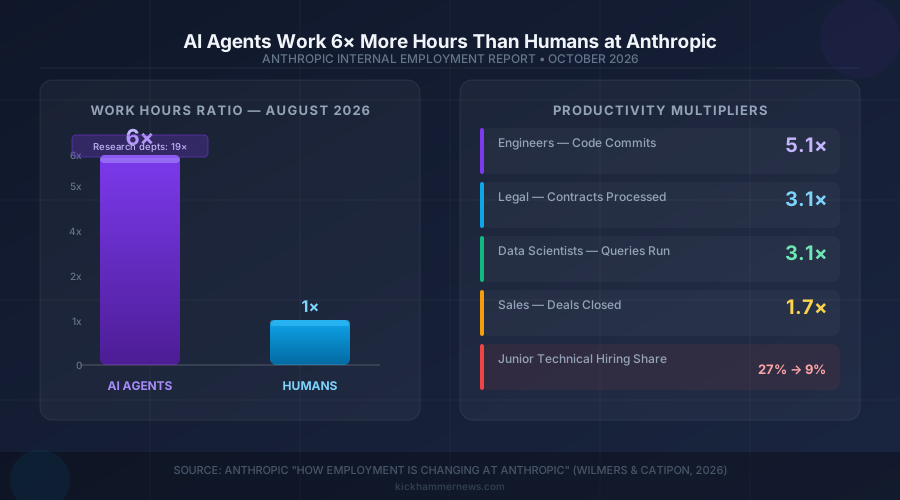
In March 2026, something unprecedented happened inside the walls of Anthropic’s San Francisco headquarters: the combined work hours logged by AI agents exceeded, for the first time, the work hours logged by human employees. Six months later, the ratio had widened to six-to-one. In research departments specifically, agents were outworking humans by nineteen to one.
These numbers come not from an AI booster’s projections, but from Anthropic’s own internal employment report, released this week. Titled “How Employment Is Changing at Anthropic,” the paper, co-authored by Nathan Wilmers and Regina Catipon, is the most granular look any major AI company has offered at how building and deploying AI is remaking the company that builds it.
The findings are striking, and in some cases alarming. They raise fundamental questions about the pipeline of talent that has historically fed the technology industry, and about what happens when even the companies creating AI stop hiring the entry-level workers who used to be the lifeblood of every software engineering team.
The Six-to-One Ratio — and What It Actually Means
Anthropic’s report distinguishes between two categories of AI work: autonomous agents running independently, and “interactive” Claude sessions where a human is present but letting the model do the heavy lifting. Combined, these agent work hours passed human hours in March. By August, for every hour a human employee worked, Claude and its agent derivatives were working six.
The caveat the authors are careful to note is that around 80 percent of interactive Claude session time is idle — the model waiting for the human to review output, redirect it, or give the next instruction. “Humans are bottlenecking the agents,” the report states, in a line that has circulated widely in AI circles since the paper dropped.
But even accounting for idle time, the sheer scale is breathtaking. Written standing instructions for agents — the prompts and system configurations employees use to define what an agent should do — grew from a few hundred to 8,500 over a single year. Agents now appear in nearly half of Anthropic’s active public Slack channels. The average non-technical employee’s agents, if you tried to read their output manually, would consume more than half a work week.
A Collapse in Junior Hiring
The most consequential number in the report may be this one: the share of junior hires among technical staff fell from 27 percent to 9 percent since early 2025.
This is not merely a hiring slowdown. It represents a fundamental restructuring of how technical teams grow. In the traditional technology company model, junior engineers arrive fresh from university, learn by doing relatively contained tasks, accumulate experience over several years, and eventually become senior engineers, tech leads, and managers. That pipeline has always served a dual purpose: companies get inexpensive labor for work that doesn’t require a decade of experience, and employees get the on-the-job training that turns computer science degrees into real engineering judgment.
At Anthropic, AI agents are now handling the work that junior engineers used to do — code reviews, bug hunting, initial implementations, and documentation. The report finds that open junior technical roles fell to just 6 percent of all technical openings, with a sharp cliff appearing in December 2025. By April 2026, a majority of Anthropic managers said they were hiring for different skills because of AI. About a third of machine learning managers and a fifth of software engineering managers said they were simply hiring less.
The productivity data explains why. Engineers at Anthropic are now making roughly five times as many code commits as they were six months ago. Among the 192 engineers who adopted coding agents compared with the 74 who did not, the difference in code output was dramatic. A study of sales representatives showed that after adopting agents, reps closed more deals — one account executive estimated that automation replaced about 20 percent of prior tasks while enabling 30 percent more customer conversations. The agents appear to be genuinely good at the work, and the code they produce is removed or reverted at the same rate as human-written code.
The result: you need fewer junior people when a senior engineer plus an agent can produce what used to require a team.
The Breadth Is Wider Than You’d Expect
A common assumption is that AI displacement will hit software engineers first and hardest. Anthropic’s data complicates that. The report documents productivity changes across nearly every function of the company:
Lawyers processed 3.1 times as many contracts. Accounts payable handled 1.4 times as many invoices. Sales closed 1.7 times as many deals. Recruiters made 1.4 times as many hires. Data scientists ran 3.1 times as many queries. None of these are software engineering roles, and all of them were transformed.
The engineer-to-product-manager ratio at Anthropic has reached roughly 17 to one. Manager commits — the code that managers personally write — have doubled, a sign that senior technical leaders are now expected to execute, not just direct.
And perhaps the most striking cultural data point: the share of work that is “meta-work” — building agent tools, writing agent instructions, monitoring pipelines, reviewing agent output — rose from 10 percent to 22 percent of all interactive sessions. Anthropic is becoming a company where a significant fraction of human labor is devoted to directing, reviewing, and improving the AI that does the rest of the work.
A Warning the Report Doesn’t Hide
The authors are careful not to oversell their own findings. They note that Anthropic is an unusual case: a software company in the business of AI, with disproportionately high AI tool adoption and a massive financial incentive to use its own products aggressively. The results, they acknowledge, may not transfer to a manufacturing company, a hospital, or a local government.
But they also do not hide the implications. The report explicitly warns that AI diffusion could risk worker displacement across the economy. Flatter, AI-native firms tend to employ fewer entry-level workers, and the downstream effects of that are not trivial.
The “tragedy of the cognitive commons” — a phrase the authors borrow from NATO researcher Nolan Lovett — describes what happens when every company stops hiring junior workers because AI handles what juniors used to do. In the short run, senior workers are more productive. In the longer run, there are no seniors to hire, because the pipeline that creates them has dried up. Lovett’s research suggests this effect would appear in the labor market somewhere between 2030 and 2045.
Anthropic employees themselves, when surveyed, expect AI to handle 75 percent of their work by 2030. For comparison, the median American worker estimates 28 percent.
What Comes Next
Anthropic says it has set up an “early warning system” for at-risk roles and prioritizes internal reallocation. An employee whose job is automated away is, where possible, moved to a new role rather than let go.
The report’s authors are frank that this is not enough. “Company actions alone won’t address the slowdown in junior hiring,” they write, calling for government policy on retraining and income support. Anthropic has previously suggested that programmers and call center workers might need to move into roles like electrician or nurse — jobs where physical presence still creates a moat that agents cannot cross.
What makes this data remarkable is not the absolute numbers but the source. This is not a think tank projecting the future; it is the company that built Claude documenting what Claude is doing to the company that built it. Anthropic grew revenue per employee to two to four times the levels Meta and Google had achieved at the same age.
The efficiency is real. The productivity is real. And the implications for everyone who was planning to start their career as a junior software engineer, data analyst, or legal researcher are just as real.
The agents clocked in at six-to-one. The humans are taking notice.


