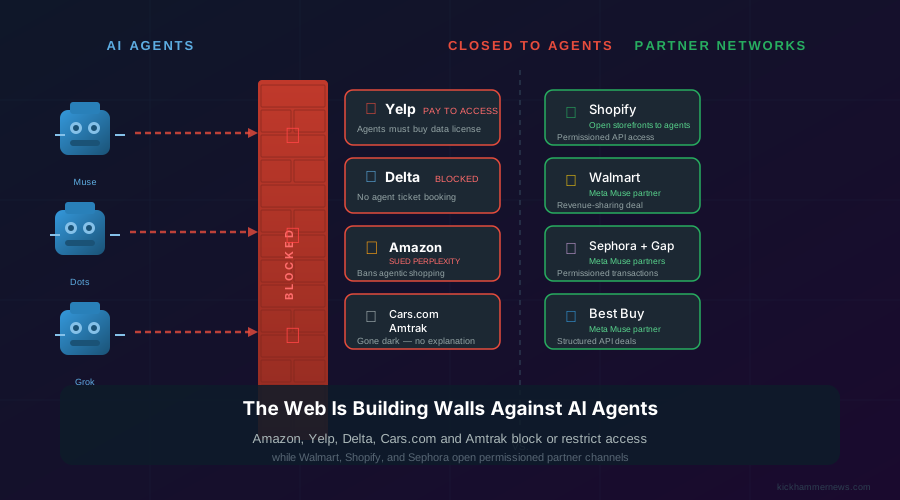
Not long ago, the pitch for AI agents was almost utopian. Your digital assistant would browse, book, buy, review, compare, and complete tasks across every corner of the internet — a tireless proxy that turned every website into a service it could use on your behalf. OpenAI’s Dots, Meta’s Muse, xAI’s Grok, and a dozen other AI agent products launched with exactly that premise: a universal digital employee that could do anything online.
The web, it turns out, has other ideas.
In October 2026, a sweeping and largely uncoordinated corporate reaction is taking shape. Amazon, Yelp, Delta Air Lines, JPMorgan Chase, Charles Schwab, Cars.com, and Amtrak have all confirmed or implemented restrictions that block, limit, or price out AI agents from their platforms. The pattern is consistent enough that observers are calling it the beginning of a “balkanized web” — where AI agents only work where they’ve been invited, paid for, and explicitly permitted to operate.
Yelp’s Price Tag: Pay to Play
Yelp’s position is perhaps the most openly transactional. The company confirmed to TechCrunch this week that it “only allows agents that pay for its data licensing program.” In other words, if an AI agent wants to help a user find a restaurant, read reviews, or check hours on Yelp, the company behind the agent first needs to cut a check.
The business logic is straightforward. Yelp built decades of user-generated reviews that it monetizes through advertising and premium business listings. When an AI agent scrapes or queries Yelp’s data and returns results directly to the user, Yelp sees no page view, runs no ad, and earns no revenue. The data it built gets consumed by someone else’s product. Licensing fees are how Yelp turns that transaction into something it can charge for.
The model isn’t unique to Yelp — it mirrors what news publishers have demanded from AI training data deals. But Yelp’s implementation is real-time and operational. It’s not a negotiation over historical datasets; it’s a gate on live API access. Agents that don’t pay are blocked.
Delta and the Airline Problem
Delta Air Lines has implemented a different kind of wall: a transactional one. The airline is preventing AI agents from booking tickets on behalf of users.
Delta’s concern is less about data and more about distribution control. The airline has spent years pushing travelers toward its own website and app, away from online travel agencies and comparison sites that dilute its relationship with customers. AI agents present a new version of the same threat: an intermediary layer that abstracts the brand relationship and may not comply with Delta’s policies on seat selection, change fees, upgrades, and loyalty program attribution.
Users of Meta’s Muse and OpenAI’s Dots have reported hitting blocks when attempting to book Delta flights through these agents. The result is that “book me a flight” — one of the most obvious use cases for a personal AI agent — doesn’t reliably work for one of the largest US airlines.
The Amazon-Perplexity Lawsuit: A Legal Precedent Forms
The most consequential conflict in this space may be playing out in court. Amazon sued AI startup Perplexity over its agentic shopping feature, which allowed users to browse Amazon listings, add items to carts, and complete purchases — all within Perplexity’s interface, without visiting Amazon’s website.
Amazon’s complaint alleges the feature violates its terms of service, allows Perplexity to benefit commercially from Amazon’s infrastructure and data without authorization, and deprives Amazon of ad revenue and the customer relationship it has built over three decades. A lower court initially issued a temporary restraining order blocking Perplexity’s shopping agents. An appeals court overturned it in August. Amazon has since filed an amended complaint, keeping the case alive.
The Amazon-Perplexity dispute is likely to set legal precedent. It is the first major lawsuit directly targeting the question of whether an AI agent has the right to transact on a third-party platform without that platform’s permission. Amazon’s position — that ad impressions and customer data are proprietary commercial assets, not public resources an agent can pass through — will be tested in court. If Amazon prevails, the legal template will be replicable by nearly every major e-commerce platform.
The Silent Blockade: Cars.com and Amtrak Go Dark
Not every restriction comes with a press release. Cars.com and Amtrak, both of which previously worked with AI agents, are reportedly no longer accessible to them. No statements have been issued, no policies publicly updated. The agents just stopped working.
This “quiet clampdown” may be the most revealing pattern. It suggests that blocking agents is becoming default behavior — a precautionary choice made by legal, product, or IT teams without public justification. The infrastructure to do it is widely available: Cloudflare’s one-click AI crawler blocking tools have made it straightforward for any site to shut out automated agents, even without specifically targeting them by name. A growing number of operators appear to be using these tools simply because they can, and because the uncertainty around agent liability makes inaction feel risky.
Chris Canal, CEO of EquiStamp, told The Verge this week that active agent blocks “limit the things agents can do” and warned that more sites may begin routing human users through harder “prove you’re not a robot” checks — an unintended side effect where legitimate users face friction because AI agents have made automated traffic indistinguishable from human browsing.
The Two-Track Web: Partners vs. Blockers
The picture is not entirely one of closed doors. Meta has built a parallel structure through commercial partnerships. Walmart, Gap, Sephora, and Best Buy have all signed deals to make their storefronts accessible to Meta’s Muse agent, with clear terms around data, transactions, and revenue sharing. Shopify is likewise opening its merchant ecosystem to agents through structured integrations.
Meta’s argument to holdouts is pointed: turning away a user’s personal AI agent means turning away the customer behind it. If Muse can’t book a Delta flight, the user might choose to book with United, which has a partnership in place.
Shopify’s approach is to treat agent access as a new storefront channel — the equivalent of a mobile app or a smart speaker integration. Merchants opt in, the data flows through permissioned APIs, and both sides agree on the terms.
The emerging bifurcation is stark. On one side: a permissioned, licensed, partner-based model where agents work smoothly in curated ecosystems. On the other: a web of sites that either actively block agents or are deteriorating into inaccessibility as anti-bot systems sweep up legitimate automated traffic in their filters.
Why This Matters More Than It Looks
The argument from the AI industry is that this is a transitional problem — that standards will emerge, legal frameworks will clarify, and the web will eventually reach accommodation with agents the way it eventually accommodated search engines and mobile apps. There’s historical precedent for that optimism.
But the analogy to search engines only goes so far. When Google indexed a website, the site still served its own pages, ran its own ads, and owned the customer relationship. An AI agent that completes a transaction for a user — booking the flight, buying the product, making the reservation — removes the website from the equation entirely. It’s less like a search engine and more like a travel agent that books Delta flights without Delta’s consent or compensation.
The revenue model threat is real and structural. If AI agents become the dominant interface for consumer transactions, every business that built its model around website visits, ad impressions, and direct customer relationships faces an existential question: do they join the permissioned ecosystem and share the economics with AI companies, or do they build walls and hope the agents route around them?
What’s becoming clear is that the answer right now is: both. The web is fragmenting into zones where agents work and zones where they don’t. And the “do anything online” promise that sold millions of users on the idea of an AI agent is running into a very old economic reality: on the internet, access to data and customers has always been something businesses charge for.
Whether AI companies, regulators, or the courts ultimately determine the rules of this new layer of the web, 2026 is the year the negotiation went from theoretical to operational — one blocked booking and one paid licensing deal at a time.


