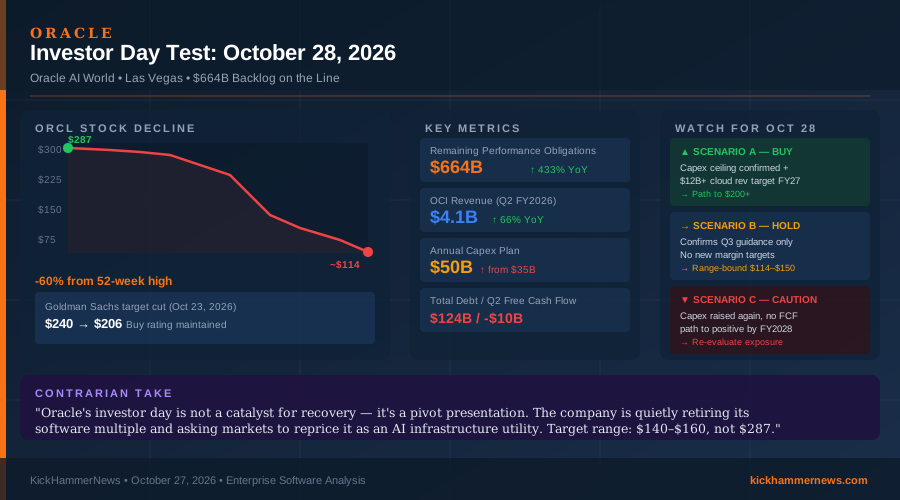
I’ve been watching enterprise software for a long time, and I can’t think of a more bizarre setup heading into a major tech company’s investor day than what Oracle is walking into tomorrow. Oracle stock sits roughly 60% below its 52-week high—trading near $114 USD after touching $287 earlier this year—while the company simultaneously holds what is arguably the most extraordinary demand backlog in enterprise technology history: $664 billion in remaining performance obligations, up 433% year-over-year.
Let that dissonance sink in. The company with the largest contracted future revenue pipeline in its history is trading at a steep discount to where it was a year ago. Something doesn’t add up—and tomorrow, at Oracle AI World in Las Vegas, Larry Ellison and Safra Catz will have a narrow window to make the math make sense.
Here’s what I think they need to prove, what the numbers actually say, and why the narrative most analysts are running with may be getting this exactly backwards.
The Numbers Behind the $664 Billion Story
Oracle’s Q2 FY2026 results were genuinely remarkable on the surface. OCI (Oracle Cloud Infrastructure) revenue hit $4.1 billion for the quarter—up 66% year-over-year. GPU-related revenue rose 177%. Total cloud revenue reached $8 billion, up 33%. Total company revenue was $16.1 billion, up 13%.
But here’s where I do the math that most coverage skips.
Backlog-to-revenue burn rate: Oracle’s $664 billion backlog would take approximately 10.3 years to work through at the current quarterly cloud revenue run rate of $8 billion. Even if Oracle accelerates to its Q3 guidance midpoint—cloud revenue growth of 39% in constant currency—that’s roughly $11 billion per quarter by FY2027 Q1. At that pace, the backlog burn still stretches beyond 2040.
This is not a criticism; it’s a context check. That $664 billion is mostly long-dated data center lease capacity committed for AI workloads from hyperscalers and enterprise customers. It is not billing-ready revenue sitting in a queue. The $248 billion in additional lease commitments Oracle disclosed in SEC filings—leases starting between Q3 FY2026 and FY2028, running 15 to 19 years—is Oracle’s obligation, not its customer’s payment.
Cost of capital on the capex bet: Oracle raised its annual capex plan to $50 billion (from $35 billion). Total debt now exceeds $124 billion, up from $89 billion a year ago. Q2 free cash flow was negative $10 billion on $12 billion of capex.
Here is what this means at real enterprise deployment scales:
| Oracle Cloud Commitment | Annual Cost (list rate, OCI compute) | 5-Year Total Cost |
|---|---|---|
| 100-seat Fusion ERP deployment | ~$480,000/yr | ~$2.4M |
| 500-seat Fusion ERP + OCI | ~$2.1M/yr | ~$10.5M |
| 1,000-seat enterprise (ERP + SCM + HCM) | ~$4.2M/yr | ~$21M |
At these scales, a 1,000-seat Oracle Fusion customer locked into a 5-year contract is writing roughly $21 million in checks over five years—and Oracle is building out the infrastructure to service them with a debt-financed capex machine running at $50 billion annually. The bet works if AI demand materializes at the scale Oracle has contracted for. If it doesn’t, the debt load becomes a serious structural problem.
What Oracle Needs to Say Tomorrow
Based on Goldman Sachs’ target cut (from $240 to $206, announced October 23), the primary concern is execution, not demand. Goldman kept its Buy rating, which tells you the analyst community still believes the cloud growth story—but has lost confidence in Oracle’s ability to build fast enough and convert backlog to revenue before the debt burden pressures margins.
Here is the decision framework for any enterprise IT leader or investor watching tomorrow’s event:
Scenario A — Buy signal (stock and platform): Oracle announces a specific quarterly revenue inflection point—say, $12B+ in cloud revenue by FY2027 Q2—and provides concrete data center delivery milestones with dates. If Ellison commits to a capex ceiling (not a floor), that signals discipline. This would be a credible path back toward $200+.
Scenario B — Hold: Oracle confirms existing guidance (Q3 cloud growth of 37–41%), talks about the backlog, reiterates AI World announcements. No surprises, no new margins guidance. In this case, nothing has changed—the stock stays range-bound between $114 and $150 through year-end.
Scenario C — Caution signal: Oracle raises capex again without a corresponding raise in near-term revenue guidance. If the capex-to-revenue gap widens, free cash flow stays negative through FY2027, and the debt load hits $150 billion, the interest payments alone begin to meaningfully impact earnings per share. At $124B debt and a weighted average interest rate of ~4.5%, Oracle is paying approximately $5.6 billion annually in interest expense—roughly 8.7% of total annual revenue. That’s not fatal, but it’s a headwind that compounds.
Threshold to watch: If Oracle does not show a clear path to positive free cash flow by FY2028, any stock recovery above $200 becomes speculative, not fundamental.
The Contrarian View Nobody Is Running
Most coverage frames this as: “Oracle has lost 60% from its high—it’s oversold, the backlog is proof of demand, buy before the investor day catalyst.”
I think that framing misses the actual risk. The 60% decline is not primarily a valuation correction from overexuberance—it’s the market repricing what it means when a software company transforms into a capital-intensive infrastructure utility.
Oracle’s FY2023 investor day sold a story of software-led margin expansion. Its FY2025 narrative shifted to cloud AI infrastructure as the growth vector. Now, with $248 billion in long-term lease obligations and $50 billion annual capex, Oracle is functionally operating like a hyperscaler—with hyperscaler capital costs—but is still being valued on an enterprise software P/E multiple.
The more likely outcome is not that Oracle rebounds sharply after investor day. It’s that investor day marks the moment the company formally reclassifies itself as an AI infrastructure play and asks the market to apply a utility multiple to its base business and an infrastructure multiple to OCI. That repricing would push the stock toward the $140-160 range—not back toward $287. Analysts chasing the old multiple are chasing a story that Oracle itself is quietly retiring.
If I’m right about this, the investor day is not a catalyst for a V-shaped recovery. It’s a pivot presentation. Enterprise IT teams evaluating Oracle contracts should watch tomorrow’s event with that lens: is Oracle selling you software, or is it selling you a data center with software on top?
Dated Action Checklist for Enterprise IT and Investors
Tuesday, October 28, 2026 (Investor Day)
- 10:55 a.m. CT: Watch the live webcast at oracle.com/investor
- Pull your Oracle contract renewal schedule from your Oracle Support portal — any deals up for renewal in Q1–Q2 FY2027 are negotiation leverage right now while Oracle needs to convert backlog
- Note whether Ellison specifies a capex ceiling or raises it again — this is the single most actionable signal
By November 7, 2026 (Oracle AI World wrap-up)
- Review any new OCI pricing or AI agent licensing announcements from the conference
- If you’re on Oracle Fusion ERP, check the Oracle Cloud quarterly update calendar for 26D (December) — new agentic features are expected in supply chain and customer experience modules
- Run the 5-year TCO calculation for your current contract tier using the numbers in this article
By November 30, 2026
- If Oracle announces capex increase without revenue guidance raise, initiate a multi-vendor RFP process for any cloud workloads currently in Oracle-only deployments — AWS, Azure, and Google all have Oracle database services now, and the switching cost window is narrowing as Oracle lock-in deepens
- Review your enterprise license agreement (ELA) for audit rights clauses — Oracle has historically increased compliance audits during financial pressure periods
By December 31, 2026
- Assess Q3 FY2027 Oracle earnings date (expected late December 2026 or January 2027) for first evidence of whether the $4B incremental FY2027 revenue from new backlog is materializing on schedule
My Bottom Line
Oracle is at an inflection point that is more consequential than most of its investor days. The $664 billion backlog is real. The AI infrastructure demand driving it is real. But the company has made a financing bet—$50 billion in annual capex funded by debt while free cash flow is negative—that requires execution at a pace and scale it has never demonstrated before.
Tomorrow’s investor day will tell us whether Oracle has a plan or a story. The distinction matters enormously for enterprise IT leaders signing multi-year contracts and for investors deciding whether to hold through what may be a multi-year margin rebuild.
I’ll be watching whether Ellison gives us numbers or narratives. The market has already priced in the narrative discount. Numbers are what Oracle needs now.