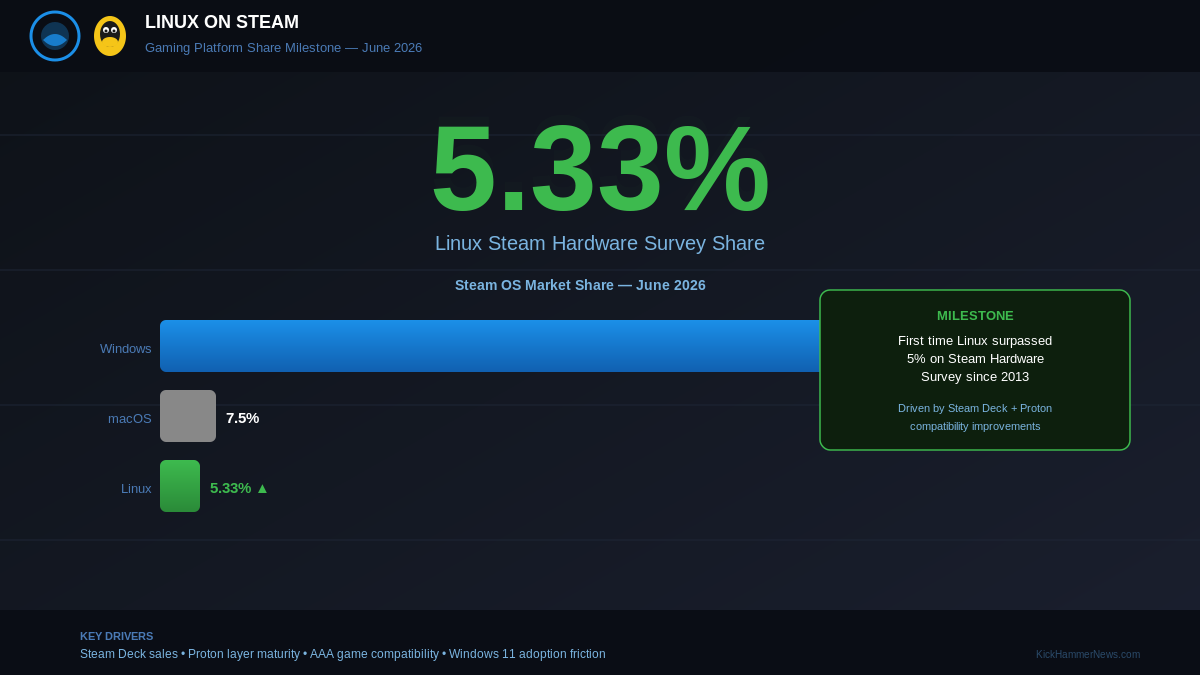
For years, Linux advocates predicted that one day, the platform would break through on gaming. That day has arrived — quietly, steadily, and with more structural momentum behind it than any previous surge. The Steam Hardware Survey for March 2026 confirmed that Linux now accounts for 5.33 percent of the Steam user base, the highest figure in the platform’s history. More than double the share recorded just six months prior, it is a milestone that tells a more complicated and more interesting story than the headline number alone suggests.
A Number Built on Three Pillars
The 5.33 percent figure did not emerge from a single product launch or a viral campaign to switch operating systems. It is the product of three converging forces that have been building separately for years and are now compounding each other in ways that were not predictable even two years ago.
The first is the Steam Deck. Valve’s handheld gaming PC, which runs SteamOS — a Linux-based operating system — has been registering its users as Linux participants in the Steam Hardware Survey since the device launched. By mid-2025, an estimated 5.6 million Steam Deck units had shipped, representing roughly 48 percent of the tracked handheld gaming PC market. Every one of those users counts in the Linux column whether they are aware of it or not. The Steam Deck normalized Linux as a gaming platform not by converting desktop users but by delivering a product that ran Linux invisibly and delivered a polished, consumer-grade experience.
The second is Proton. Valve’s compatibility layer, built on Wine and a growing suite of its own enhancements, has transformed the practical calculus of gaming on Linux in ways that were hard to imagine even five years ago. As of late 2025, Proton makes approximately 106,000 of Steam’s 117,881 games playable on Linux — up from roughly 9,000 titles with native builds alone. That figure translates to approximately 90 percent of the Steam catalog, a coverage rate that removes the single most-cited objection to Linux gaming: that your library simply won’t work. The technical gap that once made Linux a second-class gaming citizen has closed to the point where casual users frequently cannot tell the difference.
The third pillar is Windows 10’s end of life. Microsoft ended mainstream support for Windows 10 on October 14, 2025, triggering a decision cascade for hundreds of millions of PC users worldwide. The options were stark: pay for Extended Security Updates (which run through October 2026), upgrade to Windows 11 on hardware that meets the platform’s stricter TPM 2.0 and Secure Boot requirements, or look elsewhere. For a meaningful portion of users — particularly those running capable older hardware that fails Windows 11’s arbitrary compatibility checks — “looking elsewhere” included Linux for the first time.
What the Data Actually Tells Us
Context matters here. Linux at 5.33 percent means Windows still commands roughly 89.4 percent of the Steam user base. This is not a revolution in desktop operating systems, and it should not be described as one. But the trajectory matters more than the absolute figure. Linux share on Steam has grown dramatically in a short period, and the dynamics driving it are not going away.
The Steam Deck’s installed base continues to grow. Valve has made clear that handheld gaming is a long-term strategic commitment, and its hardware has spawned an entire ecosystem of competing devices — the ROG Ally, the Legion Go, and others — many of which also run Linux-based SteamOS or Proton-compatible environments. The Steam Deck effect on the survey is not a one-time bump; it is a baseline shift.
Proton’s development cadence remains aggressive. Each major release improves compatibility, reduces performance overhead, and adds support for newer anti-cheat systems and DRM schemes that have historically blocked Linux players from multiplayer titles. The remaining 10 percent of the Steam catalog that does not run cleanly on Proton is increasingly concentrated in a narrow band of games with aggressive kernel-level anti-cheat — a class of software that remains technically and legally complex to handle — rather than representing a broad compatibility gap.
And Windows 10’s consumer Extended Security Update deadline looms at October 2026. As that date approaches and the cost-free upgrade window to Windows 11 narrows for ineligible hardware, the pressure on older-PC users will intensify. Linux distributions have anticipated this moment and have made significant investments in user experience, hardware compatibility, and out-of-the-box gaming readiness.
The Enterprise and Developer Echo Chamber
There is a second, less visible trend reinforcing the consumer gaming story: developer adoption. Microsoft’s own announcements at Build 2026 in June illustrated the degree to which Linux has become a native part of the Windows developer experience. The introduction of Coreutils for Windows, built-in WSL containers, and three dedicated Linux products at a single developer conference signals that Microsoft has quietly accepted what the market long ago decided — that developers increasingly want Linux tooling regardless of which operating system they are running on.
That developer-side comfort with Linux reduces the friction of the consumer migration. A user who works with WSL daily is not intimidated by a Linux gaming environment the way a user with zero terminal experience might be. The boundaries between operating systems are blurring from both directions: Linux is getting more Windows-compatible apps via Wine and Proton, and Windows is absorbing Linux tools natively into its own shell. For users caught in the middle, the jump to a Linux gaming desktop feels progressively less like a leap into the unknown.
The Limits of the Milestone
None of this means that Linux is about to become the dominant desktop gaming platform. The 5.33 percent figure is significant precisely because Linux has historically struggled to break even 2 percent in gaming surveys. But it still reflects a niche, and the forces required to push it materially beyond 10 percent would need to include broader anti-cheat support, wider AAA day-one Linux releases, and a more dramatic collapse in Windows hardware compatibility — none of which are inevitable.
What the milestone does mean is that Linux has crossed a threshold of practical viability. The platform now has enough users that game developers take it more seriously, Valve has further incentive to invest in compatibility, and hardware vendors are more likely to ensure their peripherals and components have Linux driver support. The network effects that come from crossing a perceived critical mass are real, even if the base remains modest.
The Long View
Steam’s hardware survey is an imperfect instrument — it counts device sessions, not unique users, and Valve has acknowledged that survey participation is opt-in, which can skew results. But directionally, it remains the most consistent long-running data set available on gaming platform distribution, and the trend it is showing for Linux is unambiguous.
The 5 percent barrier on Steam has been discussed, predicted, and missed for more than a decade. March 2026 was when it finally fell, and it fell for reasons that are durable: a popular Linux handheld, a compatibility layer that genuinely works, and a Windows transition cycle that has nudged millions of users to reconsider what they need from a gaming PC. That combination, more than any single product or campaign, is what a genuine platform shift looks like in its early stages.
Whether it continues will depend on Valve, on Microsoft, on anti-cheat developers, and on whether a sustained wave of Windows 10 holdouts ultimately decides that Linux is good enough. The evidence from March 2026 suggests that for a growing number of players, the answer is yes.