October 12, 2026 — Something notable happened today. Meta, the company that spent three years insisting that open-weight models were the future of AI, quietly released two closed-weight frontier models under its Superintelligence Labs banner. The stronger one is locked behind a subscription paywall. The weaker one matches a 2025-era competitor benchmark. Both are genuinely impressive. And neither has a research paper.
Welcome to the new Meta AI — where Llama is a legacy product, Alexandr Wang is the boss, and the frontier is finally within reach, even if you have to pay $200 a month to touch the top of it.
Fourteen Months, One Launch
When Meta announced it had hired Alexandr Wang — the 28-year-old Scale AI founder who negotiated a $14.3 billion deal for a 49% company stake rather than take a $5 billion acquisition offer from Zuckerberg — the question was simple: what would he actually build?
The answer arrived this morning: Muse Wonder and Muse Wonder Full. These are the first frontier-class models from Meta Superintelligence Labs. The team has been at it since August 2025 when the lab was restructured into four groups, with Wang leading TBD Lab, the unit responsible for Meta’s next-generation models. Today marks fourteen months of work condensed into a Monday morning Threads post from Zuckerberg.
The internal codename was Watermelon. The models were trained at Meta’s Prometheus data center in central Ohio, which came online earlier this year. The training stack included large-scale initial training followed by reinforcement learning. Beyond that, Meta hasn’t said much. There’s no research paper. There’s no entry on Meta’s research blog — the latest post there is from Muse Spark 1.1 in July, even though Meta announced every previous Muse model there.
That gap is either a deliberate choice about where Meta thinks the burden of proof should sit — or a sign that it didn’t want independent scrutiny of its methodology. For enterprise buyers, every performance claim currently traces back to Meta’s internal testing.
What the Models Actually Do
Both Wonder and Wonder Full are multimodal: they accept text, images, audio, video, and PDFs as input. They output text. Their context window is one million tokens — roughly eight hundred pages of dense text. They can call tools, browse the web, and operate desktop computers.
Meta highlights two architectural features as differentiators. The first is Active Memory: the model retains and synthesizes information across conversations spanning days to months. Research scientist Kavya Kopparapu said the team “put a tremendous amount of effort into making sure your model can remember what’s important to you.” This is tested on Meta’s internal MemoryBench — a benchmark the company designed, runs, and controls.
The second is Active Focus: a mechanism that keeps the model pursuing a goal when it encounters obstacles, trying alternative approaches and recovering from errors rather than giving up. This is tested on both Meta’s internal FocusBench and SWE-Marathon, a third-party benchmark for long autonomous coding tasks.
These are exactly the capabilities enterprises want from AI agents — persistence and memory across the kind of multi-day workflows that break stateless models. The question is whether the benchmarks hold up outside Meta’s own test environment.
Where They Actually Rank
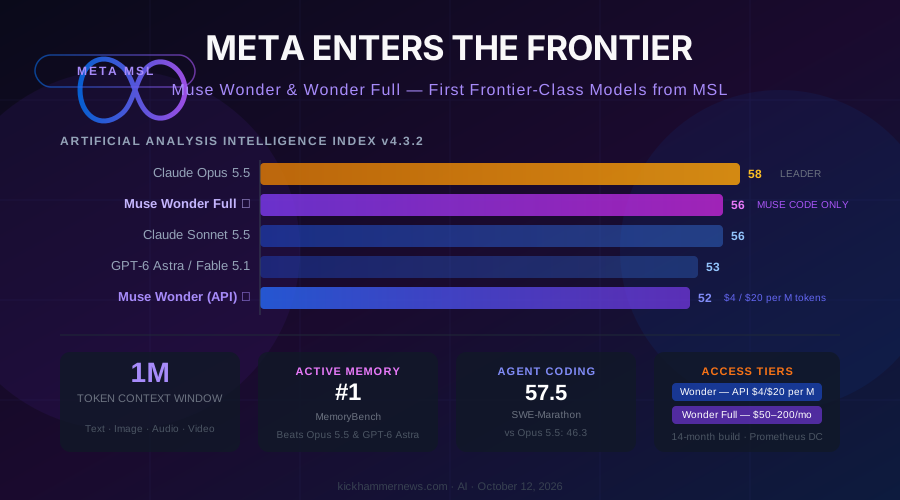
The independent scoreboard is clearer than Meta’s own chart. The Artificial Analysis Intelligence Index v4.3.2 puts the models here:
- Claude Opus 5.5: 58 — the current top
- Claude Sonnet 5.5: 56 — tied with Wonder Full
- Muse Wonder Full: 56 (55.8 unrounded) — third place overall
- Claude Fable 5.1, GPT-6 Astra, Gemini 4 Argon: 53 each
- Muse Wonder: 52
- Grok 4.6: 44
Wonder Full is in the conversation. Wonder, the model most developers can actually use through the API, is not quite at frontier pace — six aggregate points behind Opus 5.5, sitting alongside last year’s top-tier models.
Meta’s own benchmark table is more aggressive. Wonder Full wins 7 of 14 rows against Claude Fable 5.1, GPT-6 Astra, and Opus 5.5. Its biggest advantages are in the areas where it was built to shine. On SWE-Marathon — a test for long autonomous coding projects — Wonder Full scores 57.5 compared to Opus 5.5’s 46.3. On DeepSWE 1.1, another agentic coding benchmark, it reaches 79.0 against 74.2. On Harvey LAB-AA, a legal agent benchmark that few models have prioritized, it scores 13.1 — compared to GPT-6 Astra’s 8.6 and Opus 5.5’s 4.2.
The areas where it trails: Opus 5.5 wins on Terminal-Bench 4.0 (59.6 vs. 57.1), HealthBench Pro (65.6 vs. 62.3), and ProgramBench (70.5 vs. 59.0). And two of Wonder Full’s seven wins are on Meta’s own internal benchmarks, which independent labs cannot reproduce.
The Catch: The Good Model Isn’t on the API
Here is the tension at the center of this launch. Meta has released two models and made one of them unavailable to most developers.
Muse Wonder is live on the Meta Model API and on OpenRouter. The model ID is muse-wonder-1.0. Pricing: $4.00 per million input tokens, $0.20 per million cached, $20.00 per million output. Alexandr Wang promised this would be “meaningfully below” OpenAI and Anthropic’s leading models. That claim holds against Claude Fable 5.1 at $10/$50 and GPT-6 Astra at $10/$50, but it does not hold against Claude Opus 5.5 — which is also $4/$20, the exact same price, and scores six aggregate points higher.
Muse Wonder Full is not on the API at any price. It is available only through Muse Code subscriptions: $50 per month for Power Usage (20 times the Everyday plan’s allowance) or $200 per month for Maximum Usage (80 times). There’s no pay-as-you-go option. No OpenRouter listing. Developers cannot run evals on it without a subscription commitment.
The result is a classic tiered product play: the headline benchmark scores come from a model most users cannot casually access, while the accessible model is competitive but not dominant. The parallel is to early GPT-4 releases where the Turbo variants were available but the full model required enterprise agreements.
From Llama to Watermelon: The Open-Source Reversal
The irony of this launch is impossible to overstate. Meta built its AI reputation on open-weight models. The Llama series — released starting in February 2023 — became the backbone of the open-source AI ecosystem. Zuckerberg posted a long essay in July 2024 arguing that open-source AI was safer, more secure, and better for the world than closed proprietary models. At the time, Meta had no plausible path to matching OpenAI or Anthropic on frontier performance, so open-weight was a differentiation strategy as much as a philosophy.
That argument has now been quietly retired. The Muse family is closed-weight. Neither Wonder nor Wonder Full can be downloaded, fine-tuned, or run locally. Meta still maintains its open-weight track — Muse Glimmer 30B was released August 9 under an MIT-style license — but the frontier model line is now proprietary.
There is one outstanding commitment that has not been honored: Meta promised to release the Muse Spark weights in September 2026. As of today’s launch, those weights have not appeared on Hugging Face. Meta’s Hugging Face page lists only Muse Glimmer 30B. The Spark weight release was the bridge between the old Llama ethos and the new MSL era. Its absence is conspicuous.
Data and Privacy: Read the Fine Print
One detail in today’s launch deserves more attention than it is getting. The Muse Code subscriptions that give access to Wonder Full default to Contributor mode — a setting in which Meta can use your prompts, your code, your uploaded files, and your model outputs to improve future models.
Users can opt out, but only for future submissions — nothing already submitted can be recalled. Meta’s terms explicitly prohibit submitting confidential or personal information while in Contributor mode. That language is there because Meta knows enterprise users will submit code, contracts, and internal documents to a coding-focused agent, and the company wants legal cover.
For API users, the default is Standard mode, where submitted content is not used for training. Zero-data-retention is available for qualified organizations, subject to approval, but it removes several features: server-side conversation state, background requests, file uploads, and built-in web search.
What Meta’s Own Safety Team Is Worried About
The model card for Muse Wonder Full includes a disclosure that would not appear in most product launch materials: Meta cannot rule out that Wonder Full, without safety mitigations, reaches its high-risk threshold for chemical and biological misuse. With mitigations applied, residual risk is rated “moderate or lower” across tracked domains. On ExploitGym, a cyber security evaluation, Wonder Full captured 92 flags — though only 21 used the intended vulnerability.
A full safety report is promised “soon.” For now, the model card is the only safety document available. Given that Meta simultaneously claims frontier-level capability and cannot yet publish a comprehensive safety report, enterprise buyers in regulated industries will need to conduct their own due diligence before deploying Wonder Full on sensitive workloads.
What This Means for the AI Race
Before today, the frontier AI scoreboard had four serious players in the top tier: Anthropic with Opus 5.5 at the top, followed by Gemini 4 Argon, GPT-6 Astra, and Fable 5.1 clustered together. Muse Wonder Full slots in at third place by independent measure — meaningfully ahead of the GPT-6 Astra cluster, meaningfully behind Opus 5.5, and essentially tied with Sonnet 5.5.
For the specific workloads where Wonder Full has demonstrated an advantage — long autonomous coding projects, legal document analysis, multi-step agent tasks requiring persistent memory — it is now a credible best-in-class option, or close to it. For general-purpose use cases, the picture is more complicated: you are paying Opus 5.5 prices for Opus 5.5-adjacent performance but locked out of self-hosting, fine-tuning, or the kind of independent evaluation that Llama once enabled.
The more interesting question is what comes next. Alexandr Wang’s team built this model in fourteen months while simultaneously launching Muse Spark, the Muse consumer app, and the Muse Glimmer open-weight series. The next increment is likely to be faster. The missing research blog is a tell — this team is on a product cadence now, not an academic one.
The frontier is no longer a two-or-three-player game. It’s just that Meta’s ticket in costs $200 a month.


