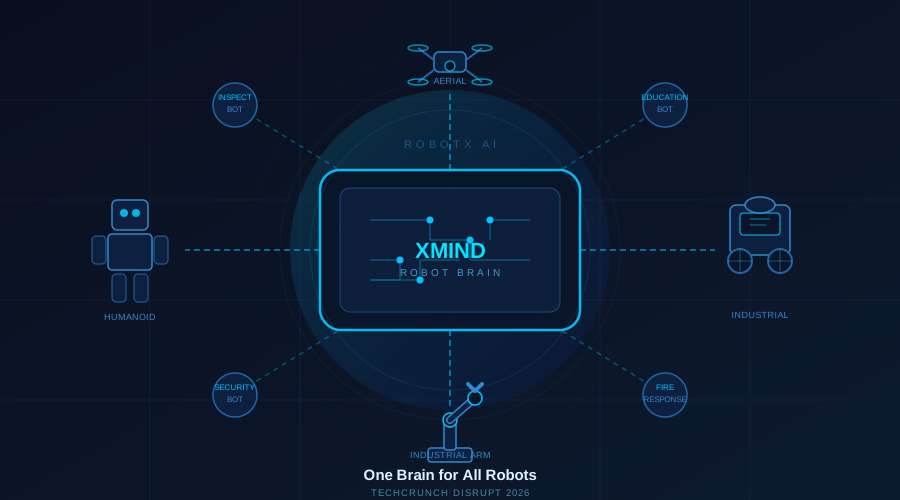
A California company just launched what it calls the first universal “robot brain” — and it’s debuting it today at TechCrunch Disrupt 2026, at exactly the moment the robotics industry is asking its hardest question.
For decades, building a useful robot meant building everything from scratch: the hardware, the sensors, the motion planning software, the perception stack, the task logic. Every arm, every wheeled platform, every humanoid was its own universe — siloed intelligence locked to a single chassis. The dream of a general-purpose robot mind, one that could be dropped into any machine and make it smarter, has remained stubbornly out of reach.
RobotX AI Inc. thinks it has found the first real answer. On October 8, the Irvine, California-based startup unveiled Xmind — a product it describes as the world’s first “robot brain” — and today the company is walking it onto the floor of TechCrunch Disrupt 2026 in San Francisco to show the world what that means in practice.
The vision the company has built around is as bold as it is simple: One Brain for All Robots.
What Xmind Actually Is
Xmind is not a robot. It’s not a humanoid platform or a new robotic arm. It is, in the company’s framing, an intelligent computing and control unit — a module that sits between a robot’s physical hardware and the AI models that tell it what to do.
Think of it as middleware for machines. Xmind connects a robot’s sensors, control systems, and AI models into a unified decision-making layer. The robot sees something through its camera. The perception module interprets what it sees. The task-planning layer decides what to do about it. The control system executes the action. In most robot deployments today, each of those steps is stitched together by custom code written for that specific machine. Xmind aims to be the universal layer that handles all of it, across different robot bodies and hardware configurations.
The core capabilities the company says Xmind brings to any robot are: visual perception and environmental understanding, voice interaction and instruction parsing, AI reasoning and task planning, robot control and system integration, multimodal information processing, and hardware adaptation for different platforms.
The applications the company is targeting span industrial inspection, firefighting, education, security, and data collection — sectors where robot deployments are growing rapidly but where the per-deployment engineering cost remains prohibitive for all but the largest organizations.
RobotX is also building out the commercial infrastructure around Xmind: a robotic application and solutions platform it calls RobotX, and a hardware marketplace called RobotXshop, where businesses can configure and procure robot-plus-brain deployments. The company says it has already received orders from businesses, government agencies, and academic and research institutions — including UCLA and Scale AI — and has a hardware partnership with Unitree, the Chinese robotics firm that has emerged as one of the dominant manufacturers of consumer and research-grade robot platforms.
The $3 Million Bet on a $66 Billion Problem
RobotX AI was founded by scientists from UC Irvine, UCLA, and Yale University, and has raised $3 million in seed funding. By the standards of the robotics funding landscape in 2026, that is a very small number.
To understand how small, consider what’s happening in the broader physical AI investment universe. Genesis AI, a vertically integrated humanoid startup, raised $105 million in seed funding alone. Mind Robotics, a Rivian spinout, pulled in $500 million for its industrial AI robot platform. Chinese robotics manufacturer Unitree went public at a $66 billion valuation — before losing nearly half its market cap in the weeks that followed, as investors confronted the gap between what today’s robots can do physically and what they’re actually intelligent enough to accomplish commercially.
That gap — the chasm between impressive hardware and genuinely useful machine intelligence — is the exact problem RobotX AI is trying to solve. And it’s the reason the company is at Disrupt today: to demonstrate Xmind integrated with physical robotic hardware to potential enterprise customers, developers, hardware manufacturers, and investors who might help it close that funding gap.
Robotics Is in Its GPT-2 Era — And Everyone Knows It
The timing of Xmind’s launch is not accidental. The entire robotics AI community is in the middle of a reckoning about what it will actually take to get machines to work reliably in the physical world.
At the Actuate conference — a gathering of developers building robot intelligence that has tripled in size since 2023, drawing 1,500 attendees this past year — the dominant theme was humility. Harry Mellsop of Antioch put a phrase to the collective mood that has stuck: physical AI is in its “GPT-2 era.” It has proven the concept. It hasn’t yet built the thing that changes the world. What it needs is more data, more compute, and better simulation tools to generate training environments that match the unpredictability of the physical world.
This is the core bottleneck that every company in the space has identified. Generalist robots — machines that can handle arbitrary tasks without specialized programming — remain far off. End-to-end learned behaviors for specific, constrained tasks are working in controlled environments but haven’t yet proven reliable enough for real-world commercial deployment at scale. The main reason is a lack of high-quality, diverse training data. Robots don’t have the equivalent of the internet — the massive corpus of human-generated text and images that made large language models possible. They have to generate their data by actually doing things in the world, which is slow and expensive.
“There will not be a ChatGPT moment for robotics,” Foxglove CEO Adrian Macneil told TechCrunch in August, pushing back against the AI industry’s habitual grand narrative framing. “Real-world distribution is much harder than software distribution.” His more measured hope: an “Apple II” or “IBM PC” moment — not a single breakthrough event, but the emergence of a platform that makes building for robots accessible enough that an ecosystem forms around it.
That is, perhaps not coincidentally, exactly what a universal robot brain would be.
The Competing Visions: Brain vs. Body
Not everyone in the industry thinks the “brain-first” approach is the right one.
Genesis AI, whose president and cofounder Théophile Gervet has become one of the more outspoken voices in the physical AI debate, argues that building a universal brain before co-designing it with the hardware is premature. “A narrow vertical built on a weaker model will lose to a competitor built on a stronger one,” Gervet has said — meaning that even specialized-use robots will eventually need frontier-grade intelligence to compete, so the question isn’t brain or body, it’s which vertical you start with and how quickly you can expand your intelligence capabilities.
The vertical-first camp has the commercial evidence on its side right now. Companies like Gritt, deploying robots in solar farms, Agility Robotics in industrial warehousing, and Bedrock in autonomous construction equipment have all demonstrated real-world revenue. These are machines doing narrow tasks reliably — and collecting real-world training data in the process. Bedrock CTO Kevin Peterson describes construction equipment as a “starting point for building an intelligence layer across all machines” — which sounds not entirely unlike RobotX AI’s own framing.
Alex Kendall, CEO of Wayve, takes the middle view. He says manipulation robotics — the ability for robots to handle physical objects reliably — is “like self-driving five years ago.” He argues the field still hasn’t committed to a shared data and simulation infrastructure because it’s too early to know which hardware platform will win. A universal brain that runs on today’s hardware may need to be rebuilt from scratch when better sensors and actuators emerge.
The AV industry, Kendall points out, was able to accelerate faster precisely because it could learn from data gathered by human-driven cars — a massive natural dataset. Robots don’t have an equivalent. They have to build theirs from the ground up.
What Xmind Has to Prove
For RobotX AI, TechCrunch Disrupt is the first major public test of whether the “one brain” concept can attract the enterprise customers and investors it needs to scale beyond its seed-stage position.
The company’s profile fits a recognizable archetype in platform technology: build the layer above the hardware, let hardware manufacturers compete on price and capability below you, and capture the value that comes from being the intelligence layer that unifies them all. In software, this is how operating systems work, how app stores work, how middleware layers from Salesforce to Twilio have generated enormous value. The question is whether robotics is far enough along — in hardware quality, in AI capability, in training data availability — to support a platform play at this stage.
The fact that Unitree is an early hardware partner is notable. Unitree’s Go2 and B2 platforms are some of the most widely deployed research and commercial robot platforms in the world. If Xmind can demonstrate reliable performance on Unitree hardware, it has an immediate path to tens of thousands of potential deployment units.
Sam Altman, whose track record of identifying which technology moments are about to arrive has been remarkably reliable, reportedly told investors earlier this year that a ChatGPT-equivalent moment for robotics is “a few years away.” If he’s right, the companies that have positioned their platforms by then — not just their products — will be the ones that capture the moment.
RobotX AI is small, early, and competing in a space where much larger and better-funded companies are also racing to solve the brain problem. But its timing is right, its framing is clear, and its debut at Disrupt is the kind of moment that — in the right circumstances — has launched platform companies before.
The robot brain race is on. Today, at a convention center in San Francisco, one small team from Irvine, California is making its move.
RobotX AI is demonstrating Xmind at TechCrunch Disrupt 2026, running October 13–15 in San Francisco. The company can be reached at info@usrobotx.com.


