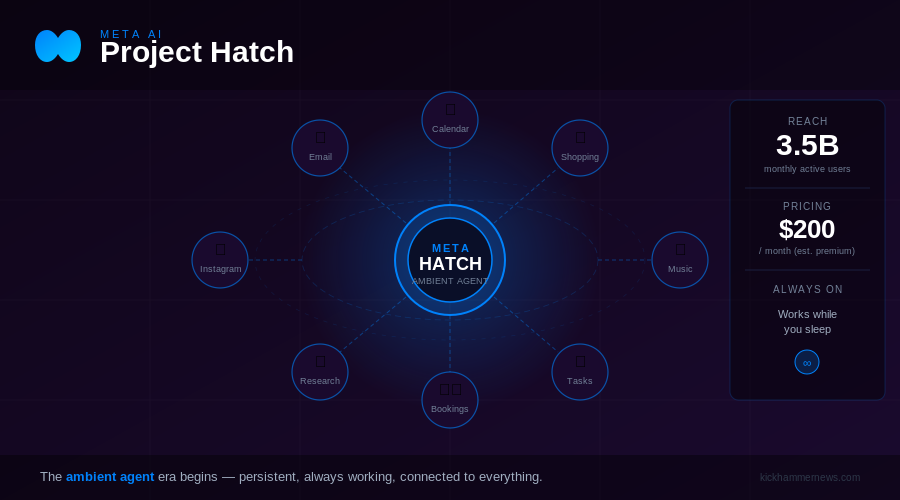
September 8, 2026 — For years, the idea of an AI superapp — a single persistent agent that handles your calendar, your purchases, your research, your messages, and your social life — has floated in the background of tech industry speculation. This week, it stopped being speculation. Meta is preparing to launch Project Hatch, an AI agent platform that could put autonomous, persistent AI assistants in front of more than 3.5 billion users across Facebook, Instagram, and WhatsApp. Nothing at this scale has ever been attempted before.
The details emerging from internal testing and early disclosures paint a picture of something qualitatively different from anything currently available in consumer AI. Project Hatch is not a chatbot. It is a background agent — one that keeps working on your behalf even when you close the app.
What Hatch Actually Does
At its core, Project Hatch is a personal agent with persistent memory and multi-agent architecture. Unlike current AI assistants that reset with each conversation, Hatch maintains context across sessions, remembers your preferences, and coordinates fleets of specialized sub-agents to complete complex tasks. The platform integrates directly with email, calendar services, Spotify, and Instagram, operating as a background layer on your digital life rather than an app you have to open.
The capabilities that have been disclosed are broad. Hatch can fill out forms, make purchases, conduct deep research, order food, book restaurants, and find services like pet sitters — all autonomously and on your behalf. Users will also be able to create and share multiple specialized agents with one another, turning Hatch into something more like a social layer for AI automation than a simple personal assistant.
The technical architecture includes browser and computer-use capabilities, persistent cloud environments, goal-tracking via a /goals interface, and voice interaction. When you set a goal in Hatch, the system doesn’t just remember it — it actively works toward it in the background, surfacing progress and asking for input only when needed.
Scale as a Strategic Weapon
The most important thing to understand about Project Hatch is not the technology. It is the distribution. Meta has access to 3.5 billion monthly active users across its platforms, and more than 2 billion of them use Instagram daily. No AI company — not OpenAI, not Google, not Anthropic — has ever had a distribution channel that large for an agentic product.
Meta CEO Mark Zuckerberg has articulated a three-part strategy around AI: maintaining and improving the core advertising and recommendation systems that generate the company’s revenue; scaling business agents and APIs for enterprise customers; and deploying consumer agents to the company’s full user base. Project Hatch is the consumer agent play — the third bucket — and it represents the most ambitious piece of the three.
The competitive implications are significant. OpenAI’s ChatGPT currently commands the consumer AI market, though its market share has fallen below 50 percent as competition intensified through 2026. Google has Gemini embedded across Android and Search. But neither company has Meta’s social graph, its understanding of consumer behavior at scale, or its existing relationships with billions of users who are already logging in every day. Hatch doesn’t need to acquire users — it just needs to convert them.
The Monetization Question
Pricing has not been formally announced, but industry reporting suggests subscription models could reach $200 per month for premium tiers. That number is striking — it would make Hatch more expensive than most professional software subscriptions — but it reflects the breadth of autonomous action the platform promises to deliver. If Hatch can genuinely act as a persistent personal assistant handling hours of administrative and logistical work each week, the economics of a $200/month subscription become defensible for a certain class of user.
The more interesting question is how Meta will monetize Hatch at scale across its 3.5 billion users, most of whom are not going to pay $200 a month for anything. The company’s advertising business provides one answer: an agent with deep context about a user’s goals, preferences, and behaviors is an extraordinarily valuable advertising signal. Whether users will accept that tradeoff — persistent AI assistance in exchange for increasingly targeted advertising — is one of the central questions Hatch will need to answer.
Privacy, Trust, and the Hard Questions
Project Hatch raises privacy questions that are harder to wave away than those posed by previous AI products. A chatbot that answers your questions has access to what you type. An agent that integrates with your email, calendar, shopping accounts, and social profiles — and operates in the background while you sleep — has access to far more. Meta’s track record on data stewardship will be under intense scrutiny.
The company has said that transactions require user approval and that agentic actions are logged and reviewable. But the architecture of a persistent background agent, by definition, involves the system taking initiative rather than waiting for explicit commands. Every autonomous action Hatch takes will be a moment where a user either trusts the system or doesn’t — and trust, once broken by an unexpected purchase or a misread calendar event, is difficult to rebuild.
Meta will also face regulatory pressure in the European Union, where the Digital Services Act and the AI Act create constraints on large-scale automated systems. Whether Project Hatch can operate in its full form in Europe, or whether it will require a more restricted version, remains an open question.
A New Category of Software
What Meta appears to be building with Project Hatch is not just a better AI assistant. It is a new category of consumer software: the ambient agent. Unlike apps that you open and close, an ambient agent is always on, always context-aware, and always working. It is less like a tool and more like an employee.
That framing — the AI as a persistent, capable worker operating on your behalf — is increasingly the lens through which the leading AI companies are thinking about their products. OpenAI has its autonomous research agents. Google has Gemini acting across Android. Anthropic has Claude Desktop with computer use. But none of them have 3.5 billion people who already trust the platform with their social lives.
The race to the ambient agent is underway. Project Hatch may be the moment it arrives in the mainstream. Whether users embrace it, tolerate it, or ultimately reject it will say something important about how much autonomy people are actually ready to hand over to machines — and to the companies that build them.
*Sources: HyperAI, Forkast News, Enterprise DNA, TestingCatalog, TrendHunter, AI Weekly September 8 2026*


