For years, enterprise software vendors have promised that switching CRM or ERP platforms is straightforward — and for years, IT teams have laughed bitterly at that promise. Migration projects that were supposed to take six months regularly stretched to two years. Data models that looked compatible on paper turned out to be labyrinthine in practice. And the customizations that made a legacy system actually work for a business? Those usually had to be rebuilt from scratch.
Microsoft is now betting it can change that calculus entirely with Dynamics 365 Activate, an AI-powered migration platform that entered public preview in September 2026. The tool is designed to dramatically reduce the friction — and the cost — of moving from entrenched CRM and ERP systems to Dynamics 365. Its first target, conspicuously, is Salesforce.
What Dynamics 365 Activate Actually Does
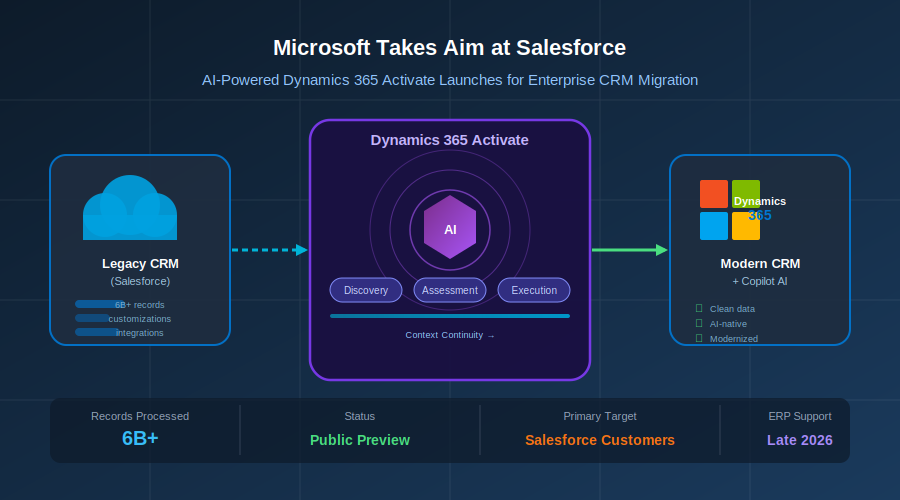
Activate isn’t a simple data-transfer wizard. Microsoft describes it as a full-lifecycle implementation platform, built around three phases: Discovery, Assessment, and Execution.
In the Discovery phase, the tool profiles the source environment. It reads data models, maps relationships between objects, catalogs integrations, and identifies years of accumulated customizations — the trigger workflows, the custom fields, the third-party connectors that are often undocumented. According to Microsoft, Activate has already processed more than six billion data records across early customer deployments, which has allowed it to build a knowledge base of common migration patterns and failure modes.
The Assessment phase is where the AI reasoning becomes most visible. Rather than simply flagging what exists, Activate generates recommendations about what should happen to each element of the legacy system. Some processes migrate intact. Others should be simplified. Some customizations that were workarounds for platform limitations in the old system can be eliminated entirely now that Dynamics 365 handles those use cases natively. And some legacy configurations, the tool warns, introduce security or performance risks that should be addressed during migration rather than carried forward.
Execution is where the migration actually happens — with automated data transfer, built-in validation at each stage, and what Microsoft calls “context continuity”: the insights gathered during discovery and assessment don’t disappear once configuration begins. They’re carried through testing and deployment, so teams aren’t re-explaining the same environment nuances at every project phase.
The Salesforce Targeting Is Not Subtle
Microsoft has been publicly eyeing Salesforce’s customer base for years, but Dynamics 365 has faced an uphill battle against a competitor with two decades of CRM market dominance and a deeply entrenched ecosystem. The biggest barrier hasn’t been feature parity — Dynamics 365 has closed most gaps — it’s been switching costs.
Enterprise organizations don’t just run Salesforce. They run their version of Salesforce: custom objects, bespoke workflows, integrations stitched together over years, and sales processes encoded in a platform that the entire revenue team knows by muscle memory. The cost and risk of migrating that institutional knowledge to a new platform has kept many organizations in place even when they’d prefer to move.
Activate is a direct attempt to lower that barrier. The public preview launched with Salesforce-to-Dynamics 365 migrations as the primary supported pathway. Microsoft has been explicit about the strategic intent: customer examples showcased at launch include Comcast, which praised how the tool “accelerated our migration assessment by providing greater visibility into our Salesforce landscape,” and Ziwi Pets, whose CEO noted it delivered “faster time-to-value and a solution that closely reflects our operational needs.”
Implementation partners are also being pulled into the strategy. congruentX, a Dynamics-focused consultancy, described combining “Microsoft’s AI migration tooling with cX IP and delivery accelerators to compress discovery and migration complexity” — suggesting Microsoft is deliberately designing Activate to amplify partner value rather than replace it.
ERP Migrations Are Next
The current public preview focuses on CRM migrations, but Microsoft has confirmed that ERP capabilities are coming later in 2026. This is where the competitive stakes get considerably higher.
ERP migrations — moving off SAP, Oracle, or older Microsoft platforms like Dynamics AX or NAV — are notoriously expensive, risky, and long. The market is littered with cautionary tales of ERP implementations that consumed hundreds of millions of dollars and still ended in litigation. If Activate can bring meaningful AI-assisted acceleration to ERP migration discovery and assessment, it would address one of the most chronic pain points in enterprise software.
Microsoft has also telegraphed additional capabilities on the roadmap: agentic mapping, natural-language guided configuration, and executive summary reporting — features that suggest Activate will increasingly blur the line between migration tooling and AI-assisted implementation consulting.
What the Dynamics Ecosystem Stands to Gain
The Microsoft partner community has watched Activate’s preview launch with considerable interest. Implementation projects are a major revenue stream for Dynamics partners, and there’s been some anxiety about whether AI tooling would compress billable hours. The early signals suggest Microsoft is positioning Activate as a complexity reducer rather than a headcount eliminator — the tool handles the tedious inventory and analysis work that currently consumes junior consultant hours, freeing senior architects to focus on design decisions and change management.
For enterprise buyers, the value proposition is clearer: faster migrations mean faster time-to-value on Dynamics 365 licenses, reduced project risk, and a lower chance of the kind of scope creep that turns a twelve-month implementation into a three-year ordeal.
Context: Microsoft’s Broader CRM and ERP Push
Activate lands in the context of an increasingly aggressive Microsoft push into CRM and ERP. The company has been tightening Dynamics 365’s integration with Copilot and Microsoft 365, making it easier for organizations already deep in the Microsoft ecosystem to extend into CRM and ERP without sourcing a separate platform. The September 2026 announcement of usage-based billing for Copilot Business also lowers the entry barrier for Dynamics-based AI features.
Meanwhile, Salesforce’s own AI initiatives — primarily its Agentforce platform, launched in 2024 — have met with mixed enterprise reviews, with some customers citing implementation complexity and unclear ROI on early deployments. That creates an opening Microsoft appears determined to exploit.
Whether Activate will meaningfully shift Salesforce’s enterprise retention rates remains to be seen. CRM migrations are emotional decisions as much as rational ones, and Salesforce’s network effects and AppExchange ecosystem remain formidable moats. But for the first time in years, Microsoft has something concrete to offer the skeptical Salesforce customer beyond a feature comparison sheet: an AI-powered path that might actually make the switch feel manageable.
The Dynamics 365 Activate public preview is available now. ERP migration capabilities are expected before the end of 2026.