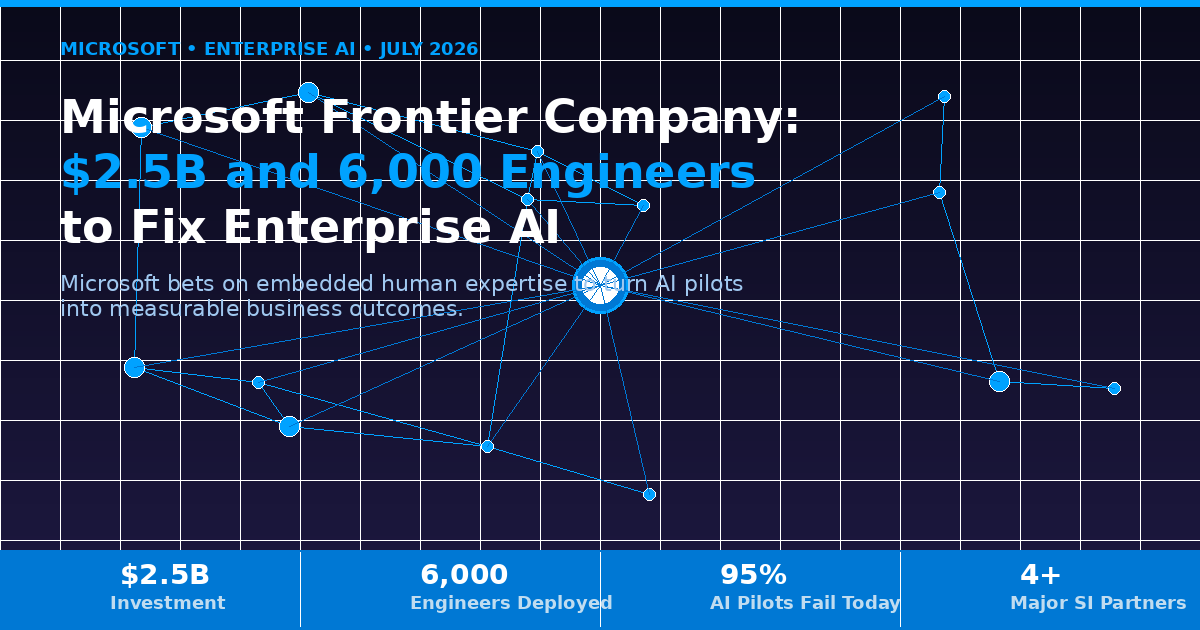
Microsoft has launched a bold new operating business — Microsoft Frontier Company — embedding 6,000 engineers directly inside enterprise customers with a $2.5 billion commitment to finally make AI work where it matters most: the balance sheet.
The announcement, made on July 2, 2026, signals a fundamental shift in how the world’s largest software company thinks about artificial intelligence. Selling AI tools is no longer enough. Now Microsoft wants to be inside your organization, running them.
The Problem Microsoft Is Trying to Solve
The launch of Microsoft Frontier Company isn’t a product announcement. It’s an admission — shared by virtually every major AI vendor — that enterprise AI is in crisis, at least when measured by real business outcomes.
Research from MIT’s Project NANDA found that 95% of enterprise generative AI pilots deliver zero measurable impact on profit and loss. Companies have spent billions licensing AI platforms, spinning up proof-of-concept chatbots, and running workshops. The results, in aggregate, have been underwhelming. Not because the technology is bad, but because deploying AI at enterprise scale is extraordinarily hard — it requires deep domain expertise, change management, systems integration, and relentless iteration.
Microsoft’s Commercial Business CEO, Judson Althoff, put it plainly in the company’s announcement: “Customers are in very different places right now, and trying to really figure out AI.” The solution, according to Althoff, isn’t better documentation or more training videos. It’s 6,000 industry and engineering experts working shoulder-to-shoulder with customers.
What Frontier Company Actually Does
Microsoft Frontier Company operates as a distinct business unit inside Microsoft, led by Rodrigo Kede Lima, who has spent six years leading enterprise transformation efforts across the Americas and Asia for Microsoft. The unit draws on engineers, industry specialists, and technical consultants who are embedded directly inside customer organizations — not just advising from afar, but co-designing, building, and continuously operating AI systems on-site.
Althoff rejected the “Forward-Deployed Engineering” label that has become shorthand for this model across the industry. “This goes beyond what has been labeled as Forward-Deployed Engineering,” he wrote, “and will be the largest, most capable, outcome-driven engineering organization in the industry.”
The emphasis on outcomes is deliberate. Frontier Company engagements are structured around measurable business results — revenue impact, cost reduction, efficiency gains — rather than the softer metrics (adoption rates, user satisfaction scores) that have allowed many enterprise AI programs to declare victory while delivering little.
Early Partners and What They’re Building
Microsoft has already been running early-stage Frontier Company deployments with several major enterprises. The London Stock Exchange Group (LSEG) is among the most prominent early partners, with Microsoft engineers embedded to build AI into LSEG Workspace — giving finance professionals the ability to query across both structured financial data and unstructured content such as analyst notes, filings, and news in natural language.
Other named early partners include Unilever, Land O’Lakes, and Novo Nordisk, spanning consumer goods, agriculture, and pharmaceuticals — industries where AI can have significant but highly specialized impact.
To scale globally, Frontier Company will work alongside a network of systems-integration partners including Accenture — with which Microsoft launched a dedicated forward-deployed practice earlier this year — as well as Capgemini, EY, KPMG, and PwC. Microsoft’s enormous existing Fortune 500 client base gives the effort a head start no pure-play AI company can easily replicate.
The Race to Own Enterprise AI Deployment
Microsoft is not alone in making this bet. The announcement arrived in the middle of what is rapidly becoming an industry-wide sprint to own the enterprise AI deployment market.
Just two days before Microsoft’s announcement, Amazon Web Services committed $1 billion to its own AI deployment venture, explicitly embracing the Forward-Deployed Engineering model. OpenAI and Anthropic had already launched similar joint ventures in May, though those efforts also involve outside capital from private equity firms. In each case, the logic is the same: the companies best positioned to capture long-term AI revenue are those that can demonstrate — with hard numbers — that AI actually works inside real organizations.
Microsoft’s scale advantage is hard to overstate. The company has existing relationships across virtually the entire Fortune 500 through its Microsoft 365, Azure, and Dynamics 365 businesses. Frontier Company can slot into existing customer relationships rather than winning new ones from scratch. The $2.5 billion commitment also dwarfs what any of the newer AI vendors can credibly offer in terms of engineering depth.
What This Means for the Enterprise Software Market
The emergence of embedded AI deployment units from the largest tech companies has significant implications for the traditional enterprise software consulting industry. Firms like Accenture, Deloitte, and IBM have historically captured the lion’s share of technology implementation spending. Microsoft’s decision to bring significant implementation capability in-house — while simultaneously partnering with those same firms through Frontier Company’s SI network — is a careful dance that signals ambition without (yet) full confrontation.
For CIOs and enterprise technology leaders, the Frontier Company model offers something the current market has largely failed to deliver: accountability. When Microsoft’s engineers are embedded in your organization and compensated based on measurable outcomes, the incentive structure changes fundamentally. The vendor and the customer are, at least in theory, aligned.
Whether that alignment holds in practice — across thousands of customers, with wildly different legacy systems, organizational cultures, and risk tolerances — is the real test ahead.
The Bigger Picture: AI Is Now a Services Business
Perhaps the most significant thing about Microsoft Frontier Company is what it reveals about the nature of the AI industry in 2026. Despite billions in infrastructure investment and remarkable advances in model capability, AI is increasingly revealing itself to be a services business at the enterprise level. The models matter. The infrastructure matters. But the thing that determines whether a company actually captures AI-driven value is human expertise applied with rigor and sustained commitment.
Microsoft’s willingness to put $2.5 billion and 6,000 people behind that thesis — rather than continuing to harvest software license revenue while customers struggle to deploy — is a meaningful bet. It’s also a hedge: if enterprise AI adoption accelerates through Frontier Company, Microsoft’s cloud, productivity, and AI platform businesses all benefit. If adoption stagnates without that support, the alternative is a generation of disillusioned enterprises that conclude the technology simply doesn’t work.
For Microsoft, and for the enterprise AI industry broadly, helping customers succeed is no longer just a nice-to-have. It’s the business.
Microsoft Frontier Company launched July 2, 2026. For more information, visit microsoft.com/frontier-company.