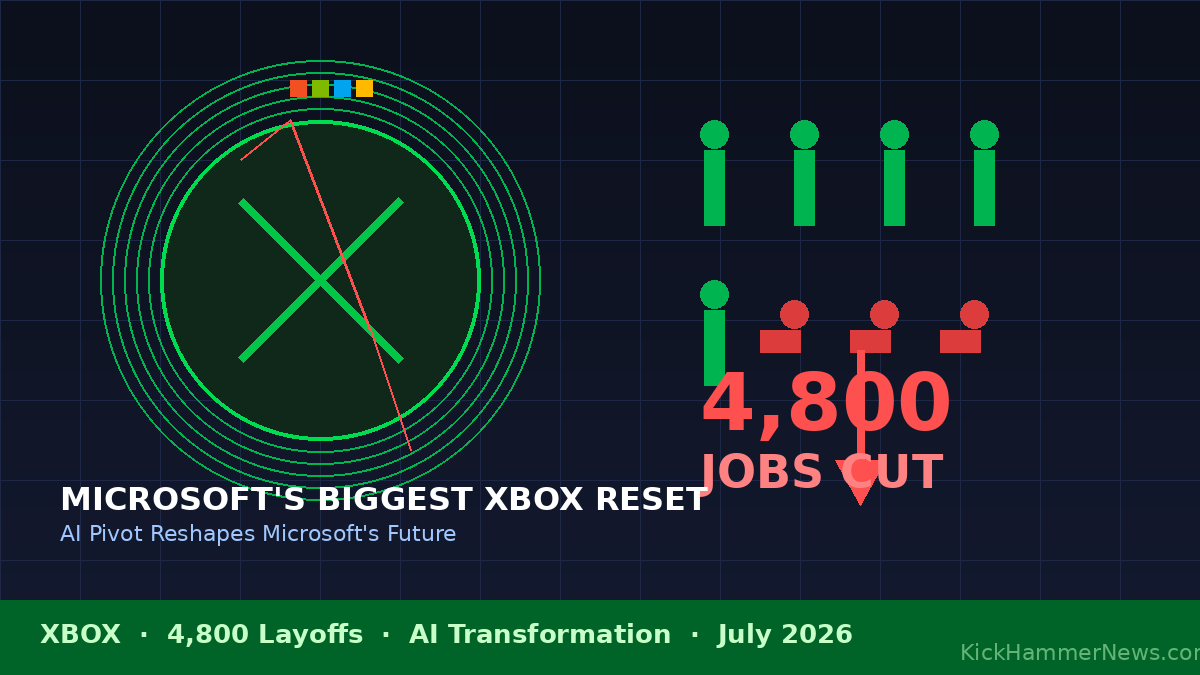
Microsoft has announced its largest single-day restructuring of 2026, cutting approximately 4,800 jobs — about 2.1% of its global workforce — with Xbox bearing the brunt in what Xbox CEO Asha Sharma called “the most significant restructure in Xbox history.” The move is the clearest signal yet that the Redmond tech giant is trading human headcount for artificial intelligence investment on a scale that is rewriting the rules of how big enterprise software companies operate.
The Numbers Behind the Cuts
Of the 4,800 roles eliminated Monday, 1,600 belong to Xbox. That’s just the opening round: Microsoft expects a further 1,600 Xbox cuts through the remainder of fiscal year 2027, bringing total gaming-division job reductions to roughly 3,200 — or about 20% of Xbox’s entire global workforce. The broader commercial sales and consulting divisions absorb the remaining cuts, reflecting a deliberate pivot away from traditional account management toward technical, AI-forward customer engagement.
In Washington state, home to Microsoft’s Redmond headquarters, about 600 jobs are being eliminated — a far smaller local impact than the 3,200 state cuts made during last year’s spring round. With ongoing hiring factored in, Microsoft says Washington-state headcount will remain roughly stable at around 52,000.
The announcements come on the heels of a voluntary retirement program that saw approximately 30% of the 8,750 eligible U.S. employees accept buyouts in recent weeks, effectively cushioning the size of Monday’s reduction in force. The company also says it has redeployed over 4,000 employees into new roles over the past year, with another 500 placed this month.
Xbox: A Business That “Is Not Healthy”
Sharma’s internal memo to Xbox employees was remarkably candid. “Our business today is not healthy,” she wrote. “We are operating at margins that are 3–10x lower than comparable platform and publishing businesses.” She disclosed that Xbox’s game studios have been losing 64 cents for every dollar invested — a rate of return that would be unsustainable at a fraction of the scale Microsoft operates at.
The gaming bets that were supposed to turn the tide — Game Pass’s all-you-can-play subscription model, massive first-party studio acquisitions, a multi-platform publishing strategy — failed to grow at the expected pace. At the same time, Xbox has added layers of management and investment, compounding structural inefficiencies rather than solving them.
Xbox’s restructuring plan is sweeping. Management is being flattened from 14 organizational layers to a maximum of five — ideally three — a move rarely attempted at a division of this size. Helen Chiang has been named Xbox’s new Chief Operating Officer, taking end-to-end profit and loss authority across content, hardware, platform, and services. Going forward, the gaming division will concentrate resources on its highest-scale pillars: Mojang (Minecraft) and King (Candy Crush), two franchises with proven platform-scale economics.
Game Studios Spun Off or Sold
Perhaps the most dramatic element of Monday’s announcement is what happens to four Xbox game studios. Compulsion Games and Double Fine Productions — home to cult favorites like Psychonauts — will be returned to independent status, with Microsoft retaining intellectual property ownership while the studios operate on their own. Ninja Theory (Hellblade) and Undead Labs (State of Decay) will transfer to new ownership, receiving dedicated funding to complete and expand existing projects.
These moves signal Microsoft’s acknowledgment that creative studio bets don’t automatically translate into platform-scale returns. For years, the company spent billions accumulating game studios under the theory that exclusive content would drive Game Pass subscriptions and hardware sales. That theory, at least for a significant portion of the portfolio, has not borne out in the financials.
AI as the Trade-Off
Microsoft’s chief people officer, Amy Coleman, was careful to frame Monday’s cuts in terms that don’t directly blame artificial intelligence. “The roles being eliminated today are not being replaced by AI,” she wrote in an all-employee memo. But she immediately followed that line with an acknowledgment that carries its own weight: “AI is changing how work gets done. Some of the tasks we do every day can now be automated, and that means we all need to keep learning, keep building new skills, and keep adapting as the work evolves.”
The timing is not coincidental. Just last week, Microsoft launched Microsoft Frontier Company — a new $2.5 billion business unit staffed by 6,000 forward-deployed engineers embedded directly inside enterprise customer environments to drive AI adoption. The unit explicitly replaces some traditional sales and consulting roles with technical headcount that sits closer to the customer workflow.
Brad Smith, Microsoft’s president and vice chair, put the broader thesis plainly: “Some things like coding require less time of software developers. At the same time, there’s new parts that are growing, whether it’s product management or software design, or perhaps most importantly, working directly with customers.” The message is a pivot from generalist services to high-value, AI-proximate human labor — with everything in between increasingly automated away.
The Market Context: A $1.2 Trillion Slide
None of this is happening in a vacuum. Microsoft’s stock has dropped roughly 30% over the past nine months, erasing approximately $1.2 trillion in market capitalization. Wall Street’s concern is a familiar one for any company betting heavily on AI infrastructure: capital expenditures are soaring while near-term AI revenue remains harder to quantify than the balance sheet would like. The pressure to demonstrate fiscal discipline while simultaneously justifying unprecedented AI spending has created the conditions for exactly this kind of restructuring.
Across the broader tech industry, the first half of 2026 has seen approximately 154,000 job cuts, with Microsoft’s latest round joining eliminations at Meta, Oracle, Amazon, and Cognizant. The pattern is consistent: AI investment goes up, human headcount in traditional roles comes down.
What Comes Next
Coleman’s memo contained one line that is likely to generate the most internal anxiety going forward: “We are still early on this journey, and there will be more changes ahead; other parts of our business will need to make similar changes.” In her subsequent interview, she declined to signal further layoffs specifically, but described a structural shift toward making voluntary exit programs a regular, ongoing option rather than a one-off event.
That framing suggests Microsoft views its workforce transformation not as a discrete event but as a continuous process — one that mirrors the rolling nature of AI development itself. The company that built its dominance on software licenses and cloud subscriptions is now betting that its next act is built on AI-deployed engineers and automated workflows, with a leaner, more technically focused human layer orchestrating it all.
For the thousands of employees receiving notices this week — at Xbox, in sales, across consulting — the transformation is immediate and personal. For the rest of the tech industry, Microsoft’s moves continue to function as a leading indicator. What happens at Redmond in July tends to echo across Silicon Valley by autumn.
*Sources: TechCrunch, GeekWire, Fox Business, Windows Central*