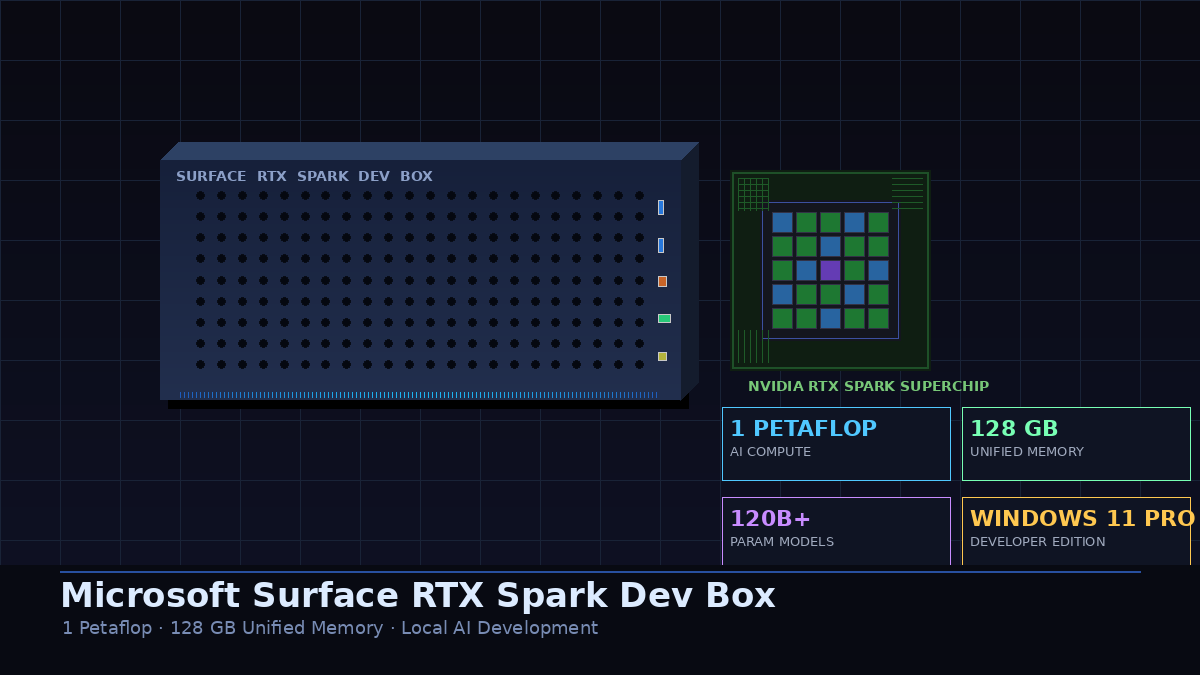
Microsoft has unveiled the Surface RTX Spark Dev Box, a compact developer workstation powered by NVIDIA’s new RTX Spark superchip that delivers up to 1 petaflop of AI compute right on the desktop. Announced at Microsoft Build 2026, the machine represents Microsoft’s most ambitious hardware push into local AI development yet — and a direct challenge to Apple’s Mac Studio in the high-performance developer workstation segment.
A Machine Built for the AI Development Era
The Surface RTX Spark Dev Box is not a general-purpose desktop. Microsoft is explicit about its purpose: it is a local-first AI development machine designed for developers who need sustained, on-premise compute to build, fine-tune, and run large AI models without continuously relying on cloud GPU instances.
At the heart of the device is NVIDIA’s RTX Spark superchip, announced at Computex 2026. The chip combines a Blackwell-generation RTX GPU with a Grace CPU in a single unified architecture, delivering up to 1 petaflop of AI compute and 128 GB of unified memory. That level of memory bandwidth and capacity allows developers to load and run models with 120 billion or more parameters locally, at interactive speeds — workloads that previously required cloud GPU clusters or enterprise-grade servers.
“The way developers build software is fundamentally changing,” Microsoft wrote in its announcement. “AI models are growing in capability and complexity, agentic workflows demand sustained compute, and every iteration can incur cloud costs, even when the work doesn’t require state-of-the-art models. Surface RTX Spark Dev Box changes that equation.”
Design: Functional Form, Unmistakable Identity
The Surface RTX Spark Dev Box ships in a long, flat aluminum chassis covered in roughly 1,000 ventilation holes across its top surface. The perforated design doubles as both a thermal management system and a visual identity — and critics and enthusiasts alike have noted the resemblance to Apple’s cheese-grater Mac Pro design language. Whether intentional or coincidental, the comparison is difficult to avoid.
The machine is equipped with a comprehensive port selection: dual USB-C ports, a USB-A port, HDMI output, a Gigabit Ethernet port, and a 3.5mm headphone jack. For a developer workstation intended to drive multi-monitor setups and connect to a range of external devices, the connectivity loadout is practical and adequate.
Pre-Configured for Developers Out of the Box
Microsoft has put considerable thought into the out-of-box software experience, and the Surface RTX Spark Dev Box arrives with Windows 11 Pro pre-configured specifically for developers. This isn’t a generic Windows image — it’s a curated setup designed to minimize friction and get developers into a working state immediately.
The configuration removes Widgets, enables Do Not Disturb, sets a dark theme, simplifies the taskbar, and enables Developer Mode. PowerShell 7 is the default shell. Under the hood, WSL 2 is configured with GPU passthrough and CUDA support, meaning Linux-based AI toolchains run natively with full access to the RTX Spark GPU. Microsoft also pre-installs Visual Studio Code, GitHub Copilot, Git, Python, and Node.js.
For enterprise deployments, the device supports integration with Microsoft Entra ID and Intune for centralized identity management and device governance at scale. Security is covered by Secured-Core PC architecture, BitLocker encryption, and Microsoft Defender, making it enterprise-ready from day one.
The Windows on Arm Angle
The Surface RTX Spark Dev Box is also part of Microsoft’s broader Windows on Arm strategy. The RTX Spark superchip uses NVIDIA’s Grace CPU — an Arm-based processor — making this machine a high-profile showcase for what Windows on Arm can accomplish at the high end of the developer workstation market.
Microsoft has struggled for years to make Windows on Arm a compelling platform. Early devices were hampered by application compatibility issues, underwhelming performance, and a lack of developer adoption. The Qualcomm Snapdragon X Elite machines released in 2024 and 2025 made meaningful progress, but the Surface RTX Spark Dev Box is a significant leap forward: a machine with legitimate professional-grade compute credentials that happens to run Arm hardware.
If Microsoft and NVIDIA’s bet pays off, the Surface RTX Spark Dev Box could become the catalyst that finally makes Windows on Arm a mainstream developer platform — or at least a serious one.
Local AI Compute vs. Cloud: The Real Tradeoff
The pitch behind the Surface RTX Spark Dev Box reflects a broader shift in how developers think about AI infrastructure. The economics of cloud GPU compute have become a real concern for developer teams iterating quickly on AI models. Sending every prompt to a cloud endpoint during development incurs latency, cost, and potential data privacy concerns — especially for enterprise customers working with sensitive data.
A local machine with 128 GB of unified memory and 1 petaflop of compute changes the development loop. Developers can fine-tune models, run inference on large parameter counts, and test agentic workflows without an internet connection or a cloud bill. For many use cases, the performance is now competitive with mid-tier cloud GPU instances — but with the predictability of a fixed capital cost.
The tradeoff is clear: if your workloads occasionally demand far more compute than a single machine can provide, or if you need to scale horizontally across many instances, the cloud still wins. But for the iterative, exploratory development work that makes up the bulk of most AI projects, the Surface RTX Spark Dev Box makes a compelling case for bringing that compute local.
Availability and Pricing
Microsoft has confirmed the Surface RTX Spark Dev Box will be available later in 2026 through Microsoft.com in the United States. No pricing has been announced. Given the NVIDIA RTX Spark superchip with 128 GB of unified memory and 1 petaflop of AI compute, analysts and enthusiasts expect the device to carry a premium price tag — likely in the range of several thousand dollars when it arrives.
A Signal of Where Microsoft Is Headed
The Surface RTX Spark Dev Box is more than a product announcement. It is a statement about how Microsoft sees the future of developer hardware: local, AI-first, and tightly integrated with its platform tools — GitHub Copilot, WSL, Entra ID, and the broader Windows developer ecosystem.
For developers building AI-native applications, agentic workflows, or local model pipelines, the Surface RTX Spark Dev Box may represent exactly the kind of machine the market has been waiting for. Whether Microsoft can price and market it effectively will determine whether it becomes a landmark product or a niche statement piece. But as a signal of intent, it’s the most serious thing Microsoft has put on a developer’s desk in years.