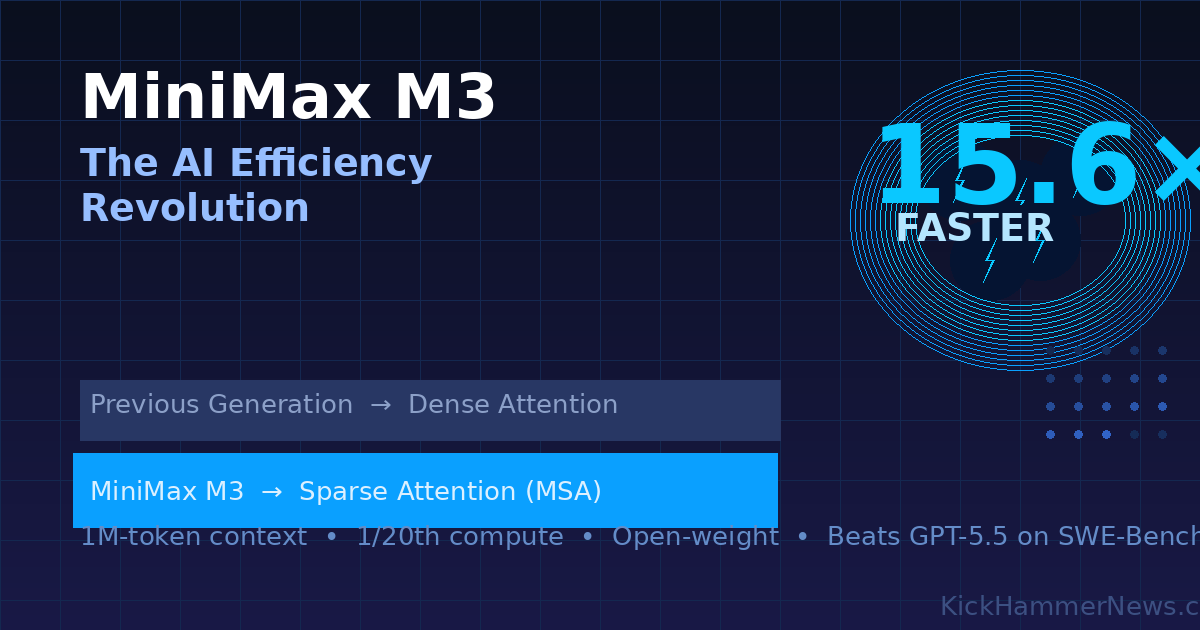
The AI race has largely been defined by a single metric: which model scores highest on the next benchmark. More parameters, more compute, more training runs — bigger has always meant better. But MiniMax, a Chinese AI startup, just launched a model that flips that script entirely. Its new M3, released June 1, 2026, doesn’t just compete at the frontier — it does so at one-twentieth the compute cost for long-context tasks, with decoding speeds that make competing systems look frozen in time.
This is a story about efficiency, and it could change everything about how AI is deployed at scale.
The Speed That Stops the Conversation
Let’s start with the headline numbers, because they are staggering. MiniMax M3 delivers 15.6x faster decoding at a 1-million-token context compared to prior generation models. Prefill — the step where the model processes your input before generating a response — runs more than 9x faster. And the per-token compute requirement at maximum context length is reduced to just one-twentieth of what the previous generation needed.
To put this in practical terms: if you give a typical frontier model a million-token document — roughly 700,000 words, or about seven novels — it struggles. It processes slowly, it costs a fortune per call, and deploying it at production scale is a budget nightmare. MiniMax M3 processes that same document and generates a response more than fifteen times faster, for a fraction of the price.
That’s not incremental. That’s architectural.
The Secret: MiniMax Sparse Attention
The technical engine behind this leap is an innovation MiniMax calls MiniMax Sparse Attention, or MSA. It’s a new approach to the core operation inside every transformer model — the attention mechanism — that has remained largely unchanged in structure since the 2017 paper that introduced transformers.
Standard attention is expensive. When a model has a long context, every token must attend to every other token, causing compute requirements to grow quadratically with context length. That’s why long-context models are slow and expensive: doubling the context roughly quadruples the attention cost.
MSA breaks this pattern with a two-branch approach. A lightweight index branch scans incoming tokens first and selects which blocks of past tokens are actually relevant for a given query. Only those selected blocks are then processed by the full attention mechanism. The rest are skipped. The result is that compute scales sparsely rather than densely — and at 1 million tokens, this sparsity makes an enormous difference.
Crucially, MiniMax reports that MSA maintains benchmark performance parity with full dense attention. You get the speed and cost benefits without giving up quality.
Benchmarks That Turn Heads
The efficiency story would be compelling on its own, but MiniMax M3 pairs it with performance that puts it squarely in frontier territory.
On SWE-Bench Pro, the widely used software engineering evaluation where models are tested on real-world GitHub issues, M3 scores 59.0% — surpassing both OpenAI’s GPT-5.5 and Google’s Gemini 3.1 Pro. For a model priced at 5-10% of those competitors’ costs, this is a notable result.
On BrowseComp, a benchmark that tests models’ ability to search the web and synthesize information from multiple sources, M3 scores 83.5, edging past Anthropic’s Claude Opus 4.7, which scored 79.3.
These are not narrow wins in cherry-picked categories. SWE-Bench and BrowseComp are respected stress tests. Beating frontier American models on them while running dramatically cheaper and faster is the kind of result the broader AI industry will study carefully.
Open-Weight and Multimodal
Two additional aspects of M3 deserve attention.
First, it is open-weight. MiniMax has released the model weights publicly, meaning developers, researchers, and companies can download and deploy M3 on their own infrastructure without paying per-token API fees. For enterprises with privacy concerns or those operating in regulated industries, this makes M3 especially attractive.
Second, M3 natively handles images and video, not just text. MiniMax bills it as the first open-weight model to combine frontier-level coding capability, a 1-million-token context window, and native multimodal understanding in a single unified model. Whether that claim holds up under scrutiny, the combination is genuinely rare at this price point.
What This Means for the AI Industry
The implications of MiniMax M3 cut in several directions.
For American frontier labs, M3 is a direct challenge that cannot be dismissed as a cheaper-but-worse option. When a model beats GPT-5.5 on software engineering benchmarks and costs a fraction of the price to run, the competitive equation shifts. OpenAI, Google, and Anthropic have long competed on benchmark leadership. M3 adds cost-efficiency as a major axis of competition.
For enterprise buyers, the calculus is changing fast. The question is no longer just “which model is smartest?” but “which model gives us the best capability per dollar at scale?” A 15x inference speed advantage translates directly into lower latency for users and lower infrastructure bills for operators. These are real-world advantages that compound quickly at production volume.
For the broader AI ecosystem, M3’s architectural innovations — particularly MSA — are open research contributions. The paper behind the approach gives other labs a roadmap to pursue similar efficiency gains. It’s not unusual for a breakthrough published by one lab to ripple across the industry within months. MSA could do the same.
And for China’s AI standing globally, M3 is another data point in a pattern that has accelerated through 2025 and into 2026. Chinese labs that were dismissed as followers two years ago are now regularly competing at — and sometimes surpassing — the frontier.
The Long Game
MiniMax’s bet is that efficiency and openness are not just competitive tactics — they are the architecture of the next phase of AI. If you can do what the most expensive closed models do, at one-twentieth the compute cost, in the open, you change who can participate in frontier AI deployment.
The era of “only the biggest clusters win” may not be over, but it is being seriously tested. MiniMax M3 is the clearest evidence yet that architectural ingenuity can compete with sheer computational scale — and that the AI race is nowhere near decided.


