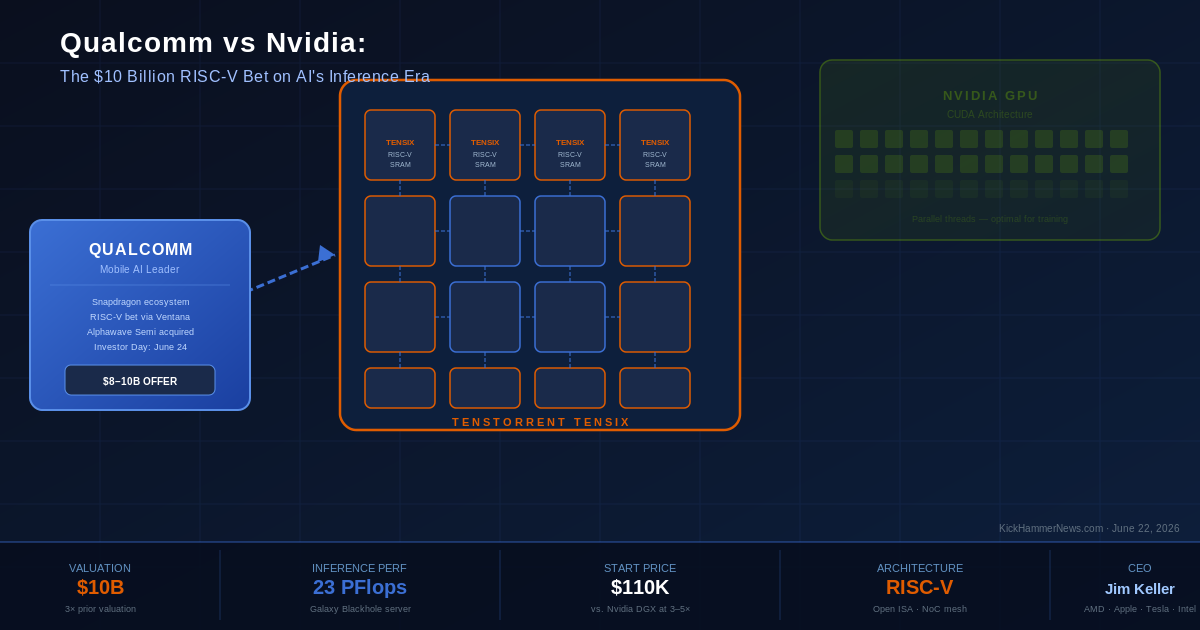
The AI chip market has a ruler, and that ruler is Nvidia. For nearly a decade, the Santa Clara company’s H100 and now Blackwell GPU stacks have been the default answer to every enterprise question about accelerated computing. But Qualcomm is now making one of its boldest moves yet to challenge that dominance — and the vehicle is a little-known Canadian startup called Tenstorrent, led by one of the most decorated chip architects alive.
According to reports first published by The Information and subsequently confirmed by Reuters, Qualcomm is in advanced talks to acquire Tenstorrent at a valuation of between $8 billion and $10 billion. The deal, if signed, would represent one of the largest acquisitions in Qualcomm’s history. It would also hand the San Diego semiconductor giant something it has never had: a clean-sheet AI accelerator architecture designed from the ground up to do what Nvidia’s GPUs do poorly — run inference workloads cheaply, efficiently, and at scale.
Why Tenstorrent Is Worth Ten Times What It Was
When Tenstorrent was raising capital in late 2025, its pre-money valuation was roughly $3.2 billion. The figure in today’s acquisition talks is triple that. What changed?
Two things: shipping silicon and competition for the asset. Tenstorrent’s Galaxy Blackhole AI compute platform reached general availability on April 28, 2026, giving the company a product with verifiable performance numbers rather than promises. And when it became clear that Intel was interested in the same asset, Qualcomm had to move — and move fast.
The company is led by Jim Keller, a chip designer whose resume reads like a greatest-hits album of the semiconductor industry. He designed the Alpha EV6 and EV7 microarchitectures at DEC. He led the K7 and K8 teams at AMD. He was behind Apple’s A4 and A5 chips. He ran Tesla’s Autopilot silicon effort. He led Intel’s silicon engineering group. Wherever Keller goes, competitive chips follow. Bernstein analyst Stacy Rasgon called acquiring Keller “a coup for any company,” though he warned that Keller’s well-documented tendency to leave public companies within a few years means Qualcomm may ultimately be paying $10 billion for an architecture, not a person. That may be exactly what Qualcomm wants.
What Makes Tenstorrent Different From Nvidia
To understand why this acquisition matters, you need to understand why Nvidia’s GPUs are simultaneously dominant and vulnerable.
Nvidia’s GPU architecture is built around a principle called latency hiding. Thousands of parallel threads run simultaneously, keeping the chip occupied while any individual thread waits for data from memory. This works spectacularly well for training large AI models, where enormous batches of data flow through the same matrix operations for hours or days at a time. The chip is never idle, memory bandwidth is never wasted, and the hardware costs make sense.
But the AI industry has shifted. Training is a one-time cost. Inference — running a deployed model to answer user queries in real time — is where the money is being spent, and where the bills are growing fastest. Inference is a fundamentally different workload: small batches, single requests, latency measured in milliseconds. Nvidia’s latency-hiding machinery requires enough simultaneous operations to work. At low batch sizes, it spins, waiting for work that is not there.
Tenstorrent built for this problem from scratch. Each of its Tensix processor cores contains five small RISC-V processor cores — two for data movement, three for orchestration — plus dedicated hardware for matrix math and vector operations, plus between one and two megabytes of on-chip static RAM. These cores connect to each other not through a shared memory hierarchy but through a direct Network-on-Chip mesh of hardware routers. Any core can reach any other core’s local memory without touching DRAM.
When an AI model’s active weights fit inside that distributed on-chip memory pool, the system runs inference without touching external memory at all. Latency collapses. Power consumption drops. The economics of serving AI at scale change.
The flagship Galaxy Blackhole server packs 32 of these chips into a 6U enclosure linked by a 100-terabit-per-second Ethernet mesh. It delivers 23 petaFLOPS of compute starting at $110,000 — roughly one-third to one-fifth the cost of a comparable Nvidia DGX configuration on inference-heavy workloads.
One honest caveat: those performance claims come from Tenstorrent’s own benchmarks. Independent testing at production scale is still limited. And the software stack — TT-Metalium, an open-source alternative to Nvidia’s CUDA — requires programmers to reason explicitly about data placement across the chip mesh. Writing for CUDA, as painful as it sometimes is, remains easier. Nvidia’s software ecosystem has nineteen years of maturity. Tenstorrent’s has a few.
Three Problems Qualcomm Is Trying to Solve
For Qualcomm CEO Cristiano Amon, the deal addresses three converging pressures at once.
The first is the Arm problem. Qualcomm’s entire product portfolio runs on Arm’s instruction set. The company won a major lawsuit against Arm in 2024 over its acquisition of Nuvia, but the legal battle exposed a structural weakness: when your ISA licensor now competes with you, you are permanently vulnerable. Qualcomm has been assembling a RISC-V hedge — acquiring Ventana Micro Systems in December 2025, then closing its purchase of interconnect specialist Alphawave Semi. Tenstorrent is the accelerator layer that turns those pieces into a coherent alternative stack.
The second is the data center gap. Qualcomm is best known for the Snapdragon chips inside billions of smartphones. It wants to be known as a data center company. JPMorgan analyst Samik Chatterjee has projected that Qualcomm could announce revenue targets of over $3 billion for fiscal 2027 from data center products, scaling toward $35 billion by fiscal 2031, at the company’s June 24 Investor Day. Right now, Qualcomm’s AI200 and AI250 accelerators are incremental improvements to mobile-derived architecture. Tenstorrent would be a statement.
The third motivation is defensive. If Qualcomm does not buy Tenstorrent, Intel might. Keller said publicly that Tenstorrent’s design philosophy is “whatever Nvidia does, we’ll do the opposite.” Letting the most technically coherent expression of that philosophy fall to a rival is not an option Qualcomm seems willing to accept.
The Risks Are Real
Talent retention is the principal risk. Rasgon’s Bernstein research note named Keller’s tendency to leave public companies as the primary concern. Qualcomm acquired Nuvia in 2021 for its CPU engineering talent; much of that team departed after lock-up periods expired. The underlying Oryon chip IP proved durable and now powers Qualcomm’s laptop processors. The pattern — IP survives, people leave — is likely to repeat.
Regulatory complexity is the second risk. Qualcomm abandoned its $44 billion NXP acquisition in 2018 after Chinese regulators ran out the clock. A China SAMR antitrust probe from the Autotalks deal remains open. A $10 billion acquisition of a prominent AI chip company would trigger multiregulatory scrutiny in the United States, Europe, and China.
And then there is the software gap. TT-Metalium is open-source, which is a genuine advantage — the CUDA ecosystem is proprietary in ways that have frustrated developers for years. But open-source is not the same as mature. Framework support, model compatibility, and developer tooling all lag behind what CUDA offers. Qualcomm would need to invest heavily in developer relations and software engineering to close that gap.
What June 24 Will Tell Us
Wall Street is watching Qualcomm’s Investor Day on June 24 as the moment of truth. QCOM shares jumped more than 4% in pre-market trading when the acquisition talks were first reported and closed at $214.07. The stock’s 52-week range runs from $121.99 to $259.92, reflecting the violent swings that attach to every AI hardware announcement.
If Amon walks onto the Investor Day stage with a signed Tenstorrent agreement, a named hyperscaler customer, and explicit revenue targets, the $10 billion price starts to look like infrastructure spending rather than a gamble. If the deal falls apart, Qualcomm must explain its AI accelerator strategy to a market that has already priced in optimism.
What no one disputes is that Nvidia’s dominance, while real, is not inevitable. The inference era is just beginning. The company or companies that solve the cost and latency problems of running AI at consumer scale will define the next decade of computing infrastructure. Qualcomm is betting that Tenstorrent has already solved the hard part. We will know soon whether the architecture survives contact with the hyperscalers.


