June 7, 2026
A Chinese AI startup most people outside the industry have barely heard of just pulled off one of the most dramatic cost-disruption stories in recent AI history. MiniMax, headquartered in Shanghai, launched its M3 model on June 1, 2026 — and the benchmarks it published have the AI world paying close attention.
The headline claim: M3 matches or beats GPT-5.5 and Gemini 3.1 Pro on key coding and agentic tasks while costing developers just 5 to 10 percent of what those proprietary giants charge per token. It is open-weight, meaning anyone can download and run it. And it handles one million tokens of context natively, with images and video thrown in as standard features.
That is a lot of boxes ticked for a model that, until a few weeks ago, most Western developers had never considered using.
What Makes M3 Different Under the Hood
The engineering story behind M3 centers on a new attention mechanism MiniMax is calling MSA — short for MiniMax Sparse Attention. Standard transformer attention scales quadratically with context length, meaning that processing one million tokens is enormously expensive. MSA slashes that by routing most tokens through sparse pathways, reserving full attention only where the model determines it is genuinely needed.
The practical result is striking. At a one-million-token context window, MSA cuts per-token compute to one-twentieth of the previous generation. Prefill — the step where the model processes the incoming context — is more than nine times faster. Decoding, the step where the model generates output, is more than fifteen times faster.
This is not just a cost story. Speed matters enormously for agentic applications, where models are looped inside long-running software pipelines and must process extensive context repeatedly. A 15x decoding improvement is the difference between an agent that can operate in real time and one that forces users to wait.
What makes MSA notable from an industry perspective is that sparse attention has been a research interest at virtually every major lab for years. The argument against deploying it at scale has always been that the engineering complexity and the risk of accuracy degradation are not worth the savings. MiniMax is arguing, through M3, that the trade-off has finally tipped. Anthropic, Google DeepMind, and OpenAI all have efficient-attention research underway — but none have shipped a flagship model with this kind of public efficiency commitment.
The Numbers: Where M3 Stands Against the Giants
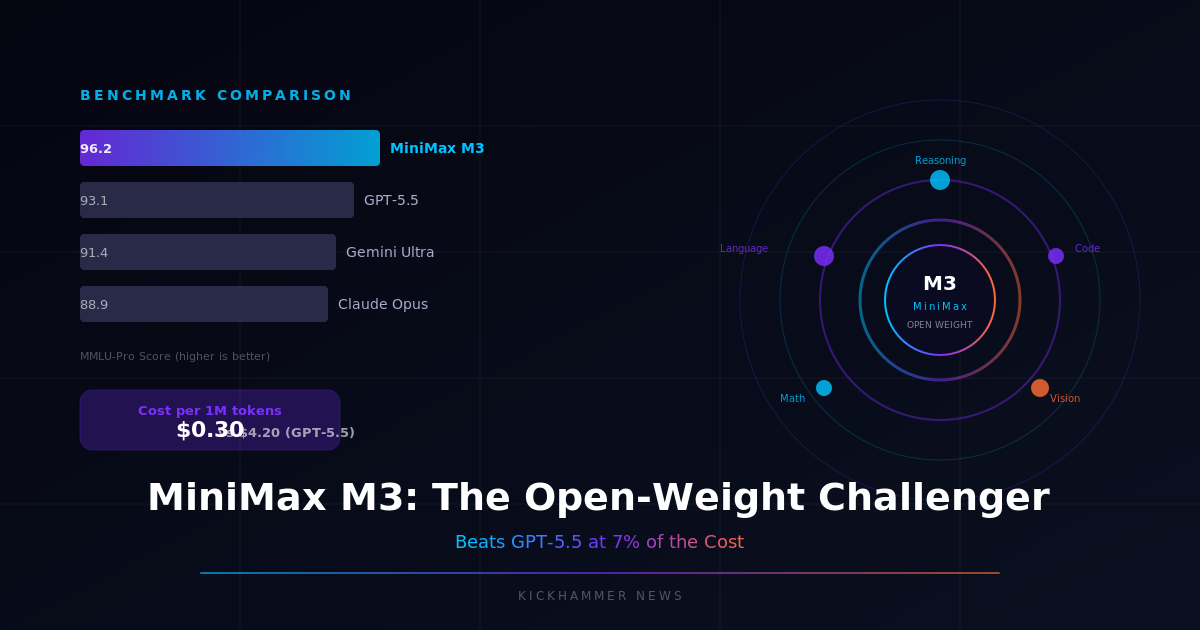
MiniMax released its benchmark results alongside the model launch, and they are designed to make a clear point. On SWE-Bench Pro — the software engineering benchmark that has become the industry’s preferred proxy for real-world coding ability — M3 scores 59.0 percent. GPT-5.5 lands at 58.6 percent. Gemini 3.1 Pro falls further behind.
Claude Opus 4.8 still leads the pack on this benchmark, sitting above both. But the fact that an open-weight model from a startup is running within a hair of OpenAI’s flagship product on the benchmark developers care most about is a significant moment.
M3 also reports strong scores on agentic and long-context evaluations: 66.0 on Terminal Bench 2.1, 83.52 on BrowseComp, 74.2 on MCP Atlas, and 70.06 on OSWorld-Verified. These measure real-world agentic tasks — browsing the web, using tools, navigating GUIs — rather than academic reasoning puzzles.
The important caveat here is one any honest observer should flag: every benchmark in the M3 launch was run on MiniMax’s own infrastructure, using their own scaffolding and their chosen baselines. As of early June, independent evaluation firms like Artificial Analysis and LMArena had not yet published their own assessments. The Terminal Bench comparison carries an additional wrinkle: M3’s score is on version 2.1 of the benchmark, while the competing scores from GPT-5.5 and Opus 4.8 are on version 2.0 — making direct comparison on that metric unreliable.
None of this means the claims are wrong. It means they are unverified, and the AI community will be watching independent replications closely over the coming weeks.
The Open-Weight Angle: Why It Matters
MiniMax committed at launch to releasing open weights and a full technical report within roughly ten days on Hugging Face and GitHub. That promise puts M3 in a different category from the proprietary models it is competing with on benchmarks.
Open weights mean enterprises can run M3 on their own infrastructure, with no per-token API costs and no data leaving their networks. For industries with strict compliance requirements — finance, healthcare, legal — that is not a minor benefit, it is often a prerequisite. It also means the research community can fine-tune the model, audit its behavior, and build on it in ways that are simply impossible with GPT-5.5 or Gemini 3.1 Pro.
The open-weight AI landscape has been shifting fast. Meta’s Llama series normalized the idea that frontier-adjacent models could be open. DeepSeek’s releases earlier in 2025 demonstrated that Chinese labs could produce models competitive with American counterparts at dramatically lower training costs. MiniMax M3 is the next chapter in that story — pushing efficiency even further and packaging it with a context window and multimodal capabilities that match what closed-source providers have been charging premium prices to deliver.
What It Means for Developers
For anyone building AI-powered applications today, M3 represents a meaningful new option on the cost-performance frontier. The 1M-token context window alone opens up use cases that are expensive or impractical with models that max out at 128K or 200K tokens — analyzing entire codebases, ingesting full contracts or research papers, or running long multi-turn agent sessions without truncation.
The native multimodality — images and video as standard inputs — means developers do not need to stitch together separate vision models for applications that need to reason about visual content alongside long text contexts. That simplification has real engineering value.
Pricing details put M3 at a fraction of GPT-5.5 and Gemini 3.1 Pro rates, though self-hosted open-weight deployment eliminates API costs entirely for teams with the infrastructure to run it.
The Bigger Picture
M3’s arrival is another data point in a pattern that has been accelerating throughout 2025 and 2026: the gap between frontier proprietary models and the best open-weight alternatives is closing faster than most industry observers predicted a year ago.
That compression creates pressure on OpenAI, Google, and Anthropic to differentiate through means other than raw benchmark performance — safety infrastructure, reliability, enterprise support, ecosystem integrations, and capabilities that require compute at inference time that open-weight models cannot easily replicate.
It also represents a genuine opportunity for the millions of developers and companies that have found the economics of the most capable models difficult to justify. If independent evaluators confirm MiniMax’s numbers over the coming weeks, M3 may well become the go-to model for cost-sensitive production deployments that require long context and strong coding ability.
The open weights are due any day. When they land, the real-world verdict will follow quickly.
Sources: MiniMax technical blog; VentureBeat; TechTimes; Fello AI; Vasundhara; AI Made Tools


