The annual ERP rankings from Nucleus Research are out, and they tell a story about where AI is reshaping enterprise software — and who’s falling behind.
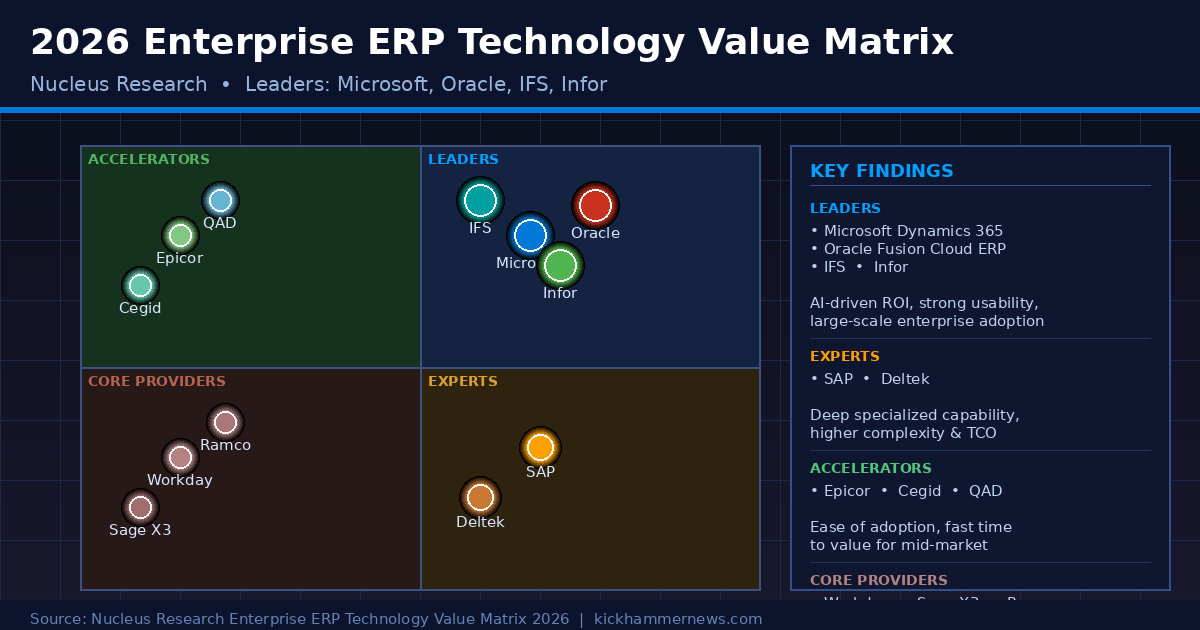
The 2026 Enterprise ERP Technology Value Matrix from Nucleus Research, released June 2, delivers a notable shakeup for the enterprise software world: SAP, long considered the undisputed king of ERP, has been classified as an “Expert” vendor rather than a market “Leader.” Meanwhile, Microsoft and Oracle hold their ground in the coveted Leader quadrant alongside IFS and Infor, signaling that AI-first execution is now the price of admission for the top tier.
For enterprise software watchers, this is a meaningful data point. Nucleus Research evaluates ERP vendors on both functionality and usability — how powerful a platform is, and how effectively real organizations can extract value from it. Leaders, in their framework, are the vendors that score highly on both axes. The designation isn’t just about features; it reflects real-world ROI and large-scale adoption success. The fact that SAP, with its massive installed base and multi-billion dollar R&D budget, sits in the Expert category rather than with the Leaders is a statement worth unpacking.
What “Expert” Means — and Why It Matters for SAP
Nucleus Research defines Expert vendors as those offering “deep, specialized functionality suited for complex requirements.” That’s not an insult — it means SAP’s platform is sophisticated. But it also reflects a gap in usability or ROI realization at scale, particularly for organizations that don’t have armies of consultants and implementation specialists to manage the complexity.
SAP has been aggressively pushing its AI assistant Joule and its Business AI portfolio, and at Sapphire 2026 this spring, the company introduced Joule Studio 2.0 and the Autonomous Suite. But Nucleus Research’s methodology leans heavily on documented customer outcomes — the actual return on investment organizations have achieved. Complexity can suppress those outcomes even when the underlying technology is impressive, and SAP’s historically high total cost of ownership has been a persistent challenge.
The company isn’t in trouble — SAP remains the largest ERP vendor in the world by revenue, with over 400,000 customers. But the optics matter. Enterprise buyers evaluating platforms use reports like this one to shortlist vendors, and being categorized differently than Microsoft, Oracle, IFS, and Infor could influence deals at the margin.
Why Microsoft and Oracle Are Holding the Top Spot
Microsoft Dynamics 365 and Oracle Fusion Cloud ERP are both well-positioned in the current AI moment, and their Leadership rankings reflect that. Both companies have deeply embedded AI into their ERP products — and crucially, they’ve done so in ways that tie directly to measurable business outcomes.
Microsoft has been rolling out Copilot capabilities across Dynamics 365 for well over a year now, and enterprise customers are reporting real productivity gains in areas like invoice processing, financial close, and procurement workflow automation. The company also benefits from the broader Microsoft ecosystem — Azure, Power Platform, Teams, and Microsoft 365 — which creates tight integration that ERP buyers find difficult to replicate elsewhere.
Oracle’s position is similarly well-founded. Oracle Fusion Cloud ERP has been adding AI-driven automation across its finance, supply chain, and HR modules. The company’s Autonomous Database and embedded analytics give it a structural advantage in data quality and real-time reporting, two areas that Nucleus Research’s report identifies as critical to AI adoption success. Oracle also made waves with its Fusion 26B update earlier this year, adding hundreds of agentic AI capabilities that automate multi-step enterprise workflows without human intervention.
Charles Brennan, Senior Analyst at Nucleus Research, framed the broader picture well in the report’s release: “Organizations realize ROI when ERP can improve visibility, reduce manual coordination, and accelerate response times across complex operating environments.” Both Microsoft and Oracle are delivering exactly that, and their customer testimonials reflect it.
IFS and Infor: The Quiet Leaders
IFS and Infor round out the Leader quadrant, and their presence is a reminder that enterprise ERP isn’t a two-horse race. IFS has carved out an exceptionally strong position in asset-intensive industries — aerospace, defense, utilities, construction — where its industry-specific depth delivers ROI that generic platforms struggle to match. The company has been aggressive about AI integration in its field service and manufacturing modules, and it’s paying off.
Infor, now fully under Koch Industries’ ownership, has similarly doubled down on deep vertical specialization. Its CloudSuites for manufacturing, distribution, healthcare, and hospitality are designed to minimize the customization burden that often kills ERP implementations. Infor’s AI layer, Coleman, has been maturing steadily, and the company’s customer retention rates are among the best in the industry.
Both companies demonstrate a key trend: enterprise buyers are rewarding vendors who understand their specific industry, not just vendors who have the most features.
The Broader Trends Driving ERP Modernization in 2026
Nucleus Research’s report does more than rank vendors — it maps the key forces reshaping enterprise ERP investment decisions right now. A few themes stand out:
AI is moving from optional to expected. Vendors that can’t demonstrate embedded AI capabilities with measurable ROI are increasingly disadvantaged. Contextual analytics, anomaly detection, and process orchestration are now table stakes for serious enterprise buyers. The question isn’t whether an ERP has AI features — it’s whether those features deliver documented value in the areas that matter most: finance, supply chain, manufacturing execution, and procurement.
Data quality is the critical bottleneck. The report specifically flags that large organizations often face fragmented systems, inconsistent master data, and disconnected reporting structures that limit automation outcomes. This is why ERP selections are increasingly being made with data governance in mind — role-based controls, auditability, and explainability aren’t nice-to-haves anymore, they’re requirements.
Industry depth is winning deals. The days of one-size-fits-all ERP are fading. Organizations in manufacturing, project-based businesses, and asset-intensive industries are demanding platforms that align with their specific operating models. Cloud migration is accelerating this, because modern cloud ERP makes it easier to integrate adjacent systems like MES, WMS, and EAM without massive custom development.
Finance remains the ROI sweet spot. Nucleus Research specifically calls out continuous accounting, reconciliation, invoice processing, variance analysis, and close management as the areas generating the clearest, most measurable return on AI investment. ERP vendors that have prioritized these capabilities are seeing adoption and renewal rates reward them accordingly.
What Enterprise Buyers Should Take Away
If you’re in the market for enterprise ERP or are renegotiating your current contract, the 2026 Value Matrix offers a few practical signals. Microsoft and Oracle are safe bets for broad enterprise use cases with strong AI integration. IFS and Infor are worth serious evaluation if you’re in an industry they specialize in. SAP remains a powerful platform but may require more internal expertise and implementation investment to achieve comparable ROI.
The report also serves as a market signal to SAP itself: customers and analysts are watching whether its ambitious AI roadmap translates into the usability gains and ROI documentation needed to return to Leader status. The Autonomous Suite and Joule Studio 2.0 are the right bets — but execution will be the proof.
For now, the 2026 ERP landscape is one where AI execution separates the Leaders from the rest. Microsoft and Oracle are executing. The market is noticing.
*The Nucleus Research 2026 Enterprise ERP Technology Value Matrix was released June 2, 2026. The full report is available at NucleusResearch.com.*