It started with frustration. A developer named Brandon Thomas, fed up with paying monthly fees for software he used every day, decided to do something about it. Armed with fifteen years of coding experience and Anthropic’s Claude AI as his co-pilot, Thomas built ArtCraft — a growing suite of free, open-source tools designed to replace some of the most dominant — and most expensive — software packages in the world.
First he came for Adobe. Now he’s coming for Microsoft Office. And if a small but vocal community of supporters gets their way, Autodesk may be next.
The Birth of ArtCraft
Thomas first gained attention by releasing a set of free applications designed to replicate Adobe’s Creative Cloud suite. Adobe’s subscription model, which locks users into monthly or annual payments for tools like Photoshop, Illustrator, and Premiere Pro, has long been a source of frustration for independent creators, students, and small businesses. Thomas saw an opportunity.
Using Claude as his primary development partner, he described the workflow as something unprecedented in software history: “AI models enable me to work as an entire company.” The result was ArtCraft, a collection of applications posted freely to GitHub, available across macOS, Windows, and Linux — an explicit swipe at Adobe’s historically weak Linux support.
The initial response was polarizing. Critics on Reddit labelled the software “vibecoded AI slop,” questioning both the code quality and the wisdom of duplicating already-existing free alternatives like GIMP and Inkscape. Thomas was unapologetic. “GIMP sucks,” he wrote bluntly in one post. “It has always sucked. There is no reason to save broken software.”
Enter the Office Killers
Encouraged by the traction ArtCraft was gaining — its Discord server began growing rapidly as word spread — Thomas turned his attention to an even larger target: Microsoft Office.
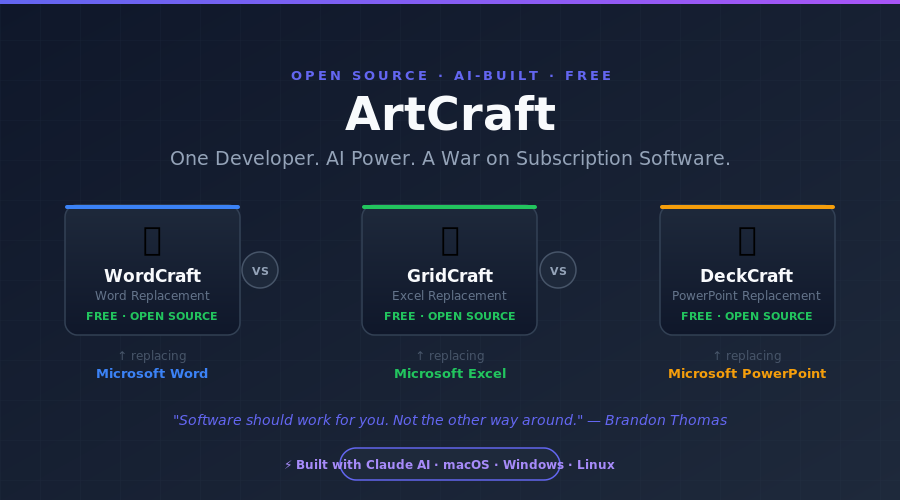
His latest announcement unveils three new applications under the ArtCraft umbrella:
- WordCraft — a free, open-source replacement for Microsoft Word
- GridCraft — targeting Excel’s spreadsheet dominance
- DeckCraft — aimed at PowerPoint’s grip on presentations
Like the Adobe clones before them, all three are built with heavy AI assistance, posted to the ArtCraft GitHub repository, and downloadable at no cost. The office apps are acknowledged to be less mature than the creative suite tools — Thomas himself describes them as early versions — but the direction is unmistakable.
“I hate LibreOffice so bad,” Thomas posted on social media, explaining his motivation. “It once killed a 40-page essay I wrote the week it was due, during finals.” His goal, he says, is not just feature parity, but a fundamentally better user experience built from the ground up.
Why Now? The Subscription Fatigue Behind the Movement
The timing of ArtCraft’s rise is no accident. Over the past several years, both Adobe and Microsoft have accelerated their shift away from one-time software purchases toward recurring subscription models. Microsoft 365 prices for enterprise customers were raised again in July 2026. Adobe continues to bundle increasingly overlapping tools into its Creative Cloud subscription, and the company has faced significant backlash over contract terms and price hikes.
For many users — particularly individuals, small teams, and budget-conscious organizations — the cumulative cost of licensing Microsoft and Adobe software has become untenable. Free browser-based alternatives like Google Workspace exist, but they come with their own tradeoffs: dependency on an internet connection, data stored in the cloud, and the ever-present risk that Google could change pricing or shut down a service.
ArtCraft, by contrast, runs locally. It promises the same experience on every major operating system. And it is free.
A Real Threat, or a Protest Project?
Not everyone is convinced ArtCraft represents a genuine competitive threat. Several commenters have pointed out that LibreOffice and Google Docs have existed as free Microsoft Office alternatives for years without meaningfully denting Office’s market share. One question on Reddit cut to the heart of it: can a single developer realistically keep up with the bug fixes, security patches, and feature development that enterprise users demand?
Thomas’s answer, implicitly, is that AI changes the calculation. The tools that once required a team of engineers to build and maintain can now be developed and iterated upon by one person with the right AI partnership. Whether that holds as the user base grows and the software is tested against real-world edge cases remains to be seen.
There’s also the question of licensing. ArtCraft is open source, which means a community of contributors could theoretically take over the heavy lifting. That community is forming — the Discord server is filling with users requesting new features, reporting bugs, and discussing what should come next. Among the most frequently mentioned: CADcraft, a potential Autodesk replacement that would bring ArtCraft into the world of engineering and design software.
What It Means for the Industry
Thomas’s project has struck a nerve precisely because it arrives at a moment when subscription fatigue is genuine and widespread. The framing resonates: one person, using AI as a force multiplier, challenging the dominance of companies that charge billions of users billions of dollars annually for tools that arguably should have remained affordable.
Whether ArtCraft ultimately succeeds as production software or remains a protest movement, its existence sends a message. The barrier to building credible software alternatives has dropped dramatically. A developer who a decade ago would have needed a team, venture capital, and years of development time can now ship functional, cross-platform applications in a fraction of that time.
For Microsoft and Adobe, the ArtCraft story is a warning sign — not necessarily of an imminent competitive threat, but of a shifting landscape in which user loyalty can no longer be assumed and the free alternative is no longer obviously worse. For users tired of subscription fees, Brandon Thomas has become something of a folk hero.
One line from his GitHub README may be the clearest summary of what ArtCraft is really about: “Software should work for you. Not the other way around.”
ArtCraft is available for free on GitHub. All applications run on macOS, Windows, and Linux. Comments are closed on this post.