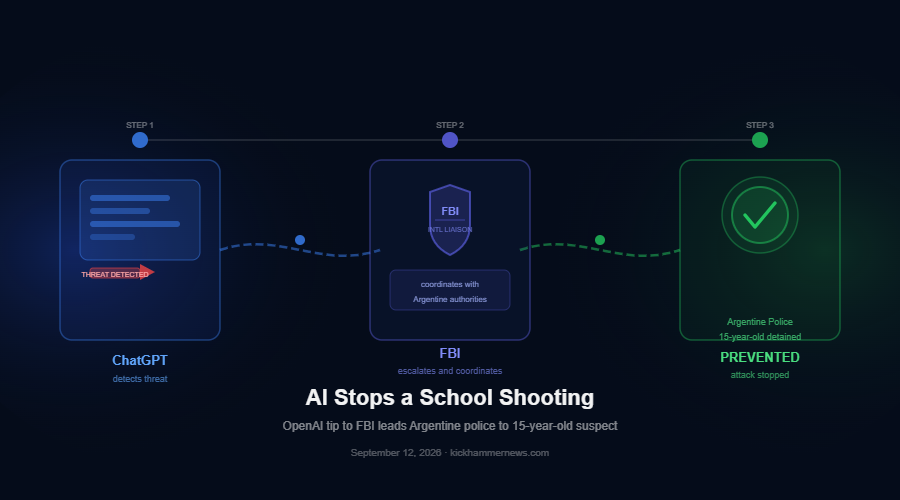
An AI company helped stop a school massacre before it happened. On September 12, 2026, it emerged that OpenAI shared intelligence with the FBI earlier this year, triggering a law enforcement chain that ultimately led Argentine police to a 15-year-old who had been using ChatGPT to plan a school shooting intended for 2027. The teenager was detained before any violence occurred.
The case stands in sharp contrast to the darkest chapter in OpenAI’s recent history — the Tumbler Ridge shooting in British Columbia, where the company’s failure to escalate a flagged account to law enforcement before a mass killing led to a wave of lawsuits and congressional scrutiny. If Tumbler Ridge was the story of how AI failed as a guardrail, the Argentina intervention is the first major public case of AI and its makers actively functioning as one.
What Happened
According to Argentine authorities, ChatGPT detected and flagged content from the user’s conversations that indicated credible planning for a mass violence event at a school. OpenAI’s systems — apparently enhanced in the months since the Tumbler Ridge fallout — escalated the case to the FBI’s international liaison channels. The FBI, in turn, coordinated with Argentine federal police, who identified and detained the suspect.
Details on the technical specifics of how the detection occurred have not been made public, and OpenAI has declined to provide a detailed technical breakdown, citing both operational security and the ongoing legal sensitivity surrounding its safety infrastructure since Tumbler Ridge. But the outcome is not in dispute: a 15-year-old was intercepted, weapons searches were conducted, and school administrators in the targeted area were notified and made aware of the threat.
No attack took place. That sentence, in the current climate around AI and violence, carries enormous weight.
The Shadow of Tumbler Ridge
To understand why this matters, you have to understand what preceded it. On February 10, 2026, Jesse Van Rootselaar walked into her former school in Tumbler Ridge, British Columbia, and killed five students aged 12 to 13 and an educational assistant before dying by suicide. She had been using ChatGPT to plan the attack for months.
OpenAI’s automated systems had flagged Van Rootselaar’s account for “gun violence activity and planning” in June 2025 — eight months before the shooting. The account was deactivated. She created a second account. OpenAI says it did not know about the second account until after the shooting. By then, six people were dead.
What followed was a legal and reputational crisis of historic proportions for the company. Thirty lawsuits were filed. Congressional hearings were convened. Florida’s attorney general opened an investigation. OpenAI’s chief global affairs officer Chris Lehane faced specific allegations that he overruled the company’s safety team’s recommendation to contact law enforcement. The company has disputed those characterizations.
But the pressure forced change. Within weeks of Tumbler Ridge, OpenAI publicly committed to a new policy: if ChatGPT detects a credible threat to life, the company will contact law enforcement. The Argentina case is the first publicly known instance of that policy succeeding at preventing harm.
A New Role for AI Platforms in Violence Prevention
The implications extend well beyond OpenAI. The Argentina case raises a fundamental question that the technology industry, law enforcement, and civil liberties advocates are now being forced to answer simultaneously: what is the obligation of an AI platform when its systems detect a user who may be planning violence?
For platforms like Facebook and YouTube, content moderation has historically focused on public speech — posts, comments, videos. The moderation decisions happen in a social layer, and there is at least a conceptual distinction between surveilling private conversations and removing public content.
AI assistants occupy a different position. Conversations with ChatGPT are not public posts. They are, for many users, closer in character to a private journal or a therapy session — an unfiltered space where people express thoughts, fears, and impulses they might not share elsewhere. The architecture of that intimacy is part of what makes language models useful. It is also what makes them a potential early-warning system unlike anything law enforcement has previously had access to.
That tension — between user trust and public safety — is now live in a way that can no longer be deferred to abstract policy discussions. OpenAI has made a concrete decision, implemented a concrete system, and produced a concrete outcome. The precedent is set, whether anyone intended to set it.
What Critics Are Saying
Civil liberties organizations have been careful not to object to the outcome in Argentina while still flagging their concerns about the mechanism. The Electronic Frontier Foundation and several academic privacy researchers noted in statements following the story’s emergence that the same system capable of flagging a genuine mass-shooting threat could, if miscalibrated, flag political speech, fiction writing, journalistic research, or mental health conversations that involve violent ideation without any intent to act.
The question of who reviews these flags before they are escalated to law enforcement is not publicly answered. OpenAI has said it has a human review layer for the most serious threat categories, but the company has not described that process in detail, how many people are involved, what their training is, or what standard of evidence triggers an FBI referral.
These are not abstract concerns. AI systems flag false positives. A teenager in Argentina who was researching gun violence for a school project, a fiction writer drafting a thriller, a mental health counselor studying case files — all could theoretically generate content that pattern-matches to threat detection criteria. The difference between those cases and the one that resulted in a law enforcement intervention is presumably some combination of specificity, intent markers, and operational detail. But without transparency into the criteria, it is impossible for users, advocates, or regulators to evaluate whether the system is well-calibrated.
The Broader Industry Context
OpenAI is not alone in now facing these questions. Anthropic, Google’s Gemini team, and Microsoft’s Copilot team all operate AI assistants with similar conversational intimacy and similar theoretical capability to detect planning for harm. Whether any of them have equivalent detection and escalation systems in place is not publicly known.
What is known is that this issue is now too visible for any major AI platform to claim it has no position on. The combination of Tumbler Ridge — a case study in what happens when these systems fail — and Argentina — a case study in what happens when they work — has created a permanent reference frame for every future debate about AI platform responsibility and violence prevention.
What It Changes
For OpenAI, the Argentina case is both a moral win and a marketing challenge. It demonstrates that the company’s post-Tumbler Ridge safety commitments are not merely rhetorical — the new protocols produced a real-world intervention that saved lives, or at least may have. That is meaningful.
But it also invites scrutiny of every subsequent case. When the next Tumbler Ridge occurs — and statistically, there is every reason to believe there will be one — the question will not be whether OpenAI had the capability to detect and escalate the threat. The question will be why it didn’t.
For the technology industry more broadly, Argentina signals that AI models are entering a new phase of societal integration. They are no longer merely tools that generate text and images. They are, increasingly, participants in the information environment that law enforcement, public health officials, educators, and policymakers depend on to understand what is happening in the world before it becomes catastrophic.
How that role is governed — with what transparency, under what legal frameworks, with what oversight — is a question that September 2026 has made newly urgent. The answers are not yet written. But the questions are no longer avoidable.


