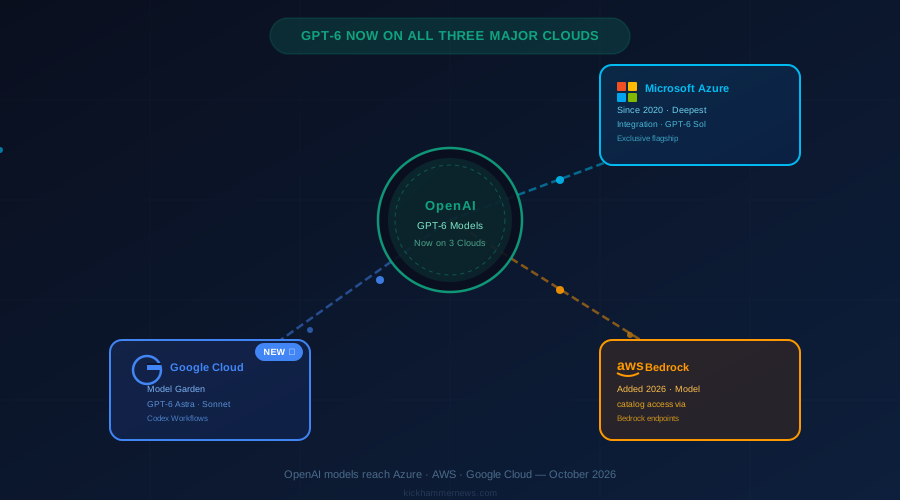
For most of OpenAI’s history, the company has had one cloud home: Microsoft Azure. Microsoft poured in roughly $13 billion across multiple funding rounds, took a ~49% stake in the company, and built OpenAI’s infrastructure into Azure as a flagship differentiator. The arrangement made Azure the only place enterprises could run OpenAI’s models natively, which gave Microsoft a structural advantage in the cloud wars that money alone couldn’t buy — a model that actually worked at scale, that developers wanted to use, that enterprises were willing to pay a premium to access.
That exclusive era officially ended this week.
On October 21, OpenAI announced a partnership with Google Cloud that places its GPT-6 model family inside Google Cloud’s Model Garden — the managed AI model hub that sits at the core of Google Cloud Platform. Three GPT-6 models are entering private preview: GPT-6 Astra (OpenAI’s flagship multimodal reasoning model), GPT-6 Sonnet (the mid-tier workhorse), and Codex Workflows, OpenAI’s developer-focused agentic coding system. Google’s Antigravity AI development platform is expected to receive the same models “soon.” For enterprises already inside the Google Cloud ecosystem, this means they can now call GPT-6 through the same APIs, billing, and IAM controls they use for everything else — without a separate OpenAI account, a separate contract, or a route through Azure.
The headline that’s circulating is accurate and worth sitting with: OpenAI’s models are now on all three major US cloud platforms. Azure has carried them since 2020. AWS added OpenAI models to its Bedrock model catalog earlier in 2026. And now Google Cloud. For the first time, a software engineer at a Fortune 500 company can call a GPT-6 API endpoint from whichever cloud they already live in.
Why Google Would Do This
On the surface, the deal seems strange. Google is OpenAI’s most direct competitor. Gemini Ultra, Gemini Pro, and the newly released Gemini Vela represent Google’s own frontier model lineup — the same models Google Cloud sells as managed services and uses to power everything from Search to Google Workspace. Hosting a competitor’s models on your own infrastructure feels like handing a rival team access to your stadium.
But Google Cloud thinks in enterprise terms, and in enterprise terms, the logic is clear. The goal of a cloud platform’s AI layer is to become the single control plane for AI — the place where governance, cost management, compliance, and access control all happen. If an enterprise is spending $80 million a year on Google Cloud but running its OpenAI workloads through an Azure bypass, that’s both a revenue gap and a foothold vulnerability. Microsoft holds the OpenAI workload; Microsoft holds the developer relationship; Microsoft may eventually win the rest of the account. Adding OpenAI to Model Garden converts that vulnerability into a retention asset. The enterprise stays on GCP. The OpenAI spend flows through Google Cloud billing. Google earns its margin on compute, not on which model runs on it.
Google Cloud CEO Thomas Kurian confirmed this framing in a statement accompanying the announcement: “Customers should be able to build on the models they choose using the infrastructure they trust. By bringing OpenAI models to Google Cloud, we’re giving customers more options while maintaining the security, compliance, and operational simplicity they expect from GCP.”
For OpenAI, the calculus is about reach and reducing dependency. The company’s IPO preparation — widely expected in the first half of 2027 — requires demonstrating that revenue is not solely dependent on Microsoft’s distribution channel. Being on all three major clouds is the infrastructure equivalent of achieving distribution parity. It also opens OpenAI to Google Cloud’s 4 million+ enterprise customers, many of whom would never have accessed GPT-6 otherwise.
What’s Actually in the Catalog
The initial Google Cloud offering is deliberately limited. GPT-6 Astra is in private preview, meaning Google Cloud enterprise customers can apply for access but won’t find it in the public catalog today. GPT-6 Sonnet is the likely first model to reach general availability, expected “in the coming weeks.” Codex Workflows — OpenAI’s agentic coding system that can plan and execute multi-file development tasks — is available for testing by select enterprise partners.
Notably absent from the Google Cloud launch: GPT-6 Sol, OpenAI’s most capable (and most expensive) reasoning model, which remains Azure-exclusive for now. This suggests the deal was structured with intentional sequencing — Microsoft retains premium-tier exclusivity temporarily, likely as a condition of not opposing the Google Cloud expansion entirely.
The models will appear in Google Cloud Model Garden alongside Google’s own Gemini models, Anthropic’s Claude family (which has been on Google Cloud via Vertex AI since 2023), Meta’s Llama open-weights models, and over 200 other models across providers. Customers will be able to call them through the standard Vertex AI endpoints, with full integration into Google Cloud’s logging, monitoring, cost controls, and VPC-isolated inference for regulated workloads.
Microsoft’s Strategic Position
The obvious question is what this means for Microsoft, which spent over a decade building OpenAI into Azure’s identity. The simple answer is that Microsoft still holds structural advantages that don’t evaporate overnight: its ~49% equity stake, its deeply embedded enterprise relationships through Teams, Office 365, and Azure, and the Copilot product line built on top of OpenAI models.
What changes is the leverage dynamic. When OpenAI was Azure-exclusive, an enterprise that wanted GPT-6 had to go through Azure — full stop. That’s no longer true. If Google Cloud or AWS can match Azure’s pricing on GPT-6 compute, enterprises can route their inference workloads to whoever offers the best deal. OpenAI models become less of a Microsoft differentiator and more of a commodity layer, like a database engine that runs on every cloud.
Microsoft CEO Satya Nadella, speaking at a conference on October 22, addressed the development with characteristic restraint: “We’ve always said OpenAI’s success is aligned with ours. If enterprises want to access OpenAI on different clouds, that’s a testament to the value OpenAI has built. Azure remains the deepest, most integrated home for OpenAI models.” The statement acknowledged reality without conceding territory — Microsoft isn’t going to publicly resist OpenAI’s multicloud expansion when it holds 49% of OpenAI’s equity and benefits from any increase in OpenAI’s enterprise reach.
The Model as Utility
What this week’s deal signals, taken together with OpenAI’s earlier arrival on AWS Bedrock, is an accelerating shift in how the industry thinks about AI models. In 2023, models were tied to labs — you used OpenAI models through OpenAI’s API, Google models through Google’s API. In 2025, Microsoft began the bundling era — OpenAI models as an Azure premium. In 2026, we are moving toward models as interchangeable utilities, available wherever compute runs.
This has an analog in database history. Oracle and Microsoft SQL Server were once platform-differentiated products — you chose your database partly by choosing your infrastructure ecosystem. Cloud-native databases and then Postgres-on-every-cloud progressively turned database engines into utilities that any cloud could run. Enterprise workloads now move between clouds with relatively low switching friction on the database layer; the differentiation happens at the platform layer (developer tools, managed services, security integrations) not the engine itself.
The same dynamic may now apply to frontier AI models. GPT-6 on Google Cloud, Claude on Azure, Gemini on AWS — if every model is available everywhere, model choice decouples from cloud choice. That’s good for enterprises, who get genuine optionality. It’s challenging for any cloud that had banked on model exclusivity as a retention mechanism. And it suggests the next phase of the AI platform war will be won not by who has the best exclusive model, but by who builds the best environment for running, governing, and integrating models at scale — whichever model the customer chooses.
OpenAI just made that future arrive a year earlier than anyone expected.


