For years, Tesla has operated on a simple, if ambitious, premise: Full Self-Driving is always almost here. The goalposts have moved so many times that tracking the promises became its own minor industry. But this week, the company delivered two updates that together tell a surprisingly honest story about where autonomous driving really stands in late 2026 — and why the finish line is more complicated than “car drives itself.”
The Delay, and the Fine Print
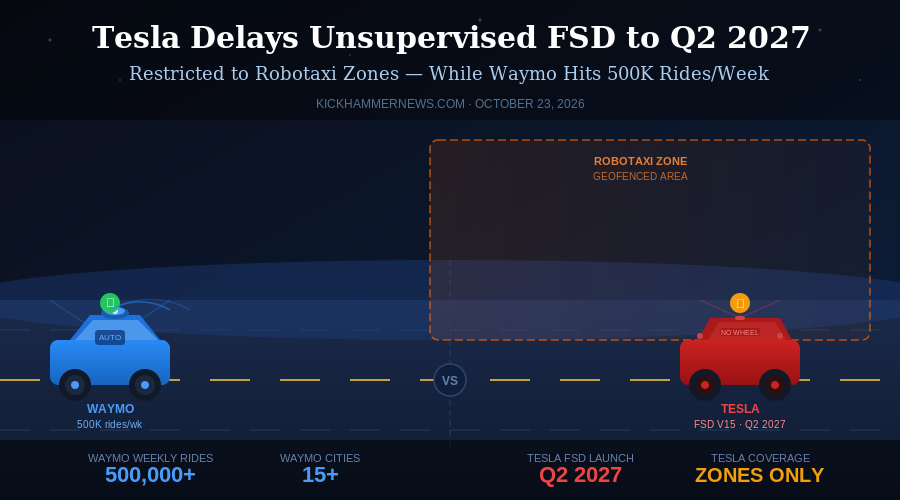
On October 21, Tesla confirmed what analysts had suspected for months: unsupervised FSD — the version where no human needs to monitor the road — will not reach customer cars until Q2 2027 at the earliest. The prior public timeline had pointed vaguely to “late 2026.” The new date is the version that ships with FSD V15, a complete architectural overhaul the company describes as a ground-up rewrite of the perception and planning stack.
But the delay isn’t the real headline. The fine print is.
When unsupervised FSD does arrive for customer-owned vehicles, it will operate only inside designated Robotaxi zones — geofenced geographic areas where Tesla has mapped every lane, intersection, curb cut, and traffic pattern to a level of precision that general public roads don’t yet have. Customers who paid $8,000 for the Full Self-Driving package — or $99 per month on the subscription plan — are getting a capability that works in Austin, and parts of the Bay Area, and a handful of other approved corridors. Outside those zones: human supervision required, same as today.
To put a finer point on it: Tesla is still planning to sell the Cybercab — a purpose-built vehicle with no steering wheel and no brake pedal — to retail customers in 2026. But the software that would make a steeringless car safe is not arriving until the middle of next year, and even then, only within pre-approved areas. The company insists this is a staged, responsible rollout. Critics, including several prominent members of the National Highway Traffic Safety Administration’s advisory panel, have suggested it is a hardware-software timing mismatch with meaningful safety implications.
Tesla has not publicly addressed how Cybercab customers are expected to use a car without a steering wheel in a zone where unsupervised operation isn’t yet certified.
What FSD V15 Actually Is
V15 represents the most significant software overhaul in Tesla’s self-driving history. Earlier versions of FSD — including the V12 series that brought end-to-end neural network architecture — still relied on a hybrid system: some explicit rule-based logic for handling edge cases, layered over a learned model for routine driving. V15 eliminates most of the rule-based scaffolding entirely.
The system now runs a single unified transformer model that ingests the full sensor stream — eight cameras, ultrasonic sensors, and occupancy network data — and produces steering, throttle, and braking outputs as tokens, not as classical control values. Tesla engineers describe this internally as a “driving language model”: instead of a traditional control loop, V15 outputs sequences of vehicle commands the way a language model outputs words.
The vision-language-action architecture (sometimes called VLA in the research community) is the same general approach that Google DeepMind’s Gemini Robotics 2 uses and that several of the leading humanoid robot labs have converged on. Tesla’s application of it to a vehicle with a 50-mph highway case and a four-year accumulated fleet dataset gives it a meaningful real-world training advantage over research teams working in simulation.
V15 has logged 380,000 cumulative miles in unsupervised internal testing on Hardware 4 vehicles — primarily modified Model Y units operating in Austin’s Robotaxi fleet. The internal safety metrics Tesla has shared with regulators reportedly show a substantial improvement in disengagement rate per mile over V13 and V14. Independent verification is not yet available.
Meanwhile, Waymo Is Running a Business
The contrast with Waymo this week is striking. While Tesla announced a delay, Waymo announced a milestone.
The Alphabet subsidiary confirmed it is now handling more than 500,000 paid rides per week across its commercial fleet — a figure that has doubled in under twelve months. The company currently operates in 15 U.S. cities, with San Diego, Las Vegas, Tampa, and Denver among the most recent additions. A co-CEO announcement in February outlined a path to one million weekly rides by end of 2026; that target now appears achievable, though the company hasn’t provided a revised estimate.
Waymo’s growth is happening at a clip that forces a re-evaluation of the competitive landscape. At a $126 billion valuation after its February 2026 funding round, it is the most valuable self-driving company in the world by a significant margin. Tesla has not disclosed a comparable standalone valuation for its autonomy division, partly because the full-stack FSD business is still pre-revenue as a standalone product.
The fundamental approaches of the two companies have diverged significantly. Waymo uses a sensor-rich, LiDAR-plus-camera stack and builds centimeter-precision HD maps of every operating area before launch. This is slower and more expensive to scale — each new city requires months of dedicated mapping and validation — but it produces a system that regulators have found consistently auditable. Tesla uses cameras only, with no LiDAR, and relies on its fleet learning to handle novel situations through sheer volume of exposure.
Both approaches work. Neither is obviously superior at scale. But Waymo is already generating commercial revenue in fifteen cities while Tesla’s commercial operation remains confined to a single Robotaxi pilot in Austin with a fleet numbered in the hundreds, not thousands.
The Regulatory Picture
The Robotaxi zone limitation Tesla announced this week is not purely a technical decision. The National Highway Traffic Safety Administration and several state DMVs have been in active dialogue with Tesla about the scope of any unsupervised FSD certification. California’s Department of Motor Vehicles, which regulates autonomous vehicle deployment in the state, requires a separate certification process for driverless commercial operation distinct from the supervised FSD product. Arizona, where Tesla has also sought approval, has a lighter regulatory framework but still requires demonstrated safety data.
By limiting initial unsupervised deployment to geofenced zones with extensive prior mapping and testing data, Tesla is presenting regulators with a narrower, more auditable scope — a strategy that mirrors what Waymo did in Phoenix and San Francisco before receiving broader commercial permits. The difference is that Waymo built its regulatory credibility over seven years of incremental expansion, while Tesla is attempting to compress that timeline significantly.
Whether that compression is achievable is the central question in autonomous vehicle regulation right now. Advocates for faster deployment point to the 40,000 annual traffic fatalities in the United States and argue that a meaningfully safer autonomous system — even a geofenced one — should be certified and deployed as quickly as possible. Advocates for a slower approach argue that the failure modes of AI-driven vehicles in edge cases are still not well-understood, and that the cost of a high-profile fatality attributable to a prematurely deployed system could set the broader industry back years.
Tesla is betting it can satisfy both camps with a staged rollout that starts conservatively and expands as safety data accumulates. It has done something similar with Autopilot and earlier FSD versions — graduated the capability, gathered the data, expanded the envelope. The difference this time is that “unsupervised” means there is no human fallback. The stakes for each individual failure event are categorically higher.
What This Means for the Industry
The week’s two data points — Tesla’s delay and Waymo’s milestone — tell a consistent story: fully autonomous driving at scale is arriving, but it is arriving on a longer timeline and through more cautious pathways than the most optimistic forecasts suggested.
That’s not a failure. It may be the healthiest possible outcome for a technology that will eventually affect every person who uses a road. The AI driving these vehicles has improved dramatically, and V15 may well demonstrate in Q2 2027 that the performance bar needed for safe unsupervised operation has genuinely been crossed. Waymo’s 500,000 weekly rides represent a real proof of commercial viability that would have seemed implausible five years ago.
But the Cybercab situation — a steeringless vehicle sold into a market where the software enabling its most basic use case doesn’t yet exist in a certified form — is a genuine tension that Tesla will need to resolve publicly before Q2 2027. Customers who bought hardware for a promise are waiting. Regulators who approved hardware specifications are watching. And Waymo, carrying half a million passengers a week with no drama, is setting a reference standard that is harder to argue with every month.
Sources: Electrek (October 21, 2026), Drive Tesla Canada, Hoodline, InsideEVs, Citipen, ai2.work, Yahoo Finance, Waymo expansion reports.


