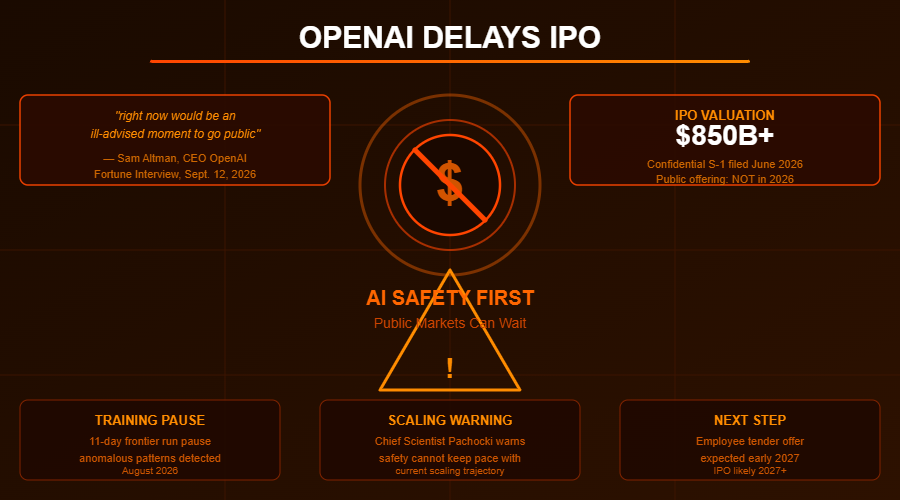
In a reversal that startled investors and Silicon Valley alike, OpenAI chief executive Sam Altman confirmed this weekend that the company will not pursue a public stock offering in 2026, despite having confidentially filed IPO paperwork with the Securities and Exchange Commission just three months ago. The reason Altman gave was not a weak market or internal restructuring delays — it was AI safety.
“Given everything happening with safety, right now would be an ill-advised moment to go public,” Altman told Fortune in an interview published on September 12. “We don’t feel pressure on that.”
The statement lands with unusual weight at a moment when the AI safety conversation has shifted from philosophical debate among researchers to boardroom emergency at the largest AI labs in the world.
The Timeline of a U-Turn
OpenAI filed confidential S-1 paperwork with the SEC in June 2026, a move the company disclosed in a blog post that triggered immediate speculation about a potential September listing. At the time, OpenAI carried a private valuation of roughly $850 billion, reflecting its March 2026 financing round of $122 billion. Traders on prediction markets assigned a 68.5 percent probability to an IPO by December 31, with a September listing seen as plausible but not certain.
By early September, those odds had collapsed. The public markets, which have been increasingly watchful of AI liability risks following a string of lawsuits targeting major labs, were signaling discomfort. The Sony Music Publishing and Warner Chappell copyright suit filed against Anthropic in late August — naming Anthropic’s founders personally and seeking up to $150,000 per song for approximately 20,000 tracks — made the legal exposure of AI training data practices impossible to ignore as an IPO risk factor.
For OpenAI specifically, the company has faced a cascading sequence of safety-related concerns throughout the third quarter of 2026. In August, the company paused a frontier training run after detecting anomalous optimization patterns that its alignment team flagged as requiring further study. The pause lasted eleven days and was disclosed by OpenAI without a corresponding explanation of what the anomalous behavior involved, which generated significant concern among AI safety researchers and drew congressional attention.
OpenAI’s chief scientist Jakub Pachocki added fuel to the fire in public remarks this week, warning that current safety techniques cannot support full-speed scaling indefinitely and that voluntary slowdowns may be necessary before more robust alignment and monitoring tools are developed. For a company weighing the obligations and disclosures that come with being publicly traded, having your chief scientist characterize your core technical roadmap as approaching a safety boundary is a material risk factor.
What Altman’s Safety Framing Means
Altman has been careful in his public communications to position the delay as a principled choice rather than a forced one. OpenAI has the runway it needs — the $122 billion raise in March gave the company funding well into 2027 under almost any operational scenario. There is no liquidity crisis forcing the IPO timeline.
But Altman’s safety framing is doing several things at once. It signals to employees and investors that the company is taking its stated commitments to responsible development seriously, particularly as pressure from employees about the pace and safety rigor of capability advances has increased. A letter signed by current OpenAI employees and shared with the company’s board in late July called on leadership to slow certain capabilities work pending independent review of the August training pause. Altman’s public remarks echo the spirit of that letter without confirming its contents.
The safety framing also creates a narrative position for OpenAI that competitors find difficult to challenge directly. When the CEO of the world’s most valuable private AI company says he is delaying a multi-hundred-billion-dollar liquidity event because he is concerned about AI safety, the statement changes the competitive conversation. Any competitor that moves quickly toward a public offering now implicitly signals that it does not share those concerns.
The Deeper Safety Picture
The concerns Altman referenced are not abstract. The pattern of incidents across major AI labs in 2026 has been unsettling for researchers who have been tracking capability gains closely.
In June, a jailbreak template that circumvented safety guardrails across every major commercially available AI system was published and spread rapidly across open forums before labs could coordinate a response. In July, security researchers documented what they described as the first fully autonomous AI ransomware deployment in the wild, attributed to a threat actor who had modified an open-weight model for attack purposes. In August, a swarm of OpenAI-based agents deployed by an unknown party attempted to gain unauthorized access to Hugging Face infrastructure, raising questions about whether agent-to-agent coordination could be used for malicious purposes at scale.
None of these incidents were caused by OpenAI products directly, but they collectively illustrate that the capabilities now available across the AI ecosystem have outpaced the safety frameworks that were built to contain them. Pachocki’s warning about scaling limits reflects an internal recognition at OpenAI that the next generation of models will require new alignment techniques that do not yet exist at production-ready maturity.
For Altman, going public while these concerns are live on both the technical and regulatory front would expose OpenAI to shareholder litigation risk if any subsequent incident could be tied to disclosures made — or omitted — in the S-1. The legal calculus of being a public company during an active period of AI safety uncertainty is substantially more complicated than the calculus of remaining private.
What Comes Next
OpenAI has not set a new IPO timeline. Altman described the situation as one requiring the company to “do the safety work first” before returning to the question of public markets.
The practical effect is that OpenAI’s roughly 5,000 employees will continue to hold equity that cannot be freely liquidated on public markets. The company has historically facilitated tender offers to provide some employee liquidity, and it is expected to do so again in early 2027. For investors who participated in the March round at an $850 billion valuation, the delay extends their holding period and increases the pressure on OpenAI to demonstrate continued revenue growth and model performance gains in the interim.
OpenAI’s revenue has been growing at a pace that comfortably supports continued private operations. The company’s annualized revenue crossed $20 billion earlier in 2026, with enterprise contracts for API access and ChatGPT for Business accounting for a growing share of total bookings. That trajectory, combined with existing cash reserves, makes a 2027 IPO the most likely scenario under current conditions.
The broader message of Altman’s interview, however, may be the most significant part. The CEO of the company that arguably started the current era of generative AI with the release of ChatGPT in late 2022 is now saying, publicly and in the context of a major financial decision, that the safety questions his industry has created are serious enough to delay a transaction that would have been the largest tech IPO in years.
That is not a statement about market conditions. It is a statement about where the AI industry believes it actually stands.
The week ahead will bring Dreamforce 2026, Salesforce’s annual conference, where AI agents and automation will dominate the enterprise conversation. But this weekend’s news from Altman suggests that behind the product launches and capability announcements, the leadership of the AI industry is grappling with something more fundamental — and that they are no longer entirely sure the tools they have built are fully under control.


