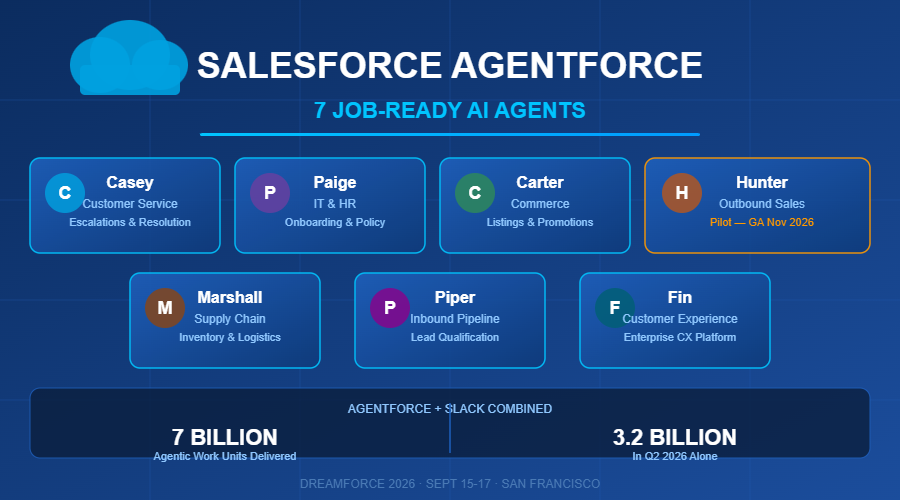
The enterprise software market received a jolt this week when Salesforce unveiled seven purpose-built “job-ready” Agentforce AI agents, each designed to own an entire business function rather than assist with isolated tasks. The announcement, timed to arrive just days before Dreamforce 2026 in San Francisco, signals that the era of generic AI chatbots inside corporate software is giving way to something far more ambitious — autonomous digital workers with proper job titles and measurable outputs.
Meet the Seven
Salesforce introduced the agents under individual names, a deliberate branding choice that underscores the company’s positioning of these systems as colleagues rather than features. Casey handles customer service escalations, routing, and resolution without requiring a human agent to intervene on routine cases. Paige manages IT and HR workflows, from onboarding ticket queues to policy queries. Carter takes ownership of commerce operations, dynamically adjusting product listings, promotions, and order flows. Hunter is aimed squarely at outbound sales, prospecting accounts and drafting outreach sequences. Marshall runs supply chain logistics, monitoring inventory signals and vendor commitments. Piper manages inbound pipeline generation, qualifying leads before they ever reach a human sales rep. Fin, the newest addition following Salesforce’s acquisition of the Fin platform on September 10, takes on broad customer experience responsibilities for enterprise clients.
Most agents are generally available as of this week. Hunter remains in pilot, with a general availability target of November 2026.
Why “Job-Ready” Matters
The framing of “job-ready” is not marketing fluff. It reflects a genuine shift in how enterprise AI is being packaged and sold. First-generation AI tools inside enterprise software required significant configuration by administrators, integration work by IT teams, and careful prompt engineering by power users. The results were often inconsistent and difficult to audit.
Job-ready agents come pre-trained on role-specific knowledge bases, connected to the relevant Salesforce data objects out of the box, and governed by the company’s new Trusted Enterprise AI Harness — a governance layer that sits across all running agent platforms in an organization and enforces compliance rules, audit trails, and escalation protocols. For enterprise buyers who have been reluctant to give AI systems meaningful autonomy, this governance layer addresses one of the core objections: that there was no reliable way to know what the agent was doing or why.
The numbers Salesforce published alongside the launch are notable. Agentforce and Slack have collectively delivered 7 billion Agentic Work Units — the company’s metric for discrete AI-completed tasks — with 3.2 billion of those in the second quarter of 2026 alone. That represents a meaningful acceleration, suggesting that early enterprise adopters have moved well past pilot stages.
Dreamforce as a Platform for a Bigger Story
The timing relative to Dreamforce 2026, which runs September 15 through 17 at the Moscone Center in San Francisco, is not coincidental. Salesforce has historically used its flagship customer conference to introduce major product directions, and this year the company is clearly framing itself as the dominant platform layer for enterprise agentic AI. With over 40,000 attendees expected, Dreamforce gives Salesforce the ability to move these announcements from press releases to live demonstrations in front of buyers who hold the budget.
Industry analysts attending the event have indicated that the Trusted Enterprise AI Harness is likely to attract substantial attention from compliance and legal teams inside financial services and healthcare companies — two sectors where AI governance has been a major adoption barrier. If Salesforce can credibly position the Harness as an off-the-shelf solution to regulatory audit requirements, the total addressable market for Agentforce expands considerably.
Competitive Context
Salesforce is not alone in moving toward named, role-specific agents. Microsoft has been embedding Copilot agents across its Microsoft 365 suite, with named agents for HR, finance, and project management appearing in preview since early 2026. ServiceNow has built similar role-based agents into its Now Platform. SAP has been rolling out AI agents across its ERP modules since its Sapphire conference in May.
What distinguishes Salesforce’s approach is the depth of CRM integration. Because Salesforce owns the authoritative system of record for customer data, contacts, pipeline, and service history at most large companies, its agents have access to richer contextual data than competitors deploying general-purpose agent frameworks. Hunter, for example, doesn’t just draft an outreach email — it can evaluate the full account history, prior deal cycles, and existing relationship signals before composing a single word.
The acquisition of Fin adds a dimension that competitors will find difficult to replicate quickly. Fin’s enterprise customer experience platform brought with it a trained model fine-tuned on billions of customer service interactions across industries. Integrating that into the Agentforce stack means the new Fin agent arrives with domain knowledge that would take competitors months to develop from scratch.
What This Means for Enterprise Workers
The question most conspicuously absent from Salesforce’s announcement materials is what happens to the human workers whose roles now overlap with these agents. Salesforce has been careful to frame Agentforce as augmenting human teams rather than replacing them, a position every enterprise AI vendor currently holds publicly. The reality being played out at early adopter companies is more complex.
At companies where Agentforce has been running in production for multiple quarters, the pattern emerging is that routine task volumes handled by human agents have dropped sharply, while the complexity of tasks that do reach humans has increased. Whether organizations respond by redeploying those workers to higher-value activities or by reducing headcount depends on factors outside Salesforce’s control — corporate strategy, labor market conditions, and the regulatory environment in each country.
The European Union’s AI Act enforcement framework, which entered its transparency and disclosure phase in mid-2026, requires companies deploying high-impact AI systems in customer-facing roles to notify customers that they are interacting with an AI and to maintain human escalation pathways. Salesforce has built these requirements into the Trusted Enterprise AI Harness, positioning compliance as a built-in feature rather than an afterthought.
The Long Horizon
Alongside the seven named agents, Salesforce also announced Long-Horizon Runtime, a new execution layer that allows Agentforce agents to maintain persistent context across sessions spanning hours or days. Traditional AI agent implementations lose context between sessions, requiring users to re-establish background and objectives each time they engage. Long-Horizon Runtime allows Hunter, for example, to continue tracking a deal cycle across weeks without requiring a human to re-brief it on the account situation.
This capability, while technically underpinned by advances in context window management and memory architectures, has practical implications that enterprise buyers will find immediately legible. An AI agent that can maintain continuity across a multi-month enterprise sales cycle behaves more like a colleague and less like a search engine.
The enterprise AI market is moving fast enough that Salesforce’s lead in CRM-integrated agents could be measured in quarters rather than years. But this week’s launch represents the clearest articulation yet of what job-specific agentic AI looks like when deployed at scale inside a Fortune 500 company. Whether the remaining competitors can match the depth of data integration Salesforce brings to the table will define who wins the next wave of enterprise software contracts.
As Dreamforce 2026 opens its doors on Monday, the central question on the expo floor won’t be whether enterprises should adopt AI agents. That question has been settled. The question now is which platform’s agents they trust to actually do the job.


