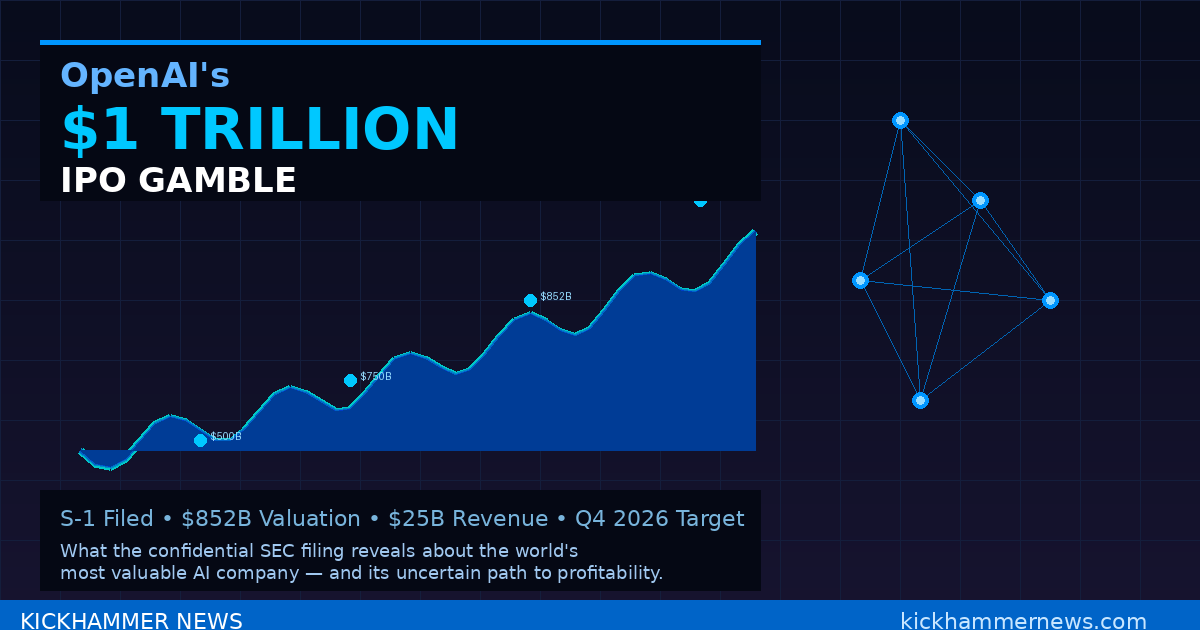
When OpenAI quietly submitted its confidential S-1 registration statement to the Securities and Exchange Commission on June 8, it wasn’t just filing paperwork. It was firing a starting gun on what could become the largest and most consequential technology IPO in history — a moment that will force Wall Street, regulators, and the broader public to put a definitive price tag on the artificial intelligence revolution.
The numbers are staggering, the risks are real, and the path to a trillion-dollar public valuation is anything but certain.
From Nonprofit Lab to Mega-Cap Aspirant
OpenAI’s origin story has always been a strange one for a company of its ambitions. Founded in 2015 as a nonprofit research lab with a mission to develop artificial general intelligence for the benefit of humanity, it spent years burning through philanthropic donations before pivoting toward a capped-profit structure — one where investors could earn no more than 100 times their money back.
That structure, which looked quirky when OpenAI was a niche research organization, became a serious legal and financial obstacle once the company started generating billions in revenue and needed to court public markets. Going public requires uncapped upside for shareholders — a non-negotiable expectation of securities law and investor psychology alike.
So OpenAI did what any aspiring trillion-dollar corporation does: it restructured. Earlier this year the company completed its conversion to a standard Delaware C-Corporation, severing the governance ties that had given its nonprofit board unusual authority over strategic decisions. The same board that fired and reinstated CEO Sam Altman in the drama of November 2023 no longer holds veto power over the company’s commercial future.
That restructuring cleared one major hurdle. The S-1 filing is the next.
The Financial Picture: Revenues Up, Losses Bigger
The headline revenue figures are undeniably impressive. OpenAI is generating roughly $25 billion in annualized revenue as of early 2026, up from $20 billion at the end of 2025. The company is adding approximately $2 billion in monthly revenue — a growth rate that analysts note is four times faster than Alphabet and Meta were growing at comparable stages of their corporate lives.
The private market has already rewarded this trajectory. OpenAI’s most recent fundraising round, a $122 billion infusion closed in March 2026, pegged the company’s valuation at $852 billion. Its IPO target of up to $1 trillion would represent only a modest premium over that figure — modest by tech IPO standards, anyway.
But the losses tell a more complicated story.
Non-GAAP figures cited in most coverage put OpenAI’s projected 2026 losses at around $14 billion. GAAP accounting tells a different story: independent analysts at FutureSearch estimate actual GAAP losses at $25 to $26 billion for the year — roughly 80 percent higher than the number making headlines. Cash burn for 2026 is projected at around $27 billion. HSBC has estimated a cumulative funding gap of $207 billion by 2030 if current trajectory continues, meaning the company would need to raise massive additional capital even after going public.
Put plainly: OpenAI is spending roughly $1.22 for every dollar it earns, and the gap between revenues and costs is not closing quickly.
The Competition Is Filing Too
OpenAI is not the only AI company preparing for Wall Street. Anthropic — the safety-focused AI lab founded by former OpenAI executives and currently home to the Claude family of models — filed its own confidential S-1 approximately one week before OpenAI’s filing became public. The timing is no coincidence.
Both companies face a narrowing window. The AI investment cycle has moved from euphoria toward a more measured, show-me phase. Institutional investors who were willing to write enormous checks based on the promise of transformative technology are now asking harder questions about unit economics, competitive moats, and paths to profitability. An IPO, with its required disclosure of audited financials and material risks, will put those questions front and center for the first time.
The competitive landscape has also tightened. Google’s Gemini has grown its share of the AI assistant market from roughly 5.7 percent to 21.5 percent over the past twelve months, while ChatGPT’s dominance has slipped from 86.7 percent to 64.5 percent. OpenAI remains the market leader by a significant margin, but the trend line is moving in the wrong direction — and that is exactly the kind of data that prospectus readers will scrutinize.
Legal Clouds and Governance Questions
Sam Altman has repeatedly said that a sub-trillion-dollar IPO valuation is a “nonstarter.” Yet the legal and governance risks in OpenAI’s past make that confidence a trickier sell than it sounds.
The most prominent legal obstacle — Elon Musk’s lawsuit alleging that OpenAI had abandoned its nonprofit mission — was dismissed by a jury on statute of limitations grounds just two days before the confidential filing became public. The timing was fortunate. But it did not eliminate OpenAI’s broader legal exposure.
The company faces ongoing copyright litigation from publishers, authors, and content creators alleging that its models were trained on protected material without authorization. Legal analysts estimate total settlement exposure across active cases at between $500 million and $5 billion, with the New York Times case carrying the largest variable. A significant adverse judgment in any of these suits could reshape the economics of the business.
Goldman Sachs and Morgan Stanley are leading the underwriting. A roadshow is expected in late August or early September, with the listing targeting Q4 2026 — though reports surfaced this week that OpenAI is also considering delaying to 2027 if market conditions don’t cooperate.
What the IPO Actually Means
Whether OpenAI reaches a trillion-dollar market cap on day one or not, the act of going public will reshape the company and the industry around it.
Disclosure requirements will force OpenAI to publish the detailed financials, risk factors, and operational metrics that private companies have kept hidden. That transparency will give competitors, regulators, and the AI research community a far clearer picture of where the frontier actually is — and what it costs to maintain a position there.
For enterprise customers, an IPO signals permanence. Corporations integrating AI deeply into their workflows need confidence that their vendors will exist in five years. A successful public listing converts OpenAI from a well-funded startup into a publicly accountable institution with the capital markets and shareholders standing behind it.
And for the broader AI industry, OpenAI’s IPO will function as a referendum. If public investors are willing to underwrite a loss-making AI company at a trillion-dollar valuation on the strength of its revenue growth and technological leadership, it signals that the AI investment cycle has years left to run. If the IPO stumbles — if the roadshow meets skepticism, if the pricing requires painful concessions — it will recalibrate expectations across the entire sector.
Sam Altman is betting that the world is ready to pay up for the future he is building. In a few months, the public markets will answer.
Sources: Fortune, CNBC, Yahoo Finance, FutureSearch, Investing.com, MindStudio, Technerdo


