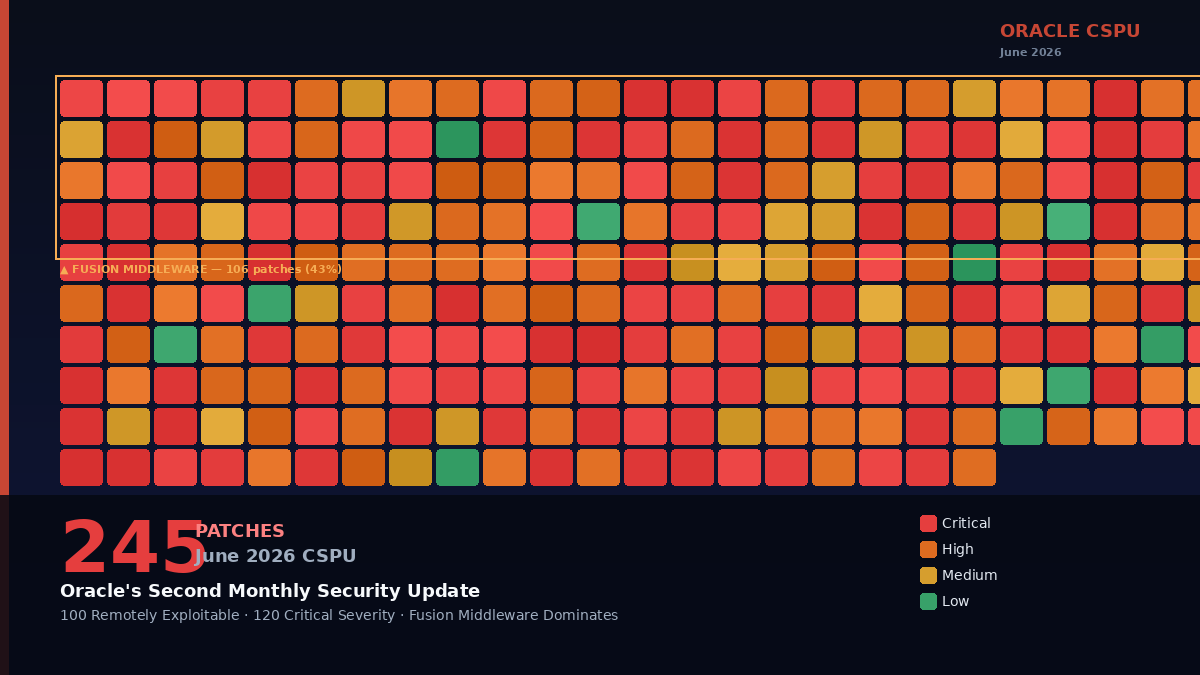
Oracle has released its June 2026 Critical Security Patch Update (CSPU), and the numbers are staggering: 245 new patches covering 11 product families, with more than 100 of them landing squarely in Oracle Fusion Middleware. This marks the second time Oracle has issued its newly introduced monthly CSPU format — and the company is wasting no time proving that the accelerated cadence was long overdue.
A New Cadence, A New Scale
When Oracle announced earlier this year that it would supplement its traditional quarterly Critical Patch Updates with monthly security releases, the enterprise software world took notice. The first monthly CSPU, released in May, resolved 77 vulnerabilities — a respectable opening act. The June edition, however, is a different beast entirely.
245 patches. Roughly 120 vulnerabilities carrying a “critical” CVSS severity rating. And of those, fully 100 can be exploited remotely without any authentication whatsoever. This is not a routine maintenance release; it is a concentrated effort to close a sprawling attack surface that has been widening across Oracle’s product portfolio for years.
Security teams responsible for Oracle environments should treat this update with the same urgency they would a zero-day disclosure. The sheer volume of remotely exploitable, unauthenticated attack paths means that unpatched systems are essentially open doors for opportunistic threat actors.
Fusion Middleware Takes Center Stage
Oracle Fusion Middleware accounts for 106 of the 245 patches — a staggering 43.3% of the entire update. The vast majority of those fixes are rated “critical” or “high” severity. Fusion Middleware underpins some of Oracle’s most broadly deployed enterprise software, including Oracle WebLogic Server, Oracle SOA Suite, Oracle HTTP Server, and Oracle Business Intelligence. It is, in many organizations, the connective tissue that links dozens of enterprise applications together.
When Fusion Middleware has a vulnerability, the blast radius is wide. A single unpatched WebLogic instance can serve as a pivot point into internal systems, often allowing attackers to move laterally with minimal friction. The concentration of fixes in this product family is a signal that Oracle’s internal security auditors have been conducting deep reviews — and finding a significant backlog of issues that need resolution.
The E-Business Suite family also received substantial attention, accounting for 55 patches, or 22.4% of the total. Oracle E-Business Suite remains a cornerstone of large enterprise operations — financial management, supply chain, HR — and its security posture directly affects the integrity of critical business data.
The PeopleSoft Shadow
Looming over this CSPU is the ongoing saga of CVE-2026-35273, a remote code execution vulnerability in Oracle PeopleSoft Enterprise PeopleTools that has been actively exploited in the wild. Researchers at Google Threat Intelligence Group and Mandiant confirmed in June that ShinyHunters, a prolific cybercrime and extortion group, used CVE-2026-35273 as a zero-day to compromise more than 100 organizations globally — with 68% of victims concentrated in the higher education sector.
The June CSPU advisory references CVE-2026-35273, and Oracle has urged customers to apply the patch immediately. What the company has notably not done is formally acknowledge in-the-wild exploitation in its advisory documentation — a pattern that has drawn criticism from the security research community, which argues that transparent disclosure of active exploitation is essential for prioritizing patching efforts.
For Oracle customers still working through remediation, the message from the vendor is blunt: “Oracle continues to periodically receive reports of attempts to maliciously exploit vulnerabilities for which Oracle has already released security patches. In some instances, it has been reported that attackers have been successful because targeted customers had failed to apply available Oracle patches.”
Patch failures, in other words, are on the customer. Oracle’s stance has always been that it provides the fix; deployment is a customer responsibility.
What the Monthly Cadence Means for Enterprise Teams
The shift to monthly CSPUs is both a blessing and a burden for enterprise security teams. The upside is obvious: critical vulnerabilities get addressed faster, reducing the window of exposure. Under the old quarterly model, a critical flaw discovered in October might not receive an official patch until January — a three-month window that threat actors were happy to exploit.
The downside is the operational overhead. Patch management in large Oracle environments is rarely simple. Fusion Middleware stacks are notoriously complex to update without regression testing. EBS patches require careful sequencing and often involve extended maintenance windows. Organizations that were already struggling to keep up with quarterly patches now face a 12-times-per-year rhythm that demands a fundamentally different approach to vulnerability management.
The enterprises best positioned to handle this new cadence are those that have invested in automated patch testing pipelines, infrastructure-as-code practices for Oracle environments, and dedicated vulnerability management programs. For organizations still relying on manual patch processes, the monthly CSPU may create a new category of technical debt — the “lag stack” of patches that accumulate faster than teams can deploy them.
The Broader Context: Oracle’s Security Transformation
Oracle’s decision to move to monthly security updates reflects a broader recognition that enterprise software vendors can no longer afford a slow, predictable patch cycle in an era of rapid vulnerability weaponization. The average time-to-exploit for known vulnerabilities has collapsed from weeks to days as AI-assisted exploit development becomes more accessible to threat actors.
This CSPU also arrives in the context of Oracle’s growing cloud ambitions. With Oracle Cloud Infrastructure (OCI) handling increasingly sensitive workloads — particularly after Oracle’s high-profile cloud deals with major enterprises and government entities — any vulnerability in Oracle’s middleware layer carries cloud-scale risk. A compromised Fusion Middleware instance sitting between an on-premises ERP system and OCI could become a bridge for attackers into both environments simultaneously.
Security researchers have noted that the June CSPU’s Fusion Middleware focus is particularly significant for organizations running hybrid Oracle deployments — those with one foot on-premises and one foot in OCI. In these configurations, the middleware layer is both the most critical integration point and often the least rigorously hardened component.
What Organizations Should Do Now
For Oracle customers, the immediate action is clear: assess which of the 245 patches apply to your environment and prioritize accordingly. Start with the 100 remotely exploitable, unauthenticated vulnerabilities — these represent your highest-urgency risk. Any Fusion Middleware components exposed to the internet or accessible from partially-trusted network segments should be treated as top priority.
For organizations running PeopleSoft, CVE-2026-35273 has already been exploited at scale and should have been patched as an emergency measure before this CSPU even arrived. If it hasn’t been, that is the single most urgent action item on the security agenda today.
Beyond immediate remediation, the monthly CSPU era demands a strategic response. Security teams should review their Oracle patch management workflows, consider investing in Oracle-specific vulnerability scanning tools, and establish clear patch SLAs that differentiate between critical, high, and medium severity findings. The quarterly model allowed for leisurely triage. The monthly model does not.
Oracle’s June 2026 CSPU is a reminder that enterprise software security is not a compliance checkbox — it is an ongoing operational discipline. With 245 patches delivered in a single monthly release, the second act of Oracle’s new cadence is a clear signal: the era of slow, predictable patching is over.


