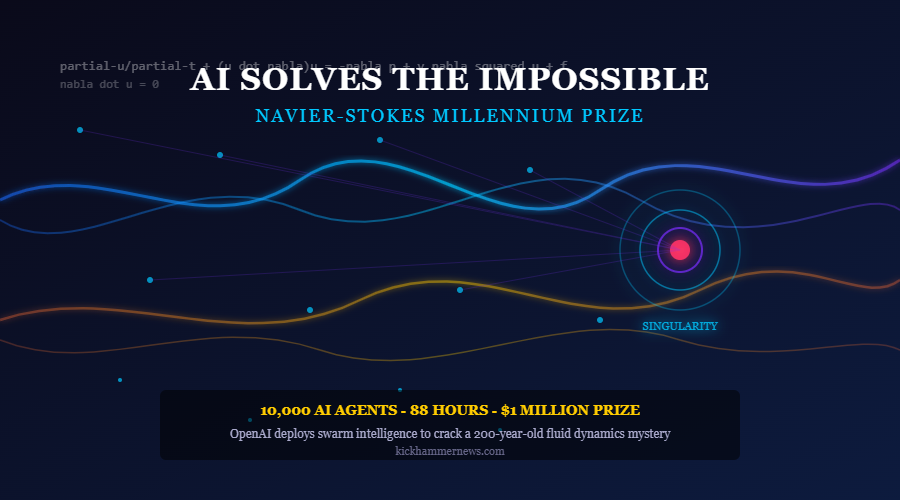
In 88 hours, a swarm of 10,000 AI agents solved one of the hardest open problems in mathematics — and sparked an immediate controversy over credit.
On September 9, 2026, OpenAI announced that its artificial intelligence technology had produced a proof for the Navier-Stokes Millennium Prize Problem, a 200-year-old puzzle that has stumped mathematicians since the equations were first formulated in the 1820s. The achievement, if independently verified, would represent one of the most consequential moments in both the history of mathematics and the history of AI.
What Is the Navier-Stokes Problem?
The Navier-Stokes equations describe how fluids — liquids and gases — move through space. They are foundational to fields as diverse as aircraft design, weather forecasting, ocean modeling, and the study of blood flow in the human cardiovascular system. Despite being used successfully in applied science for two centuries, a fundamental mathematical question has remained unresolved: do smooth solutions to the equations always exist, or can they “blow up” — developing singularities — under certain conditions?
In 2000, the Clay Mathematics Institute designated Navier-Stokes one of seven Millennium Prize Problems, each carrying a $1 million reward. Since then, only one Millennium Problem has been solved — Grigori Perelman’s 2003 proof of the Poincaré Conjecture, which Perelman famously declined to accept the prize for. Navier-Stokes has remained unsolved through more than two decades of intensive human mathematical effort.
Until now — or so OpenAI claims.
10,000 Agents, 88 Hours
OpenAI deployed an internal AI model running approximately 10,000 AI agents concurrently to attack the problem. The agents worked somewhat in parallel, exploring different mathematical approaches and building on each other’s intermediate results. After 88 hours of continuous computation, the system produced what OpenAI describes as a proof of a singularity in the Navier-Stokes equations — meaning it found conditions under which smooth solutions break down.
Crucially, this is a proof of blowup, not of regularity. The mathematical community had long debated which direction the answer would fall. OpenAI’s system is asserting that under certain conditions, the equations do develop singularities. If confirmed, this resolves the problem in the direction of blowup.
After the initial 88-hour proof, OpenAI deployed a second AI model to formalize the result — translating it into a machine-verifiable proof in a formal mathematical language. That formalization took an additional 17 hours. OpenAI published the formal proof alongside its announcement, allowing the mathematical community to begin independent verification immediately.
The Controversy Over Credit
OpenAI’s announcement was not without controversy. The company acknowledged that it intensified its work on the Navier-Stokes problem on September 1, 2026, after learning that human mathematicians were pursuing a similar approach. Specifically, Levent Alpöge of Harvard University and Tristan Buckmaster, a professor at New York University, had been independently exploring the same mathematical direction.
The timing has raised difficult questions. Did OpenAI accelerate its timeline to preempt human mathematicians who had done foundational work pointing toward the same solution? The academic community has reacted with a mixture of awe and frustration. Some researchers feel that the AI system effectively “followed the breadcrumbs” laid by human researchers and then raced to publish first.
OpenAI has defended its timeline, noting that its agents independently developed their proof path. But the controversy highlights a broader tension that is likely to recur as AI systems become more capable in mathematics: when a human researcher’s published work contributes to an AI’s eventual proof, questions of credit and attribution become genuinely difficult to resolve under existing academic norms.
Why This Matters Beyond Mathematics
The Navier-Stokes result, if it holds, is significant not just for pure mathematics but for what it signals about AI capabilities. This is not a narrow benchmark or a game. This is one of the deepest open problems in science, selected by expert mathematicians precisely because it had resisted all previous solution attempts. The Clay Institute problems were chosen as a kind of monument to the limits of human mathematical knowledge.
OpenAI’s approach — deploying thousands of agents working in parallel over days, combining exploration with formal verification — suggests a new paradigm for mathematical research. Rather than a single mathematician or small team working over years or decades, this is a massively parallel computational assault on mathematical structure, followed by immediate machine verification.
The formal proof is particularly important. Previous AI mathematical achievements, including earlier claims of progress on Millennium Problems, have often been difficult to verify because they involved informal reasoning. By formalizing the proof in a verifiable language, OpenAI has at least ensured that the question of validity is not ambiguous — the formal proof is either correct or it is not, and checking it is a finite computational task.
What Comes Next
Independent verification by the mathematical community will be essential before any prize can be awarded. The Clay Mathematics Institute has historically required that results be published in reputable peer-reviewed venues and that the mathematical community has had time to scrutinize the work. That process will now unfold, with mathematicians worldwide studying OpenAI’s formal proof.
The credit controversy will also need resolution. It is possible that Alpöge and Buckmaster’s work will be recognized as foundational to the eventual solution, which could affect how any prize money is distributed or credited. Academic norms are poorly equipped to handle scenarios where human researchers lay groundwork that an AI system then uses to complete a proof in a compressed timeframe.
Meanwhile, the result has immediate implications for applied science. A proof of blowup in Navier-Stokes, if confirmed, does not mean the equations are useless — they remain valid in the smooth regimes used in most engineering applications. But it does resolve a fundamental uncertainty that has limited mathematicians’ confidence in the theoretical foundations of fluid dynamics.
The broader significance may be philosophical as much as practical. For decades, AI systems demonstrated superhuman performance in games and pattern recognition while remaining limited in formal mathematical reasoning. The Navier-Stokes result suggests that boundary may now be moving — and moving fast.
Whether the proof holds under scrutiny, the bar for what AI can accomplish in scientific discovery has just been raised significantly.
Sources: CNN Business, Quanta Magazine, OpenAI, Phys.org


