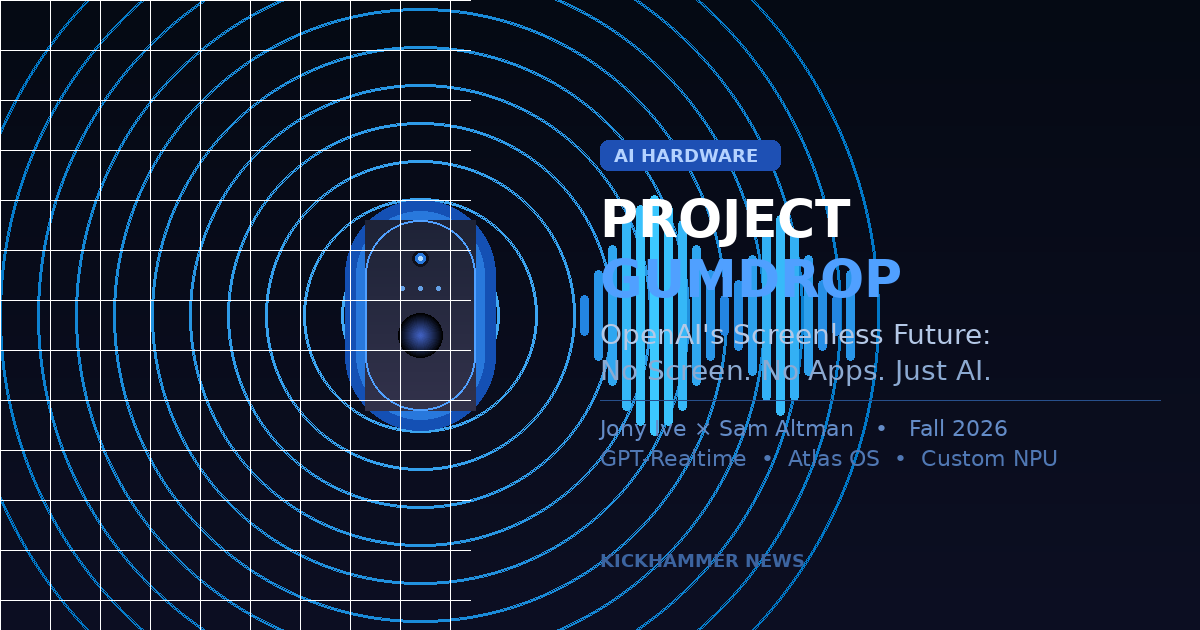
It has been nearly two decades since Steve Jobs walked on stage at the Macworld Conference and unveiled the original iPhone, declaring that Apple was reinventing the phone. Now, a new tech giant is making an equally audacious claim—that the smartphone era itself may be drawing to a close. OpenAI, best known for ChatGPT and the GPT series of language models, is preparing to launch its first hardware product: a pocket-sized, screenless AI device designed in partnership with legendary Apple designer Jony Ive, expected to ship in Fall 2026.
Internally codenamed Project Gumdrop, the device has set Silicon Valley buzzing with equal parts excitement and skepticism. Its core premise is radical: discard the screen entirely and replace the familiar tap-and-swipe interface with a voice-first, camera-equipped ambient computing companion. If OpenAI’s bet pays off, the gadget could represent the most significant shift in personal computing since the smartphone itself.
A Design Pedigree Unlike Any Other
The partnership between OpenAI CEO Sam Altman and Ive—the man who shaped the visual identity of the iMac, iPod, iPhone, and Apple Watch—was formalized when OpenAI acquired io Products, Ive’s hardware startup, in an all-stock deal valued at approximately $6.5 billion. Ive’s design firm, LoveFrom, has been deeply embedded in the project from the start, and early descriptions of the device suggest his signature obsession with tactile elegance is intact.
Project Gumdrop has been described as resembling a polished stone or high-end AI pen—small enough to slip into a pocket, with no display surface at all. Instead, the device is outfitted with high-fidelity microphones and a context-aware camera array that feeds a continuous stream of environmental data to its AI core. The philosophy is one of “calm computing”: rather than demanding your constant visual attention, the device listens, observes, and speaks—working in the background until needed.
The Technology Inside
At the heart of the device is OpenAI’s GPT-Realtime architecture, a unified speech-to-speech neural network that represents a fundamental departure from older voice assistant designs. Traditional voice interfaces—think Siri or Alexa—work by transcribing your speech to text, running it through a language model, and then converting the response back to audio. GPT-Realtime collapses this pipeline into a single end-to-end process, achieving sub-200ms latency that enables what early testers describe as genuinely natural conversation. The system supports full-duplex communication, meaning it can handle interruptions, detect emotional tone, and even respond while you’re still speaking.
To power this on a compact device, OpenAI has partnered with Broadcom to develop custom Neural Processing Units (NPUs) built specifically for the Gumdrop’s hybrid-edge architecture. Privacy-sensitive and low-latency tasks—like wake-word detection—are handled entirely on-device, while more complex reasoning is offloaded to OpenAI’s cloud infrastructure. The device will run a new AI-native operating system internally referred to as OWL (OpenAI Web Layer) or Atlas OS, in which the large language model functions as the kernel itself. Rather than opening apps, users interact with “Agentic Workspaces” where the AI navigates the web and third-party services in the background, surfacing results through voice.
This is not an assistant that lives inside your phone. It is designed to be a third computing platform—something that sits alongside, and eventually supplants, laptops and smartphones for the majority of daily tasks.
Why Now—and Why This Matters
OpenAI’s hardware ambitions are not emerging in a vacuum. The company has been quietly consolidating its audio engineering, research, and product teams over the past year, a structural shift that signaled to observers where its priorities were headed. Meanwhile, the broader AI hardware category has been struggling to find its footing. Humane’s AI Pin and Rabbit’s R1 both launched to significant hype and equally significant disappointment, hamstrung by overheating issues, clunky software, and a perceived lack of genuine utility beyond a smartphone.
OpenAI is betting that the difference lies in vertical integration. Rather than building a software wrapper around existing hardware, Project Gumdrop is designed from the silicon up, with custom NPUs, a purpose-built operating system, and a voice model that has been trained specifically for low-latency, high-fidelity audio interaction. The company is also courting developers to build for the OWL layer ahead of launch, with the goal of ensuring the device can handle complex real-world workflows—booking travel, managing calendars, drafting emails, summarizing meetings—from day one.
For Apple and Google, whose mobile operating system duopoly has generated trillions in platform value, the implications are serious. A device that bypasses the App Store economy entirely and routes user intent directly through an AI agent represents a fundamental threat to the app-centric model that has defined mobile computing since 2008.
Privacy in an Always-On World
The most significant question hanging over Project Gumdrop is not whether it can work—it is whether people will trust it. An always-on camera and microphone array raises obvious and legitimate privacy concerns. OpenAI has stated that the device will include hardware-level safeguards, including a dedicated low-power chip for local wake-word processing and Zero-Knowledge encryption modes designed to prevent raw audio and visual data from being transmitted without explicit user engagement.
Whether those assurances will satisfy a public that has grown increasingly wary of ambient surveillance is another matter. The irony of a screenless device is that users lose the visual feedback loop that reassures them an interaction is occurring on their terms. OpenAI will need to invest heavily in transparency mechanisms—visible indicators, granular privacy settings, and a demonstrable track record of responsible data handling—to build the trust that mainstream adoption requires.
The Bigger Picture
Step back from the technical specifications and the competitive dynamics, and what Project Gumdrop represents is a genuine philosophical wager about the future of the human-computer relationship. Altman and Ive have spoken publicly about their shared belief that smartphones, for all their utility, have created pathological relationships between users and their devices—endless notification loops, addictive scroll mechanics, and the steady colonization of attention.
The screenless device is, in their framing, an antidote: a computing experience defined by high-intent, voice-based interactions rather than the passive consumption that touchscreens enable. Done well, this vision is genuinely compelling. Done poorly, it risks becoming another expensive gadget that quietly gathers dust in a drawer alongside the AI Pin and the smartwatch you stopped wearing.
The stakes could not be higher. If OpenAI gets this right, Project Gumdrop may well be remembered as the moment the smartphone era ended. If it falls short, it will serve as a cautionary tale about the gap between a beautiful idea and a product that people actually want to live with. Either way, Fall 2026 is shaping up to be one of the most consequential product launches in the history of consumer technology.
Sources: The Information, TokenRing AI, JustDoers, builtin.com, MindStudio


