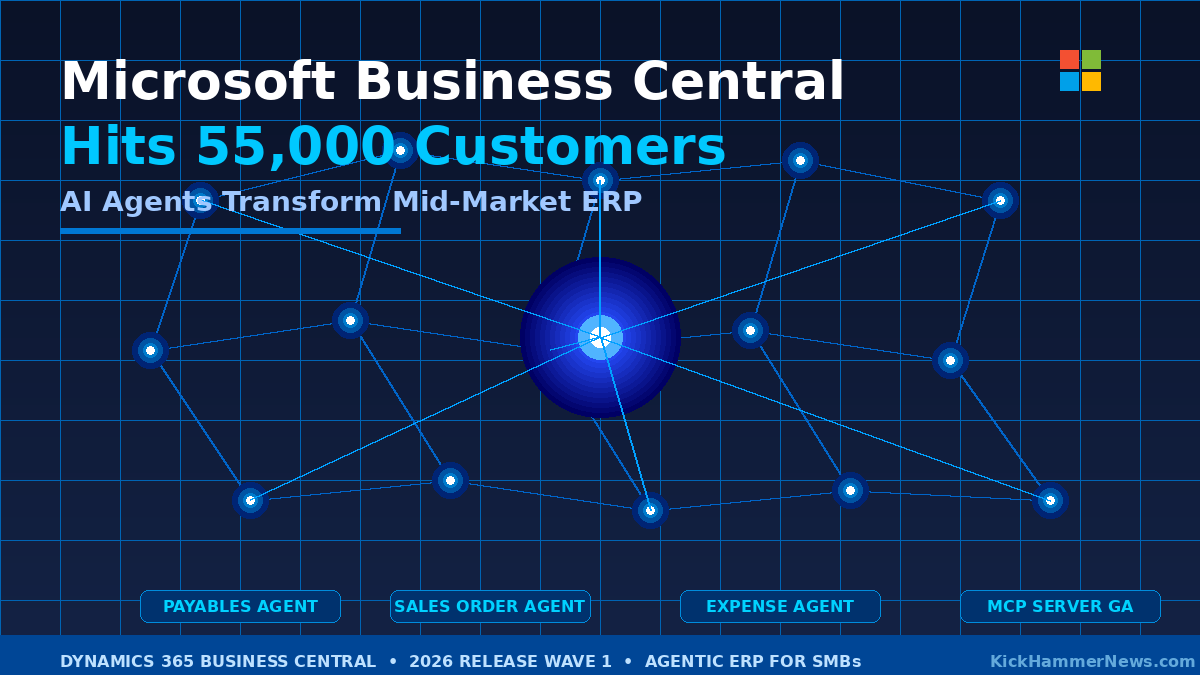
When Microsoft announced that Dynamics 365 Business Central had surpassed 55,000 customers at the Directions North America 2026 conference in late April, it was more than a growth milestone — it was a signal that the era of agentic ERP for small and mid-sized businesses has well and truly arrived. That figure, up from 50,000 just six months earlier, reflects a product that has found a compelling identity: a cloud-first ERP platform for the mid-market that is now aggressively deploying autonomous AI agents to automate the most time-consuming corners of business operations.
From Copilot Assistant to Agentic Operating Layer
For the past two years, Microsoft’s messaging around Business Central and AI centered largely on Copilot — a productivity assistant that helped users draft emails, generate summaries, and surface insights from within the ERP. Wave 1 of the 2026 release plan, rolling out from April through September 2026, marks a decisive architectural shift. Copilot is no longer just an assistant. It is now the backbone of an embedded agentic operating layer running across finance, supply chain, sales, and payables.
“The vision is a full pipeline of agents that coordinate, enrich, and generate — but with humans in the loop to steer and approve what agents do,” said Peter Borring, Business Central product manager at Microsoft, during his Directions North America session. That framing is important: Microsoft is pitching agentic ERP not as full automation, but as intelligent co-piloting where human judgment remains in the governance chain.
The Agents That Are Already Working
Two of Business Central’s flagship AI agents — the Sales Order Agent and the Payables Agent — are now generally available in every country and region where Business Central is deployed, making them the broadest rollout of embedded ERP agents in the mid-market to date.
The Payables Agent tackles one of accounting’s most universally despised tasks: vendor invoice processing. It monitors a designated mailbox, reads incoming invoice PDFs, extracts vendor details, matches them against purchase orders, and creates draft purchase invoices for human review. Rather than requiring staff to manually key in invoice data or chase down discrepancies, the agent applies accounting context and historical vendor patterns to interpret ambiguous documents. Organizations processing hundreds of invoices per month stand to reclaim meaningful hours every week. The agent is designed with auditability in mind — all drafts require human approval before posting, keeping the finance team firmly in control.
The Sales Order Agent takes natural-language instructions or incoming email orders and transforms them into complete sales documents. A customer emails in a purchase request with informal wording and an attached spec sheet; the agent interprets intent, checks inventory, and creates the sales order for review. For distributors and manufacturers handling high volumes of repeat orders, the impact on response time and order accuracy can be substantial.
Microsoft previewed a third agent at Directions North America: the Expense Agent, an upcoming addition that will handle expense report intake and categorization. No firm general availability date has been announced, but Borring described it as coming “soon,” placing it likely within the Wave 1 window.
Custom Agents Go Low-Code — And Go Live
Perhaps the most strategically significant Wave 1 development is the general availability, targeted for May 2026, of Business Central’s custom AI agent designer — a low-code, natural language interface that lets functional users and implementation partners build their own agents without deep developer resources.
The designer allows users to describe a workflow in plain language, prototype agent behavior visually, and deploy agents that operate within Business Central’s existing permission and governance model. Agent boundaries respect company, environment, and tenant isolation automatically, meaning a partner building a custom Payables Agent variation for a client in the food distribution industry doesn’t need to worry about agent activity crossing into other client environments.
This democratization of agent development is a significant differentiator for Business Central in the mid-market. Enterprise ERP platforms like SAP S/4HANA and Oracle Fusion Cloud have their own agentic AI ambitions, but they carry implementation complexity and licensing costs that put them out of reach for the 55,000-plus customers that Business Central now serves. Microsoft is betting that low-code agent design — combined with the familiar Microsoft 365 ecosystem — will keep mid-market IT teams from needing to build or buy elsewhere.
MCP Integration and the Broader Ecosystem Play
Wave 1 also brings general availability of the Business Central MCP server — an implementation of the Model Context Protocol that allows AI agents built in Microsoft Copilot Studio or third-party environments to interact with Business Central data and workflows through a governed, structured interface.
MCP availability is a significant move for the partner ecosystem. Independent software vendors and system integrators can now build agents that reach into Business Central from within Teams, Outlook, or external orchestration platforms without writing custom API integrations for every scenario. For organizations using Business Central alongside other Microsoft tools — and most do — MCP creates a unified connective tissue for cross-application agent workflows.
Combined with Immersive Home, a new adaptive workspace reaching general availability in Wave 1, users now have a single dashboard surfacing agent activity, pending approvals, task priorities, and workflow status across the ERP and connected Microsoft 365 apps. For mid-market finance and operations leaders who have long complained that ERP systems require too much context-switching to manage effectively, Immersive Home is a meaningful quality-of-life improvement built directly on agentic infrastructure.
The Competitive Picture
Business Central’s 55,000-customer milestone and its Wave 1 agentic push come at a moment when the mid-market ERP space is experiencing genuine disruption. SAP’s Autonomous Enterprise announcements at Sapphire 2026, Oracle’s Fusion Cloud 26B agentic ERP updates, and Workday’s expanding AI agent library are all targeting overlapping customer segments. The ERP software market is on track to reach approximately $106 billion in global spending in 2026, according to industry analysts, with agentic AI now a defining evaluation criterion for buyers.
For mid-market organizations, the evaluation question is shifting. It’s no longer which platform has the most modules, or which implementation partner has the most certified consultants. The question is: which platform can deliver autonomous agents that work reliably, respect business rules, and require minimal ongoing IT maintenance — while keeping accounting and operations teams in meaningful control of outcomes?
Microsoft’s answer in 2026 is a deepening bet on Business Central as an intelligent ERP that operates across the Microsoft cloud fabric most mid-market organizations already rely on. With 55,000 customers, a GA Sales Order Agent, a GA Payables Agent, an incoming Expense Agent, and a new low-code agent design environment, the platform has moved beyond the question of whether it can compete at the top of the mid-market — and is now making a serious case that it belongs there.
Sources: Directions North America 2026 coverage, MSDynamicsWorld.com | Dynamics 365 2026 Release Wave 1 Plan, Microsoft Learn | Dynamics 365 Wave 1 Puts Agentic AI at the Heart of ERP, ERP Today | Business Central 2026 Release Wave 1, ERP Software Blog | Cloud Wars: Microsoft Unveils Agentic AI Push