Oracle’s new hybrid appliance puts enterprise AI capabilities inside customer data centers — without the scale (or cost) of Exadata.
Oracle has long dominated the enterprise database market, but for years its cloud ambitions have created a tension for organizations that cannot move their most sensitive workloads off-premises. The company has had an answer for large-scale deployments — Exadata Cloud@Customer — but for the vast middle tier of enterprise IT, the choice has largely been: go to the cloud fully, or manage your own infrastructure and miss out on Oracle’s latest cloud-native features.
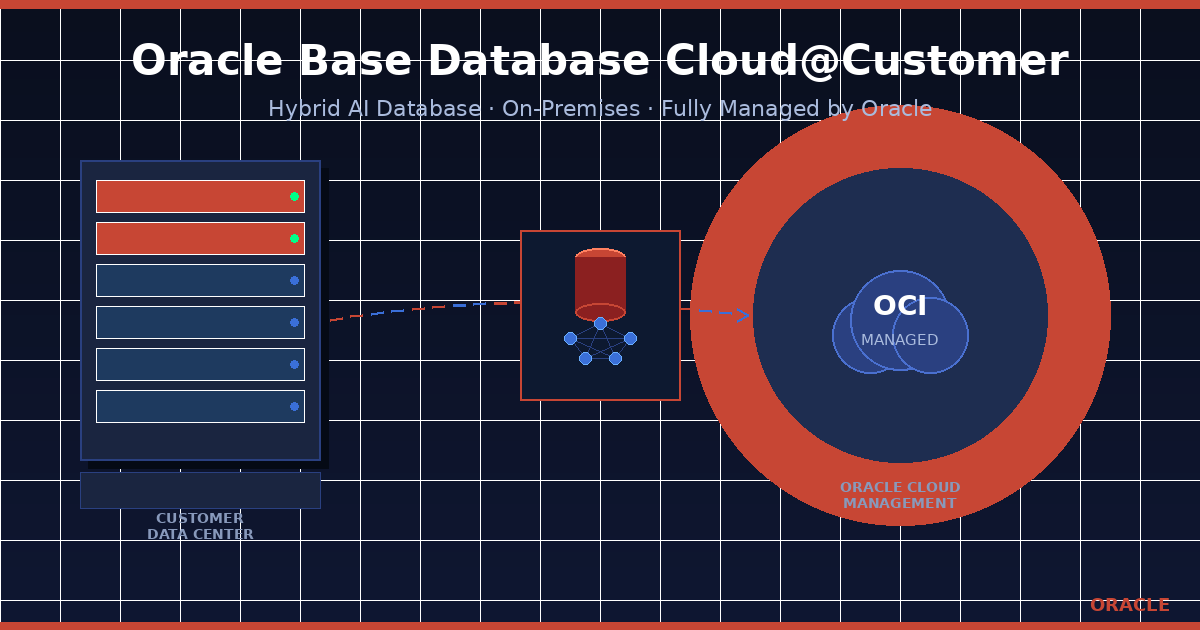
That changes with the July 22, 2026 debut of Oracle Base Database Cloud@Customer, a new hybrid cloud appliance that brings Oracle’s flagship AI database capabilities to customer-selected locations under a fully managed, pay-per-use subscription model. The announcement is Oracle’s clearest signal yet that the cloud-versus-on-premises divide is collapsing — and that the company intends to be the platform straddling both worlds.
What Is Oracle Base Database Cloud@Customer?
The new system is a purpose-built hardware appliance: an 8U (roughly 14-inch-tall) module that fits into standard server racks inside a customer’s data center, branch office, factory floor, or remote site. Unlike the company’s existing Exadata Cloud@Customer, which ships with up to 6,080 CPU cores and 87.5 terabytes of memory, the Base Database system is engineered for mid-sized, business-critical workloads — the kind that enterprises run in regional offices, operational technology environments, or specialized business units that demand low latency and local data control.
The hardware inside is no afterthought. Each appliance contains two servers built around AMD’s fifth-generation EPYC processors — one of the most powerful and energy-efficient server chip families available today. Each node delivers 60 usable CPU cores and 660 gigabytes of memory. On the storage side, a standard configuration includes 11.6 terabytes of all-flash capacity, expandable to 47.2 terabytes by adding additional solid-state drives. Storage is triple-mirrored, meaning Oracle maintains three redundant copies of every record across separate SSDs to ensure that a single drive failure never takes data offline.
For availability, customers can configure a single database instance across both servers, providing active-active redundancy at the appliance level. Oracle’s Active Data Guard is also included: it continuously replicates a read-only backup of the database, synchronizing it in near real-time and scanning each incoming record for threats like ransomware before it commits the copy. This isn’t a bolt-on feature — it’s built into the base subscription.
The AI Angle: Agents Running Next to the Data
What makes the Base Database Cloud@Customer announcement particularly timely is its explicit AI positioning. Oracle is not merely pitching this as a database appliance. It is marketing the system as a platform for running AI agents co-located with enterprise data.
“With Oracle Base Database Cloud@Customer, organizations can move key workloads into cloud environments by running Oracle AI Database, applications, and AI agents on a simple, unified, and affordable cloud subscription model in customer-selected locations, with the underlying infrastructure completely managed by Oracle,” said Oracle executives Bryce Cracco and Kevin Deihl in the company’s official announcement.
That’s more than marketing language. Running AI agents in the same physical system as the database they depend on eliminates a round-trip network call for every query. In agentic workloads — where an AI agent may execute dozens of database lookups to answer a single business question — that latency reduction compounds quickly. It also dramatically simplifies the operational model: one system, one support contract, one managed service.
Two software tools ship with the appliance to support AI development. The first is the Oracle AI Database Private Agent Factory, a low-code environment that lets developers build and deploy AI agents without deep infrastructure expertise. The second is the Oracle Private AI Services Container, which transforms structured and unstructured business data into vector embeddings — the mathematical representations that AI models use to understand and reason over enterprise content — and organizes them in indexes tuned for fast semantic search.
Together, these tools give organizations the building blocks for retrieval-augmented generation (RAG) workflows, AI-powered search, and automated business process agents, all running on company-controlled infrastructure.
Who Is This Built For?
Oracle is explicitly targeting three types of deployments with the Base Database Cloud@Customer:
Small business units and remote corporate locations. Large enterprises often run dozens or hundreds of branch offices that need reliable database access but cannot justify the cost or complexity of an Exadata cluster. The compact form factor and pay-per-use subscription make it viable to deploy enterprise-grade Oracle infrastructure at the edge.
Data residency and regulatory compliance environments. Financial services firms, healthcare providers, government agencies, and companies operating under GDPR or data sovereignty laws in particular regions often cannot send data to a public cloud region without triggering compliance obligations. The appliance keeps data physically on-premises while letting IT teams consume Oracle’s cloud management plane to provision, patch, and monitor the system — the best of both models.
Organizations modernizing away from self-managed infrastructure. Many enterprises are still running Oracle databases on bare-metal hardware they manage themselves, handling everything from firmware upgrades to security patching to capacity planning. Cloud@Customer transfers that operational burden to Oracle entirely, while leaving the workload physically in the customer’s building.
Context: Where This Fits Oracle’s Hybrid Cloud Strategy
Oracle has been building toward this moment for years. Its Dedicated Region Cloud@Customer product puts a full Oracle Cloud Infrastructure region inside an enterprise data center. Exadata Cloud@Customer handles the largest, most demanding database environments. The new Base Database system fills the remaining gap: capable, managed, and affordable for organizations that do not need rack upon rack of compute but still want modern cloud economics and Oracle’s latest AI database features.
The product also arrives at a moment when Oracle’s overall cloud business is under considerable scrutiny. The company’s July 2026 Critical Patch Update — the largest in Oracle’s history, covering more than 1,449 vulnerabilities — reminded customers that managing Oracle infrastructure in-house carries significant security overhead. With a managed appliance, Oracle handles those patches automatically, reducing the window of exposure for customers.
At the same time, Oracle’s cloud infrastructure revenue has been growing at triple-digit rates as enterprises sign massive multi-year agreements for AI training and inference capacity. The Base Database Cloud@Customer extends that commercial momentum deeper into the on-premises installed base, converting customers who might have resisted full cloud migration into managed-service subscribers.
Pricing and Availability
Oracle is offering the Base Database Cloud@Customer under a cloud subscription model with pay-per-use compute pricing. Customers scale cores up or down as needed and do not pay for idle compute capacity — a significant departure from traditional perpetual database licensing, where enterprises pay for peak capacity whether they use it or not.
The underlying hardware runs on Oracle Data Infrastructure Cloud@Customer X11, the latest generation of Oracle’s proprietary hybrid cloud infrastructure platform, ensuring the appliance stays current with Oracle’s broader cloud hardware roadmap.
Availability details and regional rollout information were not disclosed at the time of announcement. Enterprises interested in deployment should contact Oracle directly for lead times and pricing specifics.
The Bottom Line
Oracle Base Database Cloud@Customer is the company’s most direct answer yet to the growing segment of enterprise IT that wants cloud management without cloud data transfer. By pairing an accessible hardware footprint with AMD’s latest EPYC processors, fully managed operations, and built-in AI agent tooling, Oracle has made it easier than ever to adopt its platform without moving data off-site.
For IT leaders evaluating whether to continue managing their own Oracle database infrastructure — or who have been waiting for a managed option that keeps data on their terms — the Base Database Cloud@Customer is worth a serious look. The era of choosing between cloud agility and on-premises control is giving way to infrastructure designed to deliver both at once.