When Oracle and OpenAI unveiled their landmark $300 billion cloud computing contract in late 2025, it was celebrated as a defining moment for enterprise AI infrastructure. Oracle would provide the compute backbone for the world’s most prominent AI lab, securing a revenue pipeline that would dwarf anything in the company’s four-decade history. Larry Ellison and Sam Altman stood together, projecting confidence. Wall Street celebrated. The stock surged.
Nine months later, the mood has shifted considerably.
With Oracle set to report its Q1 fiscal year 2027 earnings on September 10, analysts, credit rating agencies, and market watchers are asking increasingly pointed questions about whether the deal that was supposed to secure Oracle’s AI future has instead created a dangerous concentration of risk unlike anything in the enterprise software industry.
A Deal Built on Assumptions
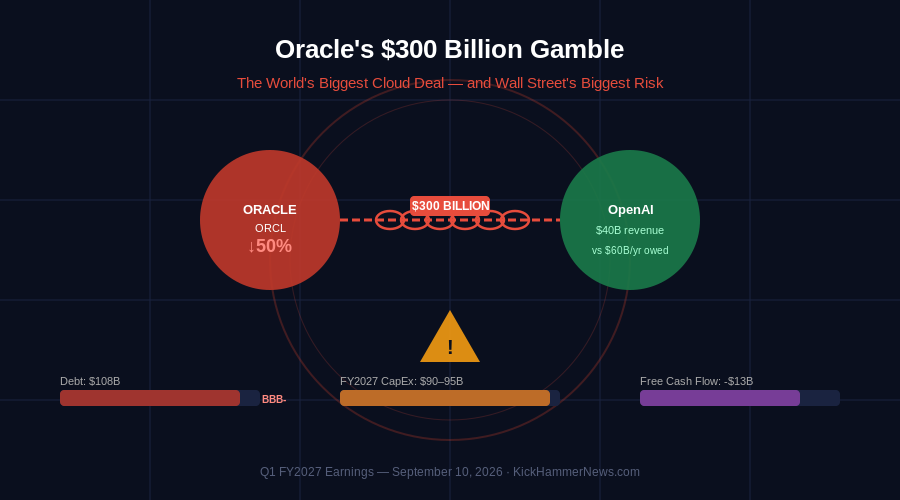
The $300 billion figure, spread over five years starting in 2027, works out to roughly $60 billion per year in compute payments from OpenAI to Oracle. That number sounds transformative — until you compare it to OpenAI’s current financial position. The AI company’s annualized revenue sits at around $40 billion. The contract commits OpenAI to paying Oracle more each year than it currently earns.
That gap is not necessarily disqualifying. OpenAI could grow into those commitments, raise additional capital, or tap public markets through an IPO. But it introduces a structural dependency that has made some of Oracle’s largest shareholders deeply uncomfortable. According to S&P Global, approximately half of Oracle’s entire $638 billion book of contracted future revenue is tied to a single customer: OpenAI.
S&P Global took action in July 2026, cutting Oracle’s credit rating to BBB-, leaving the company just one notch above junk status. The ratings agency flagged Oracle’s expected capital expenditure of $90 to $95 billion in fiscal year 2027 as the primary driver of that concern, alongside the company’s mounting debt load, which has reached $108 billion, and a free cash flow position that has turned sharply negative.
The Financing Math
To understand why investors are anxious, consider the capital requirements Oracle faces before it sees meaningful revenue from the OpenAI contract. The deal’s infrastructure commitments require roughly half of the $135 billion in AI hardware to be deployed before the end of 2026 — meaning Oracle needed to raise tens of billions of dollars in the first year of the contract before revenue recognition begins in earnest.
Oracle has responded by raising capital aggressively. The company announced plans earlier this year to raise up to $50 billion through a combination of debt and equity, with a $20 billion equity offering that caught some investors off guard given the dilutive implications. BNP Paribas analyst Stefan Slowinski noted that while the equity component surprised markets, it ultimately reassures investors that Oracle’s financing plan is coherent and that the company has a credible path to completing its data center buildout.
There are offsetting factors. Customers have been prepaying or supplying hardware for $75 billion of Oracle’s largest AI contracts, reducing the net capital Oracle must deploy from its own balance sheet. Cloud infrastructure revenue grew 77% in fiscal 2026, demonstrating genuine demand for Oracle’s OCI platform beyond just the OpenAI relationship. And orders from existing AI customers have continued to climb as global compute demand accelerates.
But the numbers are large enough, and the dependencies concentrated enough, that the structural risk is difficult to ignore.
Altman’s Warning and What It Means for Oracle
In a recent podcast interview, OpenAI CEO Sam Altman made comments that sent ripples through enterprise tech markets. Altman said he was seeing signs of what he called “unsustainable silliness” in the broader compute buildout, pointing to new cloud providers promising massive capacity without the revenue or committed customers to support it. He acknowledged that a broader market correction could affect OpenAI’s ability to “confidently pay for the compute” it has committed to, though he added the qualifier: “if the whole economy blows up.”
The comments were intended to be reassuring — Altman was distancing OpenAI from speculative overbuilders, not flagging concerns about his own company’s obligations. But they arrived at a moment when Oracle’s stock had already fallen sharply from its peak, erasing hundreds of billions in market capitalization, and when any uncertainty about the AI compute market reads as directly relevant to Oracle’s near-term financial stability.
Council on Foreign Relations senior fellow Sebastian Mallaby put it bluntly on a CFR podcast: “If OpenAI runs into trouble, I think we can say that there’s a good chance that Oracle may also run into trouble.” Mallaby noted that while Alphabet, Amazon, Microsoft, and Meta entered the AI boom with much stronger balance sheets and greater capacity to self-fund their expansions, Oracle took on significantly more leverage to compete, creating a risk profile that now depends heavily on OpenAI’s continued success.
What September 10 Will Reveal
When Oracle reports Q1 FY2027 earnings next Wednesday, analysts will be focused on several key metrics. The consensus revenue estimate sits at $19.13 billion, with cloud revenue expected to grow between 57% and 63% — targets that reflect Oracle’s own guidance rather than analyst conservatism. On the margin side, non-GAAP earnings per share guidance of $1.71 to $1.75 suggests Oracle’s underlying business remains profitable even as it absorbs enormous capital expenditure.
But the numbers that will matter most are not on the income statement. Investors will scrutinize free cash flow trajectory, the pace of data center build-out relative to the OpenAI timeline, and any updated commentary on the contractual relationship with OpenAI itself. The company’s cloud infrastructure backlog figure — a forward indicator of contracted but unrecognized revenue — will be parsed carefully for signs that OpenAI commitments are being formalized into the revenue waterfall on schedule.
There is also an IPO question hanging over the earnings call. Prediction market data from Kalshi shows traders assigning an 85% probability that OpenAI does not announce an IPO by December 31, 2026. But the same data shows a 48% chance of an announcement by March 31, 2027. An OpenAI IPO would give the AI company access to public capital markets at precisely the moment its Oracle obligations begin to ramp materially, potentially resolving the revenue-to-commitment gap that has troubled credit analysts.
The Broader Lesson
Oracle’s predicament reflects a broader tension that is now visible across enterprise technology. The race to build AI infrastructure at scale has demanded capital commitments that would have been considered extraordinary even five years ago. Companies that moved aggressively — betting on the AI compute supercycle before demand fully materialized — are now carrying the consequences of that timing.
Oracle made a bet that OpenAI would be the defining enterprise computing customer of the late 2020s. That bet may still prove correct. The 77% cloud infrastructure growth figures suggest real traction, and the prepayment arrangements indicate that at least some of that contracted revenue is secured against hardware already in place. Ellison has consistently argued that Oracle’s database heritage and multi-cloud positioning give it advantages that pure infrastructure providers cannot replicate.
But the margin for error has narrowed considerably. At BBB- with $108 billion in debt and a capital expenditure program that rivals the largest infrastructure projects in corporate history, Oracle enters next week’s earnings report with less financial flexibility than it has had in years.
The $300 billion gamble is still very much in play. Whether it pays off depends not just on Oracle’s execution, but on whether OpenAI keeps growing fast enough to honor a contract that was audacious when it was signed and looks even more so in the light of today’s market realities.
Oracle is scheduled to report Q1 FY2027 financial results on September 10, 2026, after market close.


