Oracle has launched AI Agent Studio for Industry Applications, a new platform that lets business users build, deploy, and govern domain-specific AI agents without writing a single line of production code — targeting healthcare, financial services, supply chain, and beyond.
For years, enterprise AI deployments followed a familiar and frustrating pattern: a team of data scientists builds a promising prototype, hands it to IT for hardening, watches it stall in a six-month governance review, and then launches it — slightly too late — into a business process that has already moved on. Oracle’s newly announced AI Agent Studio for Industry Applications is a direct answer to that drag. Announced on October 21, 2026, the platform promises to collapse that timeline by giving industry domain experts the tools to assemble, test, and ship production-grade AI agents themselves, using visual workflows instead of custom code.
What Oracle AI Agent Studio Actually Is
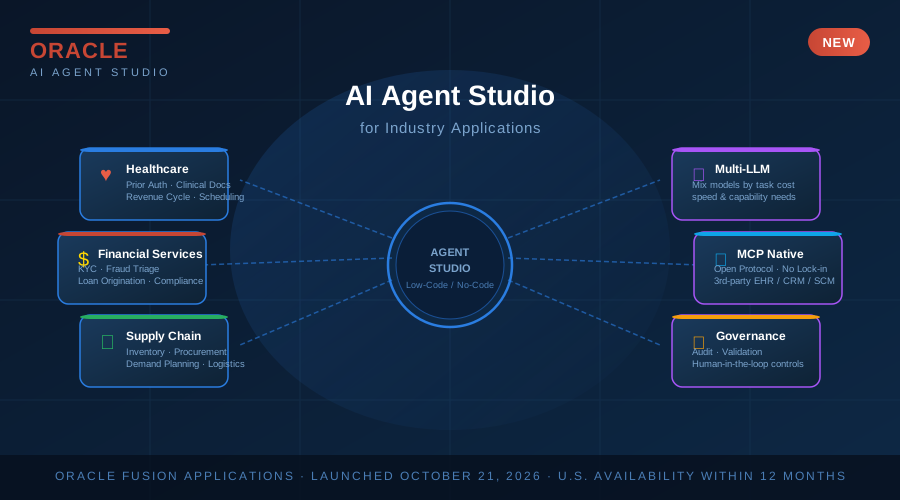
At its core, AI Agent Studio is a low-code and codeless development environment embedded inside Oracle’s existing Fusion Applications ecosystem. Users work in a drag-and-drop interface to define agent behavior: what data sources the agent can access, what actions it can take, which large language model (LLM) it should use for reasoning, and how its outputs should be validated before reaching a human or triggering a downstream system.
The platform supports multiple LLMs simultaneously, letting organizations mix and match models based on cost, latency, and capability requirements for different tasks. A healthcare system might route patient scheduling queries to a lightweight model for speed while sending clinical-decision support requests to a more powerful reasoning model. That multi-LLM architecture is increasingly critical in 2026 as organizations face pressure to avoid single-vendor AI lock-in while still maintaining coherent governance.
Oracle has also built in native support for the Model Context Protocol (MCP), the emerging open standard for connecting AI agents to external tools and data sources. MCP compatibility means that agents built in the studio can plug into third-party systems — EHRs, CRMs, logistics platforms — without Oracle needing to build custom connectors for each. It’s a pragmatic choice that acknowledges the messy reality of enterprise IT estates: no one runs entirely on one vendor’s stack.
Industry Verticals in Focus
Oracle is rolling out AI Agent Studio in waves, with the initial launch targeting a handful of high-value, high-complexity industries where the ROI case for AI automation is already proven.
In healthcare, the platform is positioned to help hospitals and health systems build agents that handle prior authorizations, clinical documentation, appointment management, and revenue cycle tasks — the administrative layer that consumes enormous labor cost with little clinical upside. Oracle cites prior authorization alone as a workflow where AI agents can reduce average processing time from days to minutes.
Financial services firms are being offered agents tuned for KYC (know your customer) document review, fraud alert triage, loan origination workflows, and regulatory reporting. These are processes where the combination of structured data, strict compliance requirements, and high transaction volume make them nearly ideal candidates for agentic automation — as long as the governance tooling is credible.
Supply chain and manufacturing customers can build agents that monitor inventory signals, trigger procurement actions, flag logistics exceptions, and surface demand-planning anomalies before they cascade into stockouts or overstock situations. Oracle’s existing strength in supply chain software through Fusion SCM gives these agents a rich native data environment to operate in.
Availability of AI Agent Studio for Industry Applications outside the initial launch cohort is targeted for the US market within 12 months, suggesting Oracle is treating this as a phased rollout rather than a broad simultaneous release — a sensible approach given the compliance and localization complexity involved in deploying AI agents in regulated industries across different jurisdictions.
Why This Matters for Enterprise Software Buyers
The announcement lands at a moment when enterprise software buyers are increasingly skeptical of AI features that exist primarily as marketing talking points. The past two years have produced a wave of “AI-powered” software updates where the intelligence is thin, the workflows are unchanged, and the pricing has quietly increased.
Oracle AI Agent Studio represents something meaningfully different: a tooling play, not just a feature play. Rather than shipping a fixed set of pre-built AI capabilities, Oracle is giving customers — or more precisely, giving the non-technical business experts inside those customers — the infrastructure to define and deploy their own automated workflows. That shifts the value conversation from “what does Oracle’s AI do?” to “what can your business domain experts accomplish with Oracle’s AI tools?”
That’s a harder sell in some respects. It requires customers to invest in training, change management, and internal governance processes for AI agents they’re now building themselves. Oracle’s role shifts partly from software vendor to platform provider. But for large enterprises with complex, differentiated operational processes, the ability to customize agentic behavior without waiting for Oracle’s product roadmap is exactly what they want.
The codeless and low-code emphasis also matters for workforce strategy. Enterprise software teams are already stretched thin. Requiring Python fluency to build every new AI workflow simply isn’t realistic at scale. By lowering the technical floor, Oracle is betting that the real unlock for enterprise AI isn’t better models — it’s broader access to the tooling layer.
Competitive Context
Oracle isn’t alone in this territory. SAP has been advancing its Business AI framework inside S/4HANA. Microsoft Copilot Studio continues to expand its agent-building capabilities across the Microsoft 365 and Dynamics ecosystems. ServiceNow has been aggressively shipping agentic workflow tools for IT and HR operations. The competition for enterprise AI agent mindshare is, in short, intense.
What Oracle brings to the fight is the depth of its industry-specific data models inside Fusion Applications, combined with the credibility that comes from running mission-critical workloads for global enterprises for decades. An AI agent that can natively access Oracle Fusion’s clinical, financial, or supply chain data — without complex integration work — has a meaningful head start over a generic agent that has to be taught the data model from scratch.
The Bottom Line
Oracle AI Agent Studio for Industry Applications is a credible, well-timed push into the platform layer of enterprise AI. Its focus on codeless and low-code tools for domain experts, combined with multi-LLM support and MCP compatibility, reflects a clear-eyed view of what actually blocks enterprise AI deployments today: not the models, but the tooling and governance infrastructure around them.
Whether Oracle can execute on this vision — converting early momentum into broad adoption across healthcare, financial services, and supply chain — will depend heavily on how well it supports customers through the change management process that agentic AI deployments inevitably require. The platform is promising. The proof will be in the enterprise outcomes that follow.