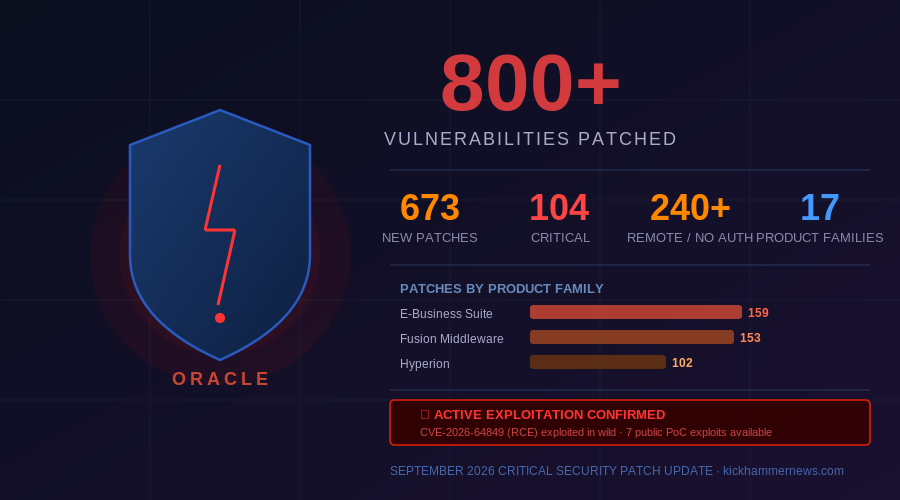
Oracle has released what may be its most consequential monthly security update yet, shipping 673 new patches in its September 2026 Critical Security Patch Update (CSPU) to address more than 800 vulnerabilities across 17 product families. With over 100 critical-severity flaws, hundreds of remotely exploitable holes, and confirmed active exploitation already being reported, security teams running Oracle software face one of the most demanding patch cycles in recent memory.
The Numbers Behind the Update
Oracle’s September 2026 CSPU advisory, published September 15, formally documents 672 unique CVEs across its published risk matrices — but that figure significantly understates the scope of what was actually fixed. The company quietly resolved more than 130 additional CVEs through patches bundled alongside other fixes, pushing the effective total of remediated vulnerabilities well past 800 for a single monthly release.
The severity breakdown is sobering. Of the 673 new patches, 104 address flaws rated critical — the highest severity tier in Oracle’s Common Vulnerability Scoring System (CVSS) framework. More alarming still is the exploitability profile: over 240 of the vulnerabilities can be weaponized remotely without authentication, meaning an attacker with nothing more than network access to an exposed Oracle system can potentially trigger them without valid credentials.
For context, Oracle’s August 2026 CSPU issued 943 patches — so September’s 673-patch release is actually smaller in absolute terms, but the critical-severity concentration and the presence of confirmed in-the-wild exploitation make it arguably more dangerous for organizations that are slow to apply updates.
Where the Vulnerabilities Are Concentrated
Three Oracle product families dominate the patch counts in this update, and they happen to be three of the most widely deployed enterprise software stacks in the world.
Oracle E-Business Suite tops the list with 159 patches — a significant number for a platform that remains the backbone of financial management, supply chain, and HR operations at thousands of organizations. E-Business Suite deployments are often deeply customized, which makes rapid patching a logistical challenge, and many of the environments running older E-Business Suite versions have long upgrade cycles.
Oracle Fusion Middleware follows with 153 patches. As the integration and application server layer underlying many Oracle Cloud and on-premises deployments, Fusion Middleware vulnerabilities can provide attackers with lateral movement opportunities into broader Oracle infrastructure. Given that Oracle has been aggressively pushing its cloud platform and Fusion applications in recent years, Fusion Middleware’s attack surface has grown significantly alongside adoption.
Oracle Hyperion — the enterprise performance management suite used by finance and planning teams — required 102 patches in this cycle. Hyperion environments often run on-premises with limited internet exposure, but many organizations use them in hybrid configurations where the risk profile is less controlled.
Beyond the big three, Oracle Fusion Applications, Oracle Database, Oracle Communications, and Oracle Java SE all carry meaningful patch loads in this update.
Active Exploitation: The Threat That Can’t Wait
What transforms a large-but-routine security update into a genuine emergency is confirmed exploitation. In this case, Hong Kong’s Government Computer Emergency Response Team Coordination Centre (GovCERT) has publicly reported that CVE-2026-64849 — a remote code execution vulnerability — is being actively exploited in the wild. GovCERT also flagged public proof-of-concept exploit code for seven additional CVEs covered in this CSPU.
The presence of working public exploits substantially lowers the bar for attackers. When proof-of-concept code is available, exploitation shifts from the domain of sophisticated nation-state actors to commodity threat groups and opportunistic automated scanning. Organizations running affected Oracle products that are reachable from the internet should treat those seven CVEs as immediate priorities regardless of their overall patch queue.
CVE-2026-64849 specifically affects Oracle’s supply chain software products, which is particularly concerning given the interconnected nature of supply chain systems and the cascading impact a successful compromise can have across an organization and its business partners.
Why Enterprise Oracle Patching Remains So Hard
The sheer volume of patches Oracle now ships each month reflects two intersecting trends: the growing sophistication of automated vulnerability discovery tools (including AI-assisted fuzzing), and the expanding attack surface of Oracle’s increasingly cloud-connected product portfolio.
But the numbers also expose a structural tension that enterprise security teams live with every day. Oracle’s products — E-Business Suite, Fusion Applications, Database, Hyperion — are not software you patch quickly. They power mission-critical financial systems, supply chains, and reporting infrastructure. Testing patches in staging environments, coordinating change windows with business stakeholders, and managing the downtime risk of applying hundreds of fixes to tightly coupled enterprise systems takes time. Weeks, sometimes months.
Oracle itself recommends applying CSPUs as soon as possible after release and notes that customers who do not apply patches are at “significantly greater” risk than those who do — a somewhat understated way of acknowledging that many customers run months or years behind on patches.
The September 2026 update also lands at a moment when Oracle’s enterprise cloud ambitions are accelerating. The company’s Q1 FY2027 results, released earlier this month, showed cloud infrastructure revenue doubling year-over-year as Oracle competes aggressively with AWS, Azure, and Google Cloud. That growth is bringing new customers and new workloads into Oracle’s ecosystem — which means the addressable attack surface for these vulnerabilities is larger than it has ever been.
What Security Teams Should Do Now
Security professionals responsible for Oracle environments should take several immediate steps in response to this update.
First, identify which Oracle products and versions are in use across the organization and cross-reference with the September 2026 CSPU advisory. Oracle’s advisory is organized by product family with CVSS scores and exploitability ratings — use those ratings to triage rather than attempting to apply all 673 patches simultaneously.
Second, prioritize the seven CVEs for which public proof-of-concept code exists, and treat CVE-2026-64849 as an emergency fix given confirmed active exploitation. If any affected systems are internet-accessible, consider temporary network controls — firewall rules, VPN gating — while patches are tested and deployed.
Third, verify that Oracle environments are enrolled in Oracle’s security alert notification service so that out-of-band emergency patches, like the hotfixes sometimes issued between monthly CSPU cycles, are not missed.
Finally, document the patching timeline. In a regulatory environment where breach disclosure obligations are tightening globally, the ability to demonstrate that known vulnerabilities were addressed in a timely and systematic way matters — both for compliance and for post-incident defense.
The Bigger Picture
Oracle’s September 2026 CSPU is a reminder that enterprise software security is not a quarterly checkbox but a continuous operational discipline. The era of applying patches once a quarter, or once a year during a planned maintenance window, is functionally over. With attackers using the same AI-assisted tools that researchers are now using to find vulnerabilities, the window between public disclosure and active exploitation has collapsed.
For the enterprises running Oracle’s product portfolio — and given Oracle’s market position, that includes a significant fraction of the Fortune 500 — the message from this month’s update is clear: the patching backlog is a liability, and September just made it more expensive to carry.


