When Runway introduced the world to AI-generated video in 2022, the reaction was a mix of awe and unease: the idea that a model could synthesize convincing moving images from a text prompt felt simultaneously like a parlor trick and a premonition. Four years later, Runway has announced something that may be even more disorienting in its implications. It is called Solaris, and it generates software interfaces — entire applications, buttons, menus, interactive layouts — frame by frame, in real time, with no code running underneath.
Announced on August 31, 2026 and now in limited early access, Solaris is the first model in a new family Runway calls Interface World Models. The company is betting that the same approach that turned language models into video generators can now turn them into software itself.
What Solaris Actually Does
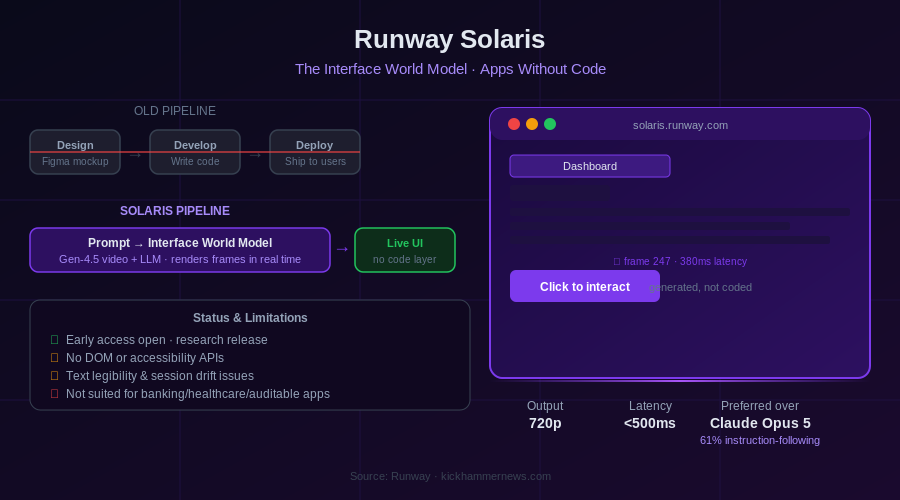
The conventional pipeline for building a digital product looks roughly like this: a designer mocks up the interface in a tool like Figma, hands the specifications to a developer, and the developer writes code that makes the design interactive. Runway’s pitch with Solaris is that the middle and final steps can be collapsed entirely.
Solaris pairs Runway’s Gen-4.5 video model with a large language model that reads each user interaction — a click, a drag, a voice command — decides what the interface should do next, and prompts the video model to render the following frames accordingly. The result is an application that exists, in a meaningful sense, only as a stream of generated imagery. There is no DOM tree, no JavaScript executing in a browser engine, no underlying data structure that a developer wrote. Just frames, generated in sequence, responding to input.
The system targets 720p output and aims for sub-500ms latency per frame — fast enough to feel interactive for a human user, though still measurably slower than a natively rendered interface. Runway says early testing showed the model performing competitively with conventional software on straightforward interaction tasks.
An independent benchmark run by AlphaSignal, based on 7,500 judgments from 250 participants, found Solaris preferred over Claude Opus 5 on instruction-following 61 percent of the time and on natural behavior 71 percent of the time — a notable result if the methodology holds up under scrutiny. Runway has not published the full evaluation details, and independent replication has not yet occurred.
The No-Code Promise, Taken Seriously
There have been waves of no-code and low-code tools for as long as there have been professional developers insisting code will always be necessary. Most of them carved out legitimate niches — landing pages, simple internal tools, basic automations — while leaving everything complex to the engineers. Solaris represents a fundamentally different claim: not that you can build software without coding by assembling pre-built components, but that you can generate interactive software as a live artifact, the same way a language model generates a sentence.
The implications for product development are worth taking seriously. Designers who currently spend significant time building high-fidelity prototypes before getting user feedback could, in theory, use Solaris to generate functional-feeling interfaces immediately from natural language descriptions. Non-technical founders could test whether a product concept resonates before spending engineering cycles on it. Interactive demos and tutorials that currently require significant production effort could be spun up in minutes.
Runway’s framing leans heavily into this positioning. The company describes Solaris as enabling “dynamic environments that adapt to the user” — the idea being that a generated interface need not be static, but can reshape itself based on context, user history, or conversational state in ways that a coded interface would require extensive engineering to achieve.
The Structural Limitations Are Real
Solaris is a research release, not a shipping product. Runway has opened an early access request form and published no public pricing, no API, and no general sign-up timeline. The current build has acknowledged issues with text legibility, session drift over longer interactions, and what the company calls “convincing-but-wrong” screens — interfaces that look correct but present false information or respond to inputs in inconsistent ways.
The deeper structural limitation is harder to engineer around. Because Solaris generates interfaces as video frames rather than structured code, the resulting applications have no underlying DOM, no accessibility APIs, and no data model that could be audited, versioned, or integrated with external systems in conventional ways. A button rendered by Solaris is not a button in any technical sense — it is pixels that look like a button and respond to a click gesture by generating the next frame.
This matters enormously for real-world deployment. Banking applications, healthcare record systems, government services, and any application subject to accessibility requirements under standards like WCAG cannot be built on a foundation that has no semantic structure. The frame-by-frame inference model also raises real cost and latency concerns for anything beyond contained demo sessions — every user interaction triggers an inference call, and at scale, those costs compound quickly.
The company is candid about these constraints. Solaris is positioned as a prototyping and exploration tool, not a production deployment platform, at least for now.
What This Signals for Software’s Future
Even as a research artifact, Solaris is significant as a directional indicator. The idea that an AI system could generate interactive software — not by writing code that runs, but by simulating the experience of software in real time — would have seemed fanciful three years ago. It is now a demonstrated prototype.
The trajectory that Runway is tracing mirrors the trajectory of video generation itself. Early AI video was low-resolution, short, and obviously synthetic. Over successive generations of models, the quality, length, and coherence improved dramatically. Interface generation faces analogous challenges — latency, accuracy, structural integrity — but there is no obvious reason those problems are fundamentally unsolvable given sufficient compute and model capability.
If Solaris or its successors do become viable for production use cases, the implications for the software industry are substantial. Developer labor is the single largest cost in software production. Tools that reduce or eliminate the coding step for a meaningful category of applications would structurally alter where value is created and captured in the technology economy.
The Immediate Takeaway
For most technology professionals, Solaris today is something to watch rather than adopt. It is a genuine technical achievement that demonstrates a new category of AI capability, and the early user experience data — to the extent the AlphaSignal benchmark is trustworthy — suggests the underlying approach has more merit than the typical research demo.
The honest version of the Runway announcement is this: the company has shown that generating software as live video is possible. Whether it becomes practical, economical, and safe enough for real-world deployment depends on engineering progress that has not happened yet. That is a meaningful difference from the version some headlines are telling.
Watch this space. The gap between possible and practical in AI has been closing faster than most predictions suggested it would.


