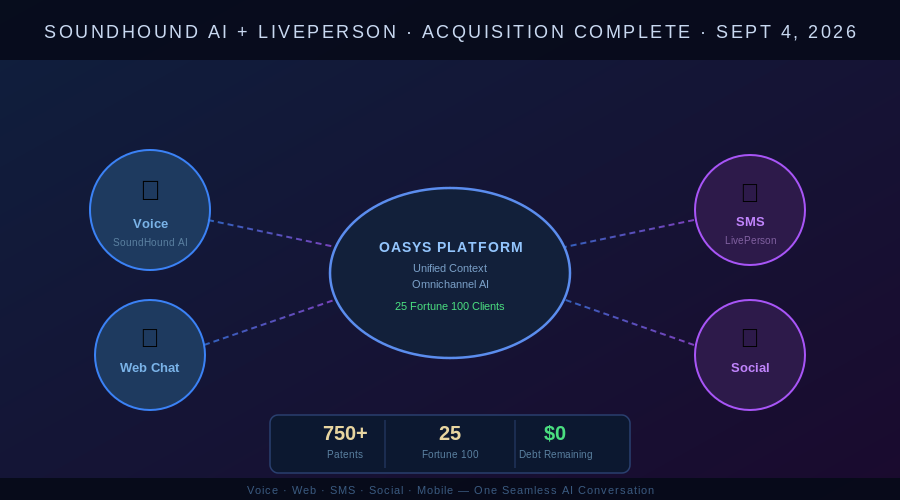
SoundHound AI completed its acquisition of LivePerson on September 4, creating what the company calls a “world-leading omnichannel conversational AI powerhouse” — and staking out territory that Big Tech has mostly ignored.
In the summer of 2026, the AI acquisition market has been dominated by headline-grabbing mega-deals: OpenAI snapping up tools, Nvidia buying model companies, and hyperscalers absorbing startups at a furious pace. Against that backdrop, SoundHound AI’s completed acquisition of LivePerson — finalized on September 4 — might seem like a mid-market footnote. It isn’t. For anyone paying attention to how conversational AI actually gets deployed at enterprise scale, this deal represents something worth examining closely.
What Just Happened
SoundHound AI, best known for its voice AI technology powering automotive and restaurant ordering systems, has now absorbed LivePerson, Inc. — a company with over 750 patents in digital messaging and conversational commerce, and a customer roster that includes 25 Fortune 100 companies. LivePerson stockholders approved the transaction on September 2. It closed two days later, and on the same day SoundHound announced that John Collins would step in as Chief Financial Officer of the combined company.
As part of the deal, SoundHound retired all of LivePerson’s outstanding debt, leaving the merged entity on a debt-free balance sheet. That’s a meaningful signal about financial discipline: rather than leveraging up to absorb a struggling company, SoundHound cleaned the slate.
Two Different Strengths, One Platform
To understand why this merger makes strategic sense, it helps to map each company’s strengths and limitations before the deal.
SoundHound built its reputation in voice. Its technology powers drive-through ordering at fast food chains, in-car voice assistants, and phone-based customer service systems. The company’s OASYS platform — its enterprise AI product suite — is capable and well-regarded in voice-first environments. The weakness? Voice alone is increasingly insufficient. Customers today expect to shift between a phone call, a web chat, an SMS thread, and a social media message within a single interaction with a brand. SoundHound, pre-acquisition, couldn’t seamlessly follow them across all those channels.
LivePerson filled exactly that gap. The company spent years building what it calls a “digital messaging network” — infrastructure for routing customer conversations across web, mobile, SMS, WhatsApp, Apple Messages for Business, and other channels. Its 750-patent IP portfolio is largely defensive moat around that messaging infrastructure. The weakness? LivePerson’s AI capabilities had not kept pace with the frontier. The company was running on AI that felt, to users, a step behind what newer systems could do.
Put SoundHound’s voice AI and multimodal reasoning together with LivePerson’s channel breadth and enterprise relationships, and the combination is genuinely competitive in a way neither company was independently.
The Omnichannel Opportunity
“Omnichannel” has been a buzzword in customer service for years, but the technical reality has lagged the aspiration. Most enterprise deployments of conversational AI still operate in silos: a voice bot here, a web chat widget there, an SMS auto-responder somewhere else — each running on separate infrastructure, maintaining no shared context, handing customers off awkwardly between channels.
The combined SoundHound-LivePerson platform is positioned to solve that. The integration roadmap described in the deal announcement envisions conversations that can start on a phone call, continue in an SMS thread, and resolve through a web interface — with the AI maintaining context throughout, without the customer having to repeat themselves. That’s not a trivial engineering problem, and few companies have the underlying infrastructure to do it at Fortune 100 scale.
The 25 Fortune 100 companies on LivePerson’s customer list are the critical asset here. Enterprise AI sales cycles are long and relationship-dependent. Displacing an incumbent vendor at a major bank, retailer, or telecommunications company can take years. SoundHound just inherited a set of deep enterprise relationships that would have taken the better part of a decade to build organically.
Where SoundHound Sits in the Competitive Landscape
The conversational AI market in 2026 is crowded and getting more so. Google’s CCAI platform, Amazon Lex, Microsoft’s Azure AI and Copilot for customer service, Salesforce’s Einstein, and a handful of well-funded startups are all competing for the same enterprise budgets. SoundHound is not the largest player in this field by any measure.
What the company has, though, is specialization. The hyperscalers are building AI platforms for everything, which means their customer service products are rarely optimized for the specific workflows of, say, a drive-through ordering system or a bank’s fraud inquiry line. SoundHound has spent years going deep on those specialized use cases. The LivePerson acquisition extends that depth into digital messaging channels where the company previously had no real presence.
The debt-free balance sheet post-acquisition also matters more than it might seem. Companies that over-leverage during acquisitions often find themselves constrained when they need to invest in integration, product development, or additional deals. SoundHound enters the post-merger phase with financial flexibility — a relative rarity in the current acquisition wave.
The Talent Factor
Any acquisition’s success ultimately comes down to execution, and execution comes down to people. The appointment of John Collins as CFO signals that SoundHound is thinking about the combined company’s financial architecture with fresh eyes. Collins comes in without legacy attachment to either organization’s prior structure, which could actually be an advantage during integration.
The deeper talent question is what happens to LivePerson’s engineering and product teams. The company’s messaging infrastructure is complex, and the institutional knowledge required to run and extend it is not easily replaced. If key engineers exit during integration — a common outcome in acquisitions — the promised synergies become much harder to realize.
What to Watch
Over the next 12 months, the metrics to watch are straightforward: How many of LivePerson’s 25 Fortune 100 customers expand their contracts to include SoundHound’s voice AI? How quickly does the integrated platform ship omnichannel features that neither company could build alone? And does the combined entity win new enterprise logos that would have been out of reach before the deal?
If the integration goes well, SoundHound may have quietly positioned itself as the most capable specialized conversational AI company in the enterprise space. If it goes poorly, the company will have spent significant resources on a merger that failed to deliver the promised synergies.
The bet is a real one. But the strategic logic is sound.
Published September 5, 2026. Sources: GlobeNewswire, MarTech Series, Investing.com, SEC Filings.


