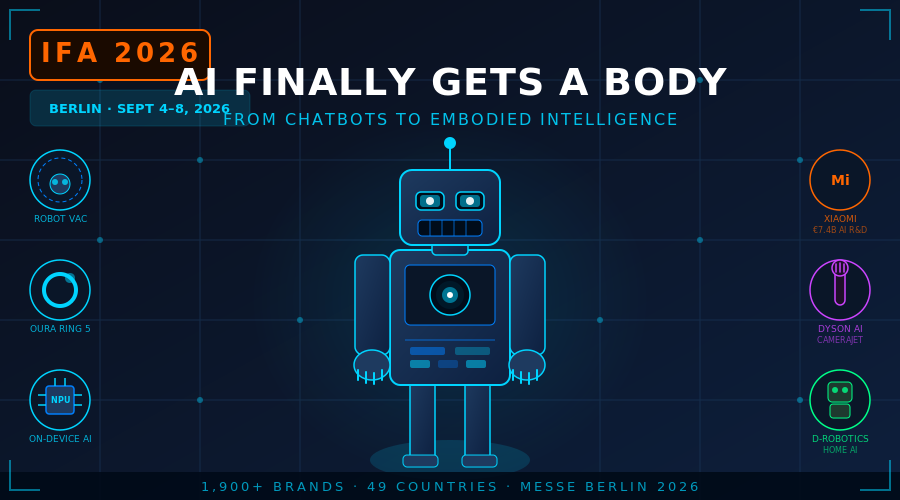
Berlin, Germany — September 5, 2026
The doors to Messe Berlin swung open Thursday for IFA 2026, the world’s oldest and largest consumer electronics show, and the message was unmistakable: artificial intelligence has left the screen. After years of chatbots, copilots, and cloud-based inference, the industry is now betting that AI’s next great leap is physical — folded into robot vacuums, strapped to your wrist, embedded in your toothbrush, and increasingly, walking on two legs around your living room.
With more than 1,900 brands from 49 countries represented across the sprawling exhibition halls, IFA 2026 delivers a snapshot of where consumer technology is heading — and the picture is unmistakably robotic.
Samsung Out, Xiaomi In: A Changing of the Guard
One of the most talked-about storylines before the show even began was Samsung’s conspicuous absence. The South Korean giant, a longtime IFA anchor, skipped the event entirely, ceding the floor to a flood of Chinese manufacturers hungry for European mindshare.
Filling the vacuum in spectacular fashion: Xiaomi. Making its first major IFA appearance, the Beijing-based tech conglomerate arrived with approximately 400 products on display — spanning electric vehicles, humanoid robots, AI-powered home appliances, and the latest version of its HyperOS operating system. Alongside the hardware showcase, Xiaomi announced a €7.4 billion commitment to AI research and development stretching from 2026 through 2028, covering electric vehicles, robotics, and the AI systems powering both.
AMD also made a strong showing, positioning its latest neural processing units (NPUs) as the backbone of on-device AI — a shift that puts AI computation directly into laptops and consumer devices rather than relying on the cloud. The message: AI inference is coming home.
The Robot Revolution on the Show Floor
The dominant visual theme of IFA 2026 is robots — not the industrial arms of factory floors, but consumer-grade machines designed to live alongside humans.
D-Robotics, a Wuhan-based startup spun out of Horizon Robotics, debuted its Sunrise AI chip family at the show, powering three distinct consumer home robots designed for household tasks ranging from elder care assistance to general-purpose cleaning and companionship. The chips, designed specifically for edge AI inference, allow the robots to perceive their environment, recognize faces, and navigate cluttered spaces without a cloud connection.
The robot vacuum category has evolved dramatically. Anker’s new Eufy Omni E35 — priced at $1,300 — generates 35,000 Pa of suction and pairs it with a self-cleaning mop roller and onboard AI that can identify furniture types, children’s toys, and pet obstacles in real time. It’s an appliance that once required a human operator now capable of making judgment calls independently.
The broader theme, as Forbes put it, is that “AI finally gets a body.” Consumer electronics have officially crossed the threshold into what analysts are calling autonomous physical computing — devices that don’t just process commands but perceive, reason, and act in the real world.
Health Tech Goes Passive and Predictive
Wearables had a strong presence on the show floor, with a clear trend toward passive, continuous monitoring that doesn’t require the user to do anything.
Oura launched the Oura Ring 5, its latest generation of finger-worn health tracker. The new model boasts improved heart rate variability sensors, a longer battery life, and deeper integration with AI-driven health coaching that can now flag anomalies — irregular rhythms, stress signatures, sleep debt — before the wearer is consciously aware of them.
Google used IFA to unveil an on-wrist breathing emergency detection feature for its smartwatch line, a first-of-its-kind capability that identifies the physiological signature of respiratory distress and can automatically summon emergency services if the user is unresponsive. Fitbit and Garmin both showcased new screen-free activity trackers — slim bands that forego displays entirely, relying instead on haptic feedback and smartphone companion apps to communicate data.
The message from the wearables aisle: the best health sensor is one you forget you’re wearing.
Dyson Goes Dental (And Goes Big)
Perhaps the most unexpectedly viral product of IFA 2026 is Dyson’s $500 CameraJet electric toothbrush — the British engineering company’s first foray into oral care. In classic Dyson fashion, the company didn’t just make a toothbrush; it made a statement.
The CameraJet integrates an AI-powered miniature camera that analyzes brushing coverage in real time, providing feedback through a companion app on which teeth are being missed. It also incorporates a water flosser, combining two daily hygiene tasks into a single device. The $500 price tag is eye-watering for a toothbrush, but Dyson is betting there’s a segment of health-conscious consumers willing to pay for feedback loops even in the bathroom.
NPUs and the On-Device AI Wave
Beyond any single product, the deeper story at IFA 2026 is architectural. The neural processing unit — a dedicated chip for AI inference — is appearing in an expanding array of consumer devices: laptops, televisions, smartphones, and household appliances.
AMD’s announcements at IFA underscore a broader industry conviction that the next phase of AI is not purely cloud-based. Latency, privacy, and connectivity concerns are driving demand for AI that runs locally, on the device, without sending data to a remote server. The result is a generation of consumer electronics with onboard intelligence capable of tasks — object recognition, natural language understanding, predictive personalization — that would have required a data center connection just two years ago.
Intel, Qualcomm, and MediaTek have all made similar bets, and IFA 2026 is the venue where those chips finally meet the products built around them.
The Bigger Picture: AI Leaves the Cloud
IFA has long served as a bellwether for where consumer technology is headed. In 2019, it was 8K televisions and foldable screens. In 2023, it was generative AI integrations bolted onto every appliance imaginable. In 2026, the theme is different in kind, not just degree.
The products on display this week in Berlin aren’t just “smarter” versions of existing devices. They represent a fundamental shift in the relationship between software intelligence and physical hardware. Robots that navigate your home autonomously. Toothbrushes that watch you brush. Wristbands that monitor your breathing while you sleep. Chips embedded in laptops that run large language models entirely offline.
The era of AI as a cloud service — something you access through a browser or a smartphone app — is not ending. But it is being joined by something new: AI as infrastructure, woven invisibly into the fabric of everyday objects.
IFA 2026 is where you can see exactly what that looks like — and it looks a lot more like the world than a screen.
*IFA 2026 runs through September 8 at Messe Berlin. More announcements are expected through the weekend.*


