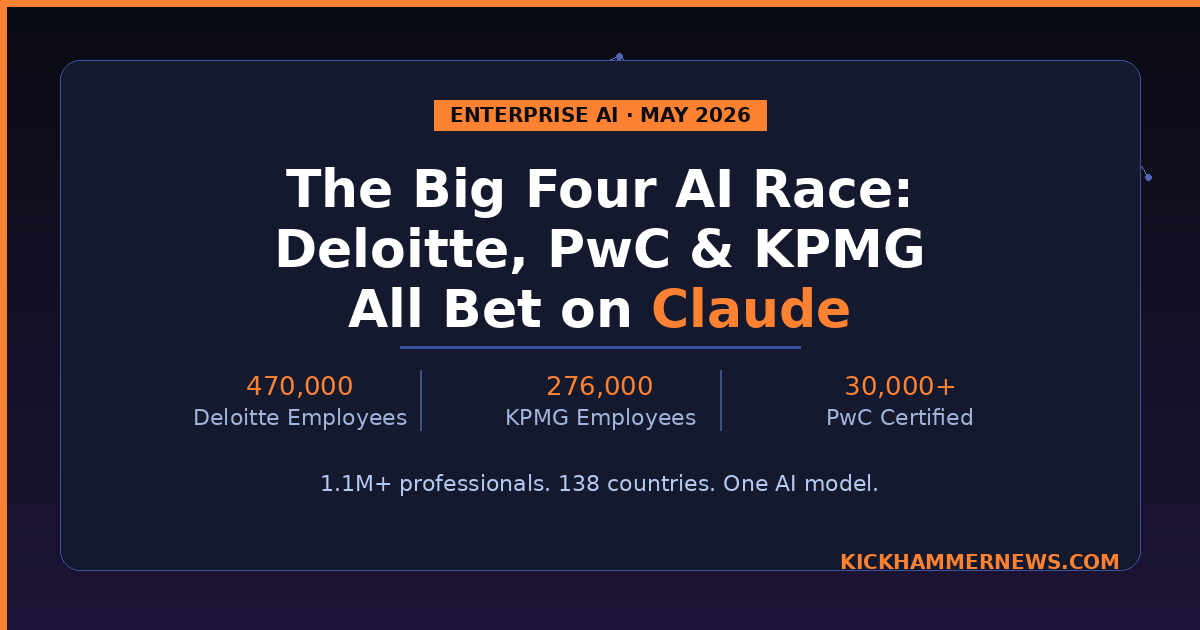
When three of the four largest professional services firms in the world converge on the same AI model within 60 days, it’s no longer a product story — it’s a structural shift in how business gets done.
May 2026 will be remembered as the month the enterprise AI race moved decisively beyond benchmarks and into boardrooms. In a span of roughly 60 days, three of the four largest professional services firms in the world — Deloitte, PwC, and KPMG — each committed to company-wide deployments of Anthropic’s Claude. Together, those three firms represent over 1.1 million professionals operating in virtually every country on earth, advising the Fortune 500, global governments, and hundreds of thousands of mid-market organizations. The competitive AI race of 2026 is not being fought in research labs. It’s being fought in consulting rooms, tax audits, and private equity deal rooms — and Claude is winning it.
A Cascade of Announcements
The deployments arrived in rapid succession. Deloitte moved first, announcing a Claude deployment to its approximately 470,000 global employees in early 2026, the single largest enterprise Claude commitment on record at the time. Then on May 14, PwC announced a global alliance deploying Claude Code and Claude Cowork across its worldwide professional services workforce, with 30,000 US professionals already enrolled in a certification program. Insurance underwriting timelines at PwC-advised clients reportedly dropped from 10 weeks to 10 days. Security task time was cut by up to 70%.
Then on May 19, KPMG joined the wave. The company and Anthropic announced the KPMG Digital Gateway Powered by Claude — embedding Claude directly into KPMG’s core client delivery platform for all 276,000 professionals across 138 countries and territories. Unlike a simple “AI access for employees” license deal, the KPMG integration deploys Claude Cowork and Claude Managed Agents directly inside Digital Gateway, the platform KPMG professionals use for every client engagement. That means KPMG staff aren’t just chatting with an AI assistant — they’re using Claude to build agentic workflows in real time, on the same system where client work actually happens.
The deployment is hosted on Microsoft Azure and targets full implementation by September 2026, starting with Tax & Legal and private equity clients before expanding to all advisory services. Anthropic has designated KPMG a preferred consultant for private equity — creating a formal commercial channel for Claude deployment across PE portfolio companies globally.
Why This Is Bigger Than It Looks
The scale of these deployments matters, but the deeper significance lies in what they mean for Anthropic’s distribution model. Each Big Four firm doesn’t just bring its own headcount — it brings its entire book of client relationships.
When Deloitte, PwC, and KPMG standardize on Claude, they make an implicit product endorsement to every CFO, board, and operating committee they serve. Procurement decisions that might otherwise take months of internal AI evaluation get short-circuited by a simple fact: your trusted advisor is already using Claude and can demonstrate it in your own workflows. That’s not marketing. That’s proof of concept delivered at the highest credibility level possible in enterprise circles.
KPMG Global Chairman and CEO Bill Thomas specifically framed the alliance around “security, trust, and governance rather than speed alone” — which is precisely the language that enterprise risk committees need to hear in 2026. After years of AI hype cycles and overpromised pilots, major organizations are skeptical of AI vendors leading with capability benchmarks. What they want is responsible deployment with clear audit trails, and Anthropic’s safety-first positioning aligns naturally with that demand.
The cybersecurity angle of the KPMG deal is particularly notable. One of the initial deployment areas is vulnerability scanning — using Claude to identify and remediate vulnerabilities in critical client systems. With 276,000 professionals covering the clients of KPMG’s clients, Claude’s defensive cybersecurity reach through this single alliance is extraordinary.
The Architecture Behind the Deployments
What makes these Big Four commitments technically credible rather than aspirational is the platform architecture underneath them. Claude Cowork, Managed Agents, and MCP connectors provide the infrastructure for enterprises to build real production workflows rather than chatbot interfaces.
A tax partner at KPMG dealing with a regulatory change doesn’t need to ask Claude a question — she needs Claude to analyze the regulatory text, compare it against 200 client portfolios, flag the ones requiring immediate action, and draft the client memos with citations. That’s an agentic workflow. It requires persistent context, tool access, and the ability to coordinate multiple steps without human intervention at each stage. Claude’s architecture in 2026 is designed for exactly that — and the Big Four deployments are the first large-scale real-world test of whether agentic enterprise AI delivers the productivity gains that have been promised for three years.
Early signals are favorable. PwC’s reported underwriting time reduction from 10 weeks to 10 days represents a 6x speed improvement on a workflow that involves significant professional judgment, not just information retrieval. If that figure holds at scale, the productivity argument for enterprise AI stops being theoretical.
OpenAI Responds: The $4 Billion DeployCo Bet
OpenAI’s response to losing the Big Four channel to Anthropic is itself a major story. On May 11, OpenAI launched the OpenAI Deployment Company — known internally as DeployCo — a majority-owned standalone consulting subsidiary backed by over $4 billion in initial capital from a consortium that includes TPG, Goldman Sachs, McKinsey, Bain Capital, and Capgemini.
The DeployCo model places Forward Deployed Engineers directly inside client organizations, diagnosing where AI creates value, building production systems, and measuring ROI before expanding. The company acquired Tomoro, an applied AI consulting firm with 150 engineers, as its operational foundation.
The move is an explicit acknowledgment that model capability alone doesn’t win enterprise contracts. By building its own $4 billion deployment infrastructure, OpenAI is attempting to own the enterprise deployment layer independently of consulting firm intermediaries. But 150 engineers scaling to maybe a few thousand cannot quickly replicate the reach of three Big Four firms with combined headcount above one million. In the near term, DeployCo is a competitive signal, not a competitive counter. The question is whether it closes the gap over a three-to-five-year horizon.
The Elephant in the Room: EY
Three of the four firms have committed. Ernst & Young has not made an equivalent public announcement — and that silence is beginning to carry weight. In client conversations where AI deployment credentials matter, EY now faces the awkward position of being the only major consulting firm without a published, enterprise-wide AI partnership.
Competitive pressure in consulting is asymmetric and visible. When a company is choosing between advisory firms and one of them can demonstrate live agentic workflows built on Claude while the other is still running pilot programs, the pitch dynamic changes. Industry observers expect an EY announcement in Q3 2026. How long they wait — and whether they match the deployment scope of the other three — will say a great deal about how EY’s leadership reads the competitive landscape.
What This Means for Enterprise Technology Buyers
If your company already works with any of the Big Four for any service line — audit, tax, advisory, consulting — Claude is likely entering your organization through that consulting relationship, whether or not your internal IT or procurement teams have made an explicit AI decision.
This matters because it changes the evaluation question. Rather than starting from scratch with an internal AI platform assessment, many enterprises will find themselves in conversations with their KPMG or PwC engagement team about extending existing Claude workflows into their own systems. The question shifts from “which AI should we buy?” to “how do we govern the AI our advisors are already bringing into our projects?”
That’s not a problem — it’s an acceleration. The Big Four deployments effectively shortcut the early-stage AI evaluation cycle for their clients by arriving with working, production-grade agentic systems rather than demos. But it does mean that enterprise technology leaders need to be ahead of the curve on Claude governance, data policies, and integration architecture before the consulting relationship brings Claude’s capabilities through the front door.
The Deployment Layer Is the New AI Moat
The central lesson of the Big Four AI race is that the real competitive moat in enterprise AI is not the model — it’s the deployment layer. Benchmarks still matter at the frontier. But the companies generating durable enterprise revenue in 2026 are winning on distribution, governance positioning, and the depth of their integration with the workflows where real work happens.
Anthropic’s strategy has been to build exactly this kind of moat. By investing in Claude Cowork, Managed Agents, and MCP connectors — the infrastructure for enterprise agentic deployment — and then partnering with the firms that have the deepest existing trust relationships in the enterprise world, Anthropic has created a distribution channel that is structurally difficult to displace quickly.
For AI observers who have watched model releases and benchmark leaderboards for years, the KPMG, PwC, and Deloitte announcements represent a different kind of milestone. The race is no longer entirely about what AI can do. It’s about who controls how AI gets deployed, governed, and measured inside the organizations that run the global economy. As of May 2026, Anthropic is winning that race.
Next up on the enterprise AI calendar: Microsoft Build (June 2-3), Apple WWDC (June 8), and the SpaceX IPO (June 12) — a ten-day window that could set the AI narrative for the second half of 2026.
Sources: KPMG press release, Anthropic news, PwC alliance announcement, Build Fast with AI May 28, 2026 digest, TechCrunch, PYMNTS


