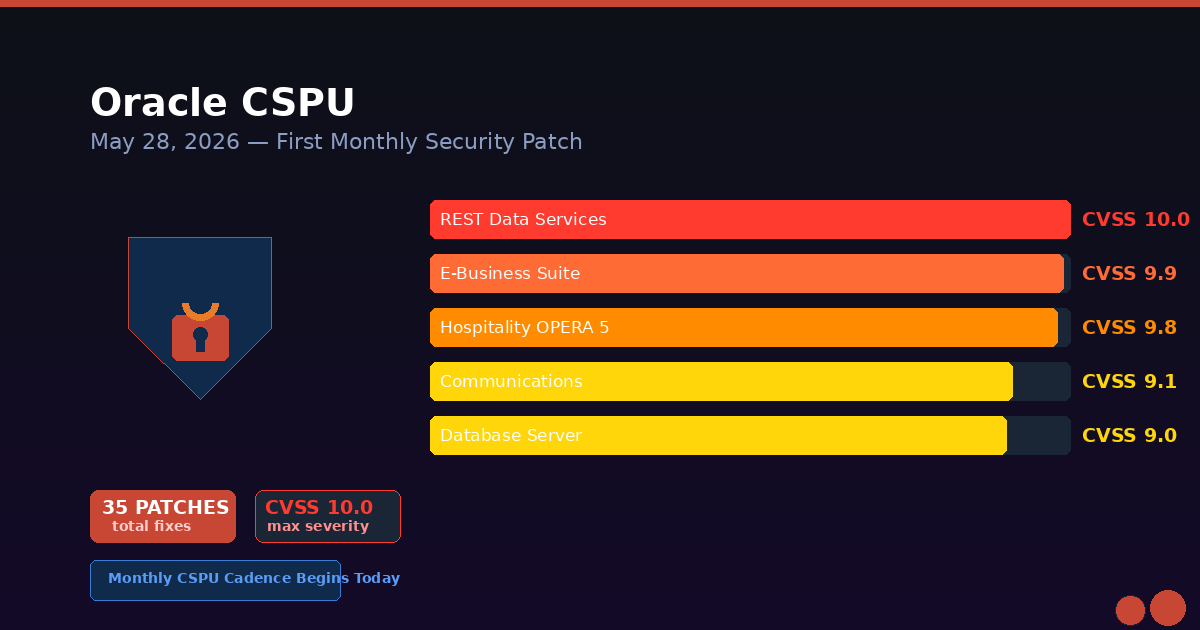
Oracle today released its first-ever monthly Critical Security Patch Update (CSPU), marking a pivotal shift in how the enterprise software giant delivers security fixes to the hundreds of thousands of organizations running its database, ERP, and middleware products worldwide. The May 28 release — long telegraphed but no less significant for it — addresses 35 vulnerabilities across Oracle’s product portfolio, including a maximum-severity CVSS 10.0 flaw in Oracle REST Data Services that security teams will need to address urgently.
The launch confirms Oracle’s transition away from a purely quarterly patching model that critics had long argued left enterprise customers dangerously exposed in the months between cumulative Critical Patch Updates (CPUs). With today’s debut, Oracle joins Microsoft and other major vendors in operating a faster security release cadence — but on its own schedule and terms.
What Is a CSPU and How Does It Differ from Oracle’s Regular CPU?
For years, Oracle’s security calendar revolved around four quarterly Critical Patch Updates, arriving in January, April, July, and October. The model was predictable, but the gaps were long. A critical vulnerability discovered in November, for example, might not reach customer-managed environments until January — a window of two or more months during which attackers who knew about the flaw had a meaningful head start.
Oracle announced the CSPU program in late April, framing it as a complement rather than a replacement for the quarterly cycle. CSPUs are intentionally narrow: they deliver targeted patches for high-priority vulnerabilities, are smaller in scope than quarterly CPUs, and are designed to be applied quickly with minimal disruption to production systems. Quarterly CPUs continue unchanged and will remain cumulative, meaning they roll up all fixes previously issued in CSPUs.
The cadence going forward will be the third Tuesday of the month in February, March, May, June, August, September, November, and December. That gives Oracle customers twelve known patch events per year — eight CSPUs plus four quarterly CPUs — with no months entirely dark. Today’s May 28 release is a one-time Thursday kickoff; from June onward, the third-Tuesday rhythm takes over.
Inside the May 2026 CSPU: The Patches That Matter Most
Of the 35 new security patches in today’s CSPU, the Oracle REST Data Services (ORDS) component carries the most alarming risk profile. Oracle has disclosed 11 patches for ORDS, with the highest CVSS v3.1 Base Score sitting at a perfect 10.0 — the most severe rating on the scale. Seven of those 11 vulnerabilities can be exploited remotely without any authentication, meaning an attacker needs only network access to a vulnerable ORDS endpoint to potentially seize control or extract data. One of the ORDS patches addresses a vulnerability rooted in a third-party component, underscoring the ongoing challenge of securing complex software supply chains.
ORDS is the gateway technology that exposes Oracle Database capabilities via RESTful APIs. It is widely deployed in Oracle Application Express (APEX) environments, in cloud-connected database architectures, and increasingly as an integration layer for modern applications consuming Oracle data. A CVSS 10.0, unauthenticated-remote-exploit flaw in ORDS should be treated as a fire-drill priority for any organization with internet-facing or partner-facing deployments of this component.
Oracle E-Business Suite (EBS) also features prominently in today’s release, with 12 patches — the largest product block in the CSPU. The maximum CVSS score for EBS vulnerabilities is 9.9, and three of those 12 flaws can be exploited remotely without authentication. EBS remains one of Oracle’s most widely deployed on-premises ERP platforms, running core financials, procurement, and HR processes for large enterprises and public-sector organizations globally. The sheer number of patches in this CSPU for EBS signals that Oracle’s AI-assisted vulnerability discovery is finding issues in long-established codebases that manual review had previously missed.
Oracle Communications products receive 8 patches in today’s update, with a maximum CVSS of 9.1 and 5 vulnerabilities carrying remote-unauthenticated exploitability. All 8 are attributed to third-party components, a pattern that reflects the telecommunications software stack’s deep reliance on open-source libraries and industry-standard protocol implementations. Oracle Database Server itself gets 3 patches, all remotely exploitable without authentication, with the highest CVSS reaching 9.0 — affecting supported versions from 23.4.0 through 23.26.2. And Oracle Hospitality OPERA 5, the property management platform used by hotel chains and hospitality groups, carries a single patch with a CVSS of 9.8 across several specific version branches.
Why Oracle Is Moving Faster: AI Is Changing Vulnerability Discovery
The shift to monthly patching isn’t happening in isolation. Oracle’s April blog post from its Integrated Cyber Center (ICC) made clear that AI is fundamentally accelerating how the company finds and prioritizes security flaws across its vast codebase. Oracle has deployed frontier AI models — including Anthropic’s Claude Mythos Preview and OpenAI’s most capable offerings through a Trusted Access for Cyber program — against its own software and services to identify vulnerabilities at a pace and scale that manual security engineering cannot match.
The practical implication is that Oracle is now discovering vulnerabilities faster than a quarterly release window can responsibly absorb. A monthly cadence is the operational response to that discovery acceleration. For enterprises, this is simultaneously reassuring and demanding: reassuring because Oracle is genuinely hardening its products with state-of-the-art tooling; demanding because the patch burden on customer-managed environments just doubled in frequency for the months that now include a CSPU.
Oracle’s cloud-managed services — Fusion Applications, Autonomous Database, and other OCI-hosted products — are unaffected by this calculus. Oracle applies patches to those environments automatically as part of the service. The urgency of today’s CSPU is squarely directed at the large install base running Oracle software on-premises or in customer-managed cloud configurations, where patching remains a human decision with a testing pipeline attached.
What Enterprise Security Teams Should Do Right Now
For organizations with Oracle REST Data Services in their environment, today’s CSPU demands immediate triage. The CVSS 10.0, unauthenticated-remote-exploitable classification places this in emergency-lane territory by any reasonable vulnerability management framework. The first question is exposure: is the ORDS endpoint accessible from the internet, from partner networks, or only from internal systems? Internet-facing deployments warrant emergency patching windows. Internal-only deployments may have slightly more room to maneuver, but given the severity, a compressed timeline is still warranted.
Oracle E-Business Suite administrators face a larger patch set. EBS environments typically require careful regression testing before patching because of the complex integration webs that connect them to downstream and upstream systems. The presence of three unauthenticated-remote-exploitable flaws in this release means that risk-based prioritization — patching the authentication-bypass category first — is a reasonable approach for organizations that cannot immediately apply all 12 fixes.
For broader Oracle patch governance, today’s CSPU debut is a prompt to revisit vulnerability SLAs written around a quarterly rhythm. An SLA calibrated to a 90-day CPU cycle does not reflect the risk profile of a CSPU, which Oracle positions specifically as a vehicle for high-priority fixes that cannot wait. Security programs that have not already established a three-lane patching model — emergency, expedited, and standard — should use the publication of today’s CSPU as the forcing function to build one.
A New Cadence, a New Discipline
Oracle’s shift to monthly CSPUs represents one of the more significant operational changes in enterprise security patch management in recent years. The quarterly CPU wasn’t just a release mechanism — it was the organizing principle around which thousands of enterprise change management programs, compliance attestations, and maintenance windows were built. Absorbing a new, faster lane without rebuilding those structures is precisely how “smaller, more focused patches” become larger organizational disruptions.
The good news is that Oracle has given advance notice and a predictable calendar. The third-Tuesday anchor, combined with the Thursday pre-release announcement the week before each CSPU, gives security and operations teams a reliable planning horizon. Organizations that treat the Thursday pre-announcement as an intake event — mapping flagged components to their Oracle inventory before release day — will be far better positioned to move quickly when severity demands it.
Today’s CSPU is the beginning of a new normal for Oracle enterprise customers. The vulnerabilities are serious, the cadence is faster, and the AI driving Oracle’s own discovery is only going to get better at finding what’s been hidden in decades of production code. The appropriate response is not alarm — it’s governance: build the lanes, set the SLAs, know the exposure, and patch deliberately.
Sources: Oracle Critical Security Patch Update Advisory — May 2026 | Oracle Security Blog: Monthly CSPUs Begin May 28, 2026 | Oracle Security Blog: Accelerating Vulnerability Detection and Response | Cyberuptive: Oracle CSPU May 2026


