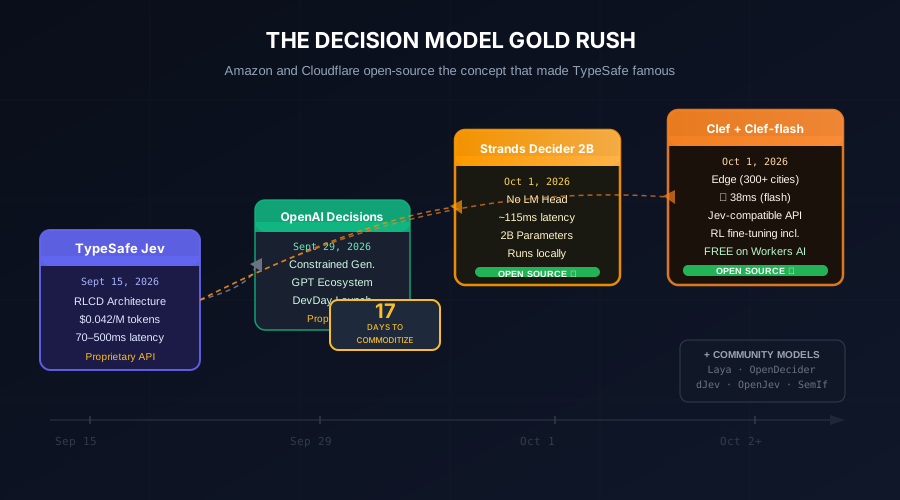
It took seventeen days. That’s how long it took after TypeSafe AI launched Jev — the “decision-only” model that briefly looked like the most disruptive AI architecture of 2026 — before Amazon and Cloudflare simultaneously open-sourced their own versions, offering the core idea for free to every developer on earth.
On September 15, TypeSafe’s Jev debuted to stunned applause: a model that returns structured, typed decisions instead of generating text, running 40 to 200 times faster than GPT-class models on classification and routing tasks, at a fraction of the cost. Within 24 hours it had become Vercel AI Gateway’s fastest-adopted model ever, landing in 13 percent of paid teams before most developers had even heard the name.
On October 1, Amazon released Strands Decider 2B. On the same day, Cloudflare released Clef and Clef-flash. Both are open-source. Both are free to use. Both do exactly what Jev does.
The decision model gold rush has arrived — and it’s already over.
What Strands Decider 2B Is, and What Amazon Did Differently
Strands Decider 2B comes from AWS Strands Labs, Amazon’s agentic AI research division, and it arrives not as a proprietary commercial product but as a fully open-source model released under Apache 2.0. The 2B stands for two billion parameters — small by frontier standards, but large enough for the task.
The architecture is where it gets interesting. Amazon’s engineers made a deliberate choice to strip out the language model head entirely, the final layer of a transformer that normally produces text token probabilities. What remains is a model that has learned to route and classify without ever generating a sentence. The result is a decision engine that picks from a provided list of options in approximately 115 milliseconds — faster than TypeSafe’s Jev in several benchmarks and competitive with its accuracy on structured routing tasks.
Strands Decider 2B is available on Hugging Face and can be run locally, which means any developer can spin up a private decision layer for their agentic workflow without paying TypeSafe or anyone else. For enterprises with on-premises requirements, that matters enormously.
The release is accompanied by native integration into the Strands Agents framework, Amazon’s open-source agentic orchestration library that launched earlier in 2026. Agent developers who are already using Strands can drop in Decider 2B as the routing brain for their tool-selection and classification steps with a few lines of configuration.
Cloudflare Goes to the Edge — and Gets There in 38 Milliseconds
Cloudflare’s Clef models take a different approach. Where Amazon’s release is built for local or cloud deployment, Cloudflare has embedded Clef directly into Workers AI — its global edge inference network distributed across more than 300 cities worldwide.
There are two variants. Clef, the full model, returns typed decisions with a median latency of 209 milliseconds. Clef-flash, the distilled version, does it in 38.8 milliseconds. Both are open-weight, available on Hugging Face for self-hosting, and free to call via Workers AI within the standard Workers AI limits.
The 38-millisecond figure deserves emphasis. TypeSafe advertised Jev at 70 to 500 milliseconds depending on load. Clef-flash running on Cloudflare’s edge consistently beats the bottom of that range while running at the geographic edge — close to wherever the user or the agentic workflow happens to be, rather than in a central data center. For latency-sensitive applications like real-time agent routing, fraud classification, or live user interface decisions, the combination of edge deployment and flash-class speed changes the calculus entirely.
Cloudflare also launched an accompanying reinforcement learning fine-tuning platform on the same day, allowing developers to train Clef-flash on their own decision data without exporting it off-platform. The combination — a fast, edge-deployed decision model with on-platform fine-tuning — is a complete developer story that TypeSafe, a startup with a single hosted API, cannot easily match.
Clef’s API is also designed to be Jev-compatible, meaning existing code written against TypeSafe’s API can be redirected to Cloudflare with minimal changes.
The Ecosystem Has Already Fragmented
Amazon and Cloudflare are not alone. By October 1, the decision model landscape had grown crowded in ways that would have seemed impossible when TypeSafe launched six weeks earlier.
OpenAI shipped its Decisions API as part of DevDay 2026 on September 29, bringing structured decision outputs directly into the GPT ecosystem. The Decisions API uses a constrained generation approach rather than a dedicated decision head, making it more flexible but slower — closer to TypeSafe’s original model than Amazon’s stripped-down architecture. It competes primarily on ecosystem lock-in: developers already using ChatGPT or OpenAI’s agent infrastructure can add structured routing without switching vendors.
On Hugging Face, a community model called Laya had already appeared as an open-weight competitor in early October, drawing comparisons to Jev. OpenDecider, a community-built model, benchmarked above both Laya and Jev on certain typed-decision tasks. Projects named dJev, OpenJev, and SemIf had accumulated thousands of downloads. The concept TypeSafe spent months researching and building has become a freely available commodity in less than three weeks.
What This Means for TypeSafe
TypeSafe AI raised $40 million at a $200 million valuation based on its first-mover advantage in decision models. That advantage has now been substantially eroded, at least in its most direct form: the idea that a typed decision model is inherently more expensive to operate than a general LLM.
The question is what TypeSafe can do that Amazon, Cloudflare, and a community of open-source contributors cannot. The likely answer is data — specifically, the calibration data and the Reinforcement Learning for Calibrated Decisions (RLCD) training methodology that TypeSafe’s team developed. Decision models are only as good as their calibration; a model that returns overconfident probabilities on edge cases creates more problems than it solves. TypeSafe has argued that Jev’s calibration, its ability to return well-hedged uncertainty estimates alongside its choices, is not something easily replicated by stripping a general-purpose 2B parameter model of its language head.
Diogo Almeida, TypeSafe’s founder, has not publicly commented on the Amazon and Cloudflare releases. The company’s pricing — $0.042 per million input tokens with free output tokens — remains substantially cheaper than most LLM alternatives, but it is no longer obviously cheaper than running Cloudflare Clef-flash at the edge for free.
The Architectural Shift That Isn’t Going Back
Regardless of what happens to any individual company, the decision model race confirms something more important: the industry has accepted that not every AI inference call needs to produce text. For years, the default assumption in agentic AI architecture was that you route a request to a language model, get back a natural language response, and then parse what you need. That assumption is now officially dead.
The pattern that TypeSafe pioneered — train a small, fast model specifically for structured choices, bypass the token generation overhead entirely, and return a typed output that requires no parsing — has been validated so thoroughly that Amazon, Cloudflare, OpenAI, and a community of open-source developers all converged on it simultaneously. That’s not a company winning; it’s an idea winning.
The real battle is now about where the decision model runs and who controls the fine-tuning data. Cloudflare’s edge-native approach gives it an advantage for latency-critical applications. Amazon’s local-deployment story appeals to enterprises with data sovereignty requirements. TypeSafe’s hosted API remains the easiest starting point for developers who want to try the concept without infrastructure overhead.
What is no longer in question is whether the concept is real. The only remaining question is who gets to sell it.
Amazon’s Strands Decider 2B is available on Hugging Face under Apache 2.0. Cloudflare’s Clef and Clef-flash are available on Hugging Face and via Workers AI. TypeSafe’s Jev API remains at jev.ai.


