Ant Group — the company behind Alipay, the mobile payments platform that processes more transactions per day than Visa and Mastercard combined — wants you to know it’s now competing with OpenAI.
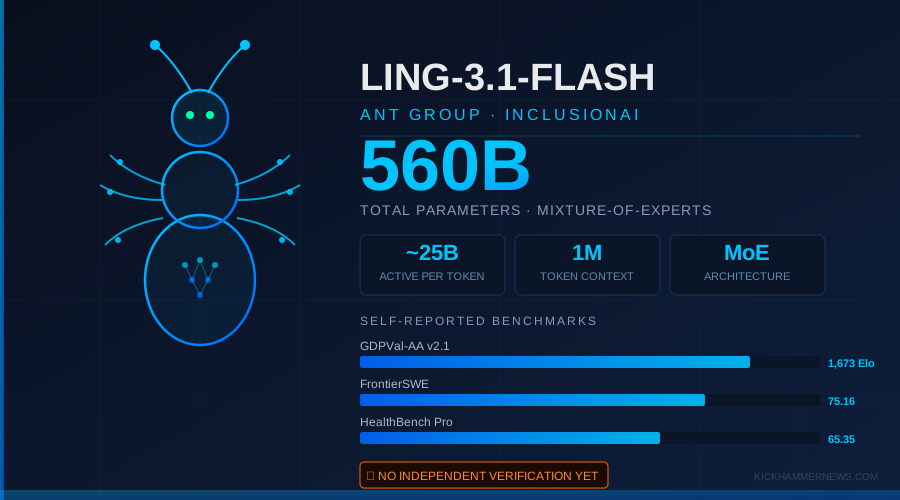
On September 30, Ant Group’s artificial intelligence division, InclusionAI, announced Ling-3.1-flash: a 560-billion-parameter mixture-of-experts language model that, according to Ant’s own benchmarks, sits comfortably near the frontier of AI performance. It handles a million-token context window. It beats other Chinese models on coding benchmarks. It costs less to run than models four times as large. And right now, you can’t download it, can’t independently test it, and can’t verify a single number Ant has published.
Welcome to the new normal in Chinese AI: announce big, benchmark bigger, deliver later.
What Ant Group Is Claiming
The specifications are genuinely impressive — on paper. Ling-3.1-flash uses a mixture-of-experts architecture with 560 billion total parameters, but only approximately 25 billion are activated per token during inference. That means the model achieves the theoretical capacity of a 560B parameter system while computing at roughly the efficiency of a 25B model — a well-established approach that DeepSeek, Alibaba’s Qwen team, and Moonshot AI have all leaned into heavily in 2026.
The context window stretches to one million tokens, though InclusionAI is currently capping users at 256,000 during its two-week free trial period. The full million-token window unlocks after October 13 for users on a paid tier.
On the benchmarks Ant chose to publish: Ling-3.1-flash scores 1,673 Elo on GDPVal-AA v2.1, 75.16 on FrontierSWE (a code-generation and software engineering benchmark), and 65.35 on HealthBench Professional. The GDPVal-AA score in particular places it in territory that, by Ant’s comparison chart, rivals established frontier models. The company says the model is purpose-built for “agent tasks, search, office software, and specialist applications” — with particular emphasis on coding, multi-step analysis, and tool-using agents.
Vercel, the web development platform, integrated Ling-3.1-flash into its AI Gateway on the day of announcement, suggesting at least some early enterprise interest.
The Elephant in the Room: No Weights, No Independent Verification
Here’s the part Ant Group’s announcement doesn’t headline: every benchmark score cited above comes from Ant itself, and the model weights have not been released. Independent benchmarking platform BenchLM, which maintains one of the most comprehensive third-party model rankings, currently lists Ling-3.1-flash as unranked, noting that “8 source-displayable benchmark rows exist but no public overall score.” ThreatFrontier summarizes the situation bluntly: “any head-to-head ranking of [this model] today is guesswork.”
There’s a further problem with the benchmarks Ant chose to highlight. The comparison chart published at launch positions Ling-3.1-flash against models including Kimi K3, GLM 5.3 variants, and DeepSeek-V4.1-Flash — a cohort that was, by the time of the September 30 announcement, already a generation behind the frontier. Notable absences from the comparison: Claude Opus 5.5 (released September 22), GPT-6.1 Sol (released September 30 — the same day as the Ling-3.1-flash announcement), and Google’s Gemini 4 Argon (released October 1). Testing against yesterday’s competition while the market races forward is a PR strategy, not a technical one.
To be clear: this is a pattern that Chinese AI labs have increasingly leaned into, and Western labs are not entirely innocent of it either. But it does mean that the story of where Ling-3.1-flash actually stands — whether it genuinely competes with the frontier or simply competes well against the models Ant chose to include — remains unanswered.
Who Is Ant Group, and Why Should You Care?
Ant Group deserves some context. Founded as the payments arm of Alibaba, Ant Group operates Alipay, which by 2026 serves over 1.4 billion users globally and handles a volume of transactions that dwarfs most Western financial institutions. The company is roughly 33% owned by Alibaba and closely associated with Jack Ma, the famously outspoken founder of Alibaba who disappeared from public view after criticizing China’s financial regulators in 2020 — a speech that preceded, by weeks, the Chinese government’s decision to abruptly halt what would have been the world’s largest IPO: Ant Group’s planned $37 billion listing.
That IPO never happened. Regulators intervened, Ma was called in for questioning, and Ant Group underwent a years-long restructuring that subjected it to the same capital requirements as a bank rather than a tech company. The event became a defining moment for Western observers trying to understand the relationship between Chinese tech giants and the Chinese state.
InclusionAI, the division behind Ling-3.1-flash, represents Ant Group’s bid to compete in the AI race that has consumed global technology investment since 2023. The name is a nod to Ant Group’s stated mission of “financial inclusion” — democratizing access to financial services for people underserved by traditional banking. The team publishes research through academic channels and has previously released the Ling-3.0-Flash, which followed a roughly two-week path from announcement to open-source release. That precedent has led observers to project that Ling-3.1-flash weights could be publicly available by mid-October.
The Crowded Room of Chinese Frontier Models
Ling-3.1-flash enters a market that has grown remarkably competitive in 2026. DeepSeek’s V4.1-Flash series captured global attention earlier this year with open-weight models that challenged Western frontier systems at a fraction of the compute cost. Alibaba’s Qwen team has pushed multiple model generations with strong coding and multilingual performance. Z.ai’s GLM-5.3-Flash series remains a strong competitor in the flash-inference tier. Moonshot AI’s Kimi K3 has built a following in academic and research communities.
What distinguishes the Chinese AI competitive landscape from the Western one — beyond the national security implications that have driven US export controls on advanced chips — is the sheer number of well-funded organizations now capable of training models at the 500B+ parameter scale. The efficiency improvements unlocked by mixture-of-experts architectures have been the key enabling factor. A year ago, training a 560B-parameter model would have required compute resources accessible only to a handful of organizations globally. Today, MoE architectures have democratized that scale to perhaps dozens.
Ant Group’s particular angle — applying frontier AI to financial services, healthcare, and enterprise agent workflows — is one that plays to the company’s existing strengths. Ant processes transactions for hundreds of millions of people and businesses; an AI model that can handle multi-step financial analysis and agentic tool use is directly applicable to Ant’s core business in ways that consumer chatbots are not.
What Happens Next
The two-week free trial ends around October 13, which is also when Ant plans to unlock the full million-token context window for paying customers. Based on the precedent set by Ling-3.0-Flash, open-source weights could follow around the same time, though the company has not committed to a specific date.
If the open-source weights land and independent benchmarkers can actually evaluate Ling-3.1-flash, the picture will sharpen quickly. The model will either hold up against third-party evaluation — which would represent a genuine addition to the open-weight frontier — or it will fall into the pattern of Chinese model launches that look better on self-reported benchmarks than on independent testing.
The stakes are real either way. An open-weight 560B MoE model with genuine frontier performance, released by a company with Ant Group’s distribution reach and enterprise relationships, would be a significant development for the AI ecosystem. A model that benchmarks well only on cherry-picked comparisons is something else entirely.
The weights don’t lie. We’ll find out which this is.


