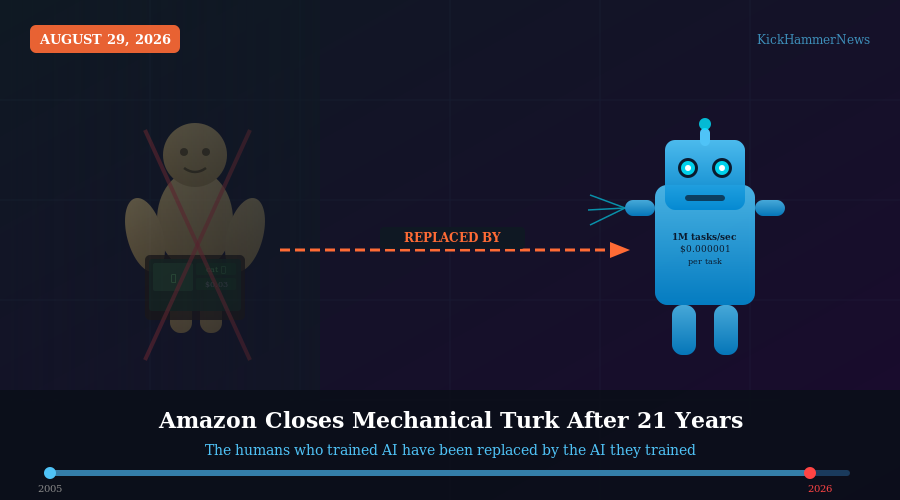
Amazon has announced it will close Mechanical Turk on September 30, 2026 — ending a 21-year experiment in human-powered AI that ultimately became a casualty of the very technology it helped create.
There is a bitter irony embedded in the story of Amazon Mechanical Turk. For two decades, the platform quietly powered the AI revolution by marshaling hundreds of thousands of human workers to label images, transcribe audio, validate data, and answer surveys — the unglamorous, penny-a-task labor that fed machine learning models their essential diet of human-verified truth. Now, those same AI systems have rendered the platform obsolete. The workers trained the machines. The machines replaced the workers. Amazon is closing the doors.
The shutdown, announced on August 25, 2026, will take effect on September 30. Amazon has also discontinued SageMaker Ground Truth and Amazon Augmented AI as part of the same exit, withdrawing entirely from the business of putting humans in the AI training pipeline.
What Mechanical Turk Was
Launched in 2005, Mechanical Turk — named after an 18th-century chess-playing “automaton” that concealed a human chess master inside — was Amazon’s answer to a simple problem: some tasks that computers found nearly impossible were trivially easy for humans. Amazon founder Jeff Bezos famously called it “artificial artificial intelligence,” a system that dressed up human cognition as algorithmic output.
At its peak, more than 500,000 workers globally used the platform. They were paid a few cents to a few dollars per “Human Intelligence Task,” or HIT. The work was humble and often invisible: tagging whether a photo contained a cat, identifying the sentiment in a product review, transcribing a garbled audio file. But in aggregate, this invisible labor built some of the most important training datasets in the history of machine learning. The faces that taught computer vision to recognize faces, the sentences that taught language models to understand language — a meaningful portion of the data underpinning today’s AI boom passed through the hands of MTurk workers.
The Slow Decline
The signs of Mechanical Turk’s demise had been accumulating for years. Amazon consistently underinvested in the platform while rivals like Scale AI, Prolific, and Mercor arrived with more sophisticated approaches to data labeling, better quality controls, and more competitive pay structures.
The more fundamental problem was structural. As AI systems grew more capable, the nature of the work they needed changed. Early language models could be trained on internet text with relatively little human annotation. Modern reinforcement learning from human feedback, or RLHF, requires nuanced comparative judgments from skilled annotators — not the commodity microtask labor that MTurk excelled at. The platform never successfully made the jump.
Then came the final indignity. A 2023 study by researchers in Switzerland estimated that between 33 and 46 percent of Mechanical Turk workers were using large language models to complete their tasks. Workers were submitting AI-generated answers to questions that AI companies were paying to get human answers to. The human signal — the fundamental product — was contaminated at the source. Amazon stopped accepting new customers for the service in July 2026 and announced the full closure weeks later.
The Symbolic Weight
The shutdown carries more symbolic freight than a routine product discontinuation. Mechanical Turk was the defining institution of the “AI winter” to “AI spring” transition. When machine learning researchers needed labeled data in the early 2010s, MTurk was the answer. ImageNet, the dataset that sparked the deep learning revolution with a 2012 breakthrough in image recognition, was substantially labeled on Mechanical Turk. The platform was infrastructure for an entire era.
That era is over. And the closure encapsulates one of the defining tensions of the current AI moment: AI systems have become sufficiently capable that they are eliminating the exact categories of human labor that made them capable in the first place. The bootstrapping is complete. The scaffold has been removed.
For the hundreds of thousands of workers who depended on MTurk — many of them in lower-income countries where a few cents per task added up meaningfully — the closure is not symbolic at all. It is economic. Amazon has pointed workers toward competing platforms, but the market for human data annotation is contracting broadly as synthetic data generation and AI-generated training data become increasingly viable.
What Comes Next for Data Labeling
The data labeling industry is not disappearing; it is transforming. The tasks that survive human annotation are increasingly complex: evaluating whether an AI-generated legal brief is accurate, assessing whether a model’s response is harmful in a culturally specific context, providing expert feedback in domains like medicine, law, and engineering where LLMs still make meaningful errors. These tasks require genuine expertise, not commodity throughput.
Companies like Scale AI have already moved in this direction, recruiting domain experts and offering substantially higher pay for more demanding work. The era of paying workers three cents to identify fire hydrants in images is largely over. The era of paying doctors and lawyers and security researchers to evaluate AI output is just beginning.
This transition reflects a broader truth about how AI changes labor markets: it tends to eliminate tasks at the routine end of any skill spectrum while creating demand for work at the expert end. The workers who thrived on Mechanical Turk’s simple, repetitive HITs face a genuine skills gap. The shift is real, and no amount of optimistic framing about “new kinds of jobs” entirely softens the disruption for the individuals caught in the transition.
The End of an Era
Mechanical Turk’s closure is a milestone worth marking, even if it has arrived quietly. In 2005, it was a genuinely creative solution to a hard problem: how do you get AI to do things it isn’t yet smart enough to do? The answer was to put humans inside the machine and pretend.
Twenty-one years later, the pretense is no longer necessary. The machines are smart enough. The humans who made them smart enough are, increasingly, unnecessary for that particular purpose. Amazon’s decision to shut down Mechanical Turk is less a business story than a historical inflection point — the moment when the original training wheels of the AI industry were finally taken off.
The chess automaton no longer needs a grandmaster hiding inside.
Amazon Mechanical Turk closes September 30, 2026. SageMaker Ground Truth and Amazon Augmented AI are closing on the same date.


