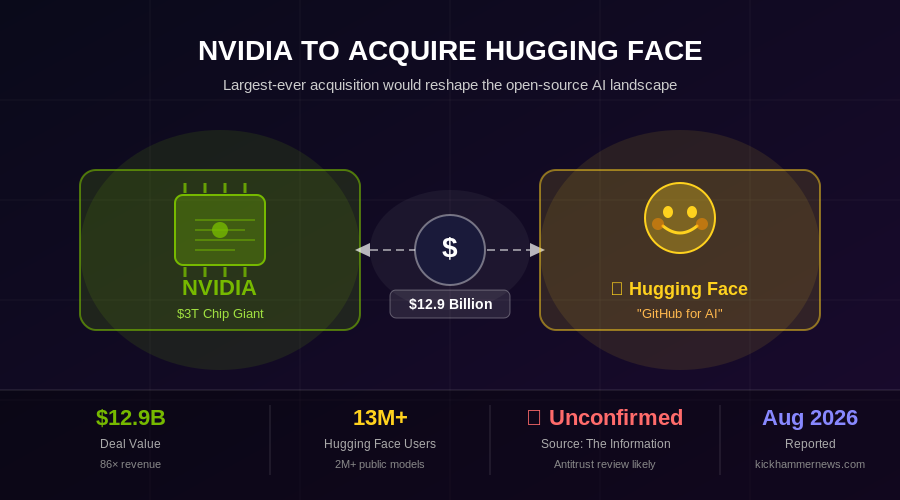
The AI industry woke up this week to a seismic report: Nvidia, the $3 trillion chipmaker that has become the engine of the artificial intelligence boom, has reportedly agreed to acquire Hugging Face, the open-source platform widely known as the “GitHub for AI,” for approximately $12.9 billion. If confirmed, the deal would be the largest acquisition in Nvidia’s history — and one of the most consequential consolidation moves in the young history of generative AI.
The report, first published by The Information and quickly picked up by CNBC, Fortune, and dozens of other outlets, cites a person familiar with the agreement. Neither Nvidia nor Hugging Face has publicly confirmed the deal. Business Insider, meanwhile, offered a more cautious read: that serious discussions at a valuation above $13 billion had taken place but that no definitive agreement had been signed. As of Friday, both companies remained publicly silent.
What Is Hugging Face, and Why Does It Matter?
For anyone outside the AI developer community, Hugging Face may not be a household name — but inside that world, it is something close to infrastructure. Founded in 2016 as a chatbot company, Hugging Face pivoted to become the dominant open-source hub for AI models, datasets, and machine learning tools. By 2025, the platform counted more than 13 million users, over two million publicly available models, and more than 500,000 datasets.
Developers working on everything from large language models to image generators to robotics pipelines rely on Hugging Face the way software developers rely on GitHub: to find, test, share, and deploy the components of their systems. The platform hosts models from every major AI lab, including Meta’s Llama family, Mistral, Google’s Gemma, and thousands of community fine-tunes. Its transformers library has been downloaded billions of times.
That reach is exactly what makes it so valuable — and exactly what makes Nvidia’s reported acquisition so complicated.
The Numbers Behind the Deal
At $12.9 billion, Nvidia would be paying roughly 86 times Hugging Face’s annualized revenue of approximately $150 million. That multiple reflects not the current cash flow, but the strategic value of owning a platform that sits at the center of how AI is built and distributed globally.
To put the price in context: Nvidia’s previous largest acquisition was Mellanox Technologies, the networking chip company, which it bought for $7 billion in 2020. The proposed Arm acquisition — which would have been a $40 billion deal — collapsed in 2022 under international antitrust pressure.
Hugging Face’s most recent outside fundraise was a $235 million Series D in 2023 that valued the company at $4.5 billion. Investors in that round included Google, Amazon, Salesforce, AMD, Intel, Qualcomm, and IBM — as well as Nvidia itself. Reports from late 2025 indicated that Nvidia had proposed a $500 million follow-on investment at a $7 billion valuation, which Hugging Face declined, reportedly because its leadership didn’t want any single investor to gain outsized influence over the platform’s direction. Full acquisition would, of course, eliminate that concern entirely — in Nvidia’s favor.
Why Nvidia Wants This
Nvidia CEO Jensen Huang has long been a vocal advocate for open-source AI. His argument is straightforward: accessible models drive adoption, adoption drives compute demand, and compute demand means more Nvidia chips. In that framing, owning Hugging Face isn’t just a business move — it’s a way to cement Nvidia’s position at every layer of the AI stack, from the silicon up through the software ecosystem.
Hugging Face already lets developers rent compute to run their models, a capability that, if brought under Nvidia’s roof, could give the company a ready-made outlet for its cloud capacity and a direct relationship with the millions of developers who currently access the platform for free.
As Siddy Jobe, a fund manager at Eonopolis Exponential Technologies, told CNBC: “Nvidia is very much a community and platform-oriented company, and Hugging Face is precisely the type of company it is.” He added that the move signals Nvidia’s intent “to be integrated at every level of the stack, from energy all the way through to foundational models and on to applications.”
The Concerns: Neutrality, Antitrust, and the Open-Source Community
Not everyone is cheering. The acquisition — if it closes — would hand the dominant AI chip supplier control over the most important neutral ground in open-source AI. Hugging Face has cultivated partnerships with AMD, AWS, Google, and others precisely because it positioned itself as a platform that belonged to the community, not to any one vendor.
That neutrality is now at risk. Competitors who currently host their models on Hugging Face — and who rely on the platform’s APIs and integrations in their own products — would suddenly find themselves dependent on infrastructure owned by their chip supplier.
Antitrust scrutiny is a near certainty. Nvidia’s proposed Arm acquisition in 2022 fell apart because regulators in the United States, United Kingdom, and European Union concluded that it would give Nvidia too much control over fundamental semiconductor IP used by the entire industry. A Hugging Face acquisition raises analogous concerns: would Nvidia use ownership of the platform to disadvantage AMD-optimized models, to steer developers toward its own cloud infrastructure, or to restrict access for AI labs that compete with Nvidia’s growing software and services business? The Federal Trade Commission and its European counterparts will almost certainly take a long look.
What Happens to Open Source?
The open-source AI community is watching carefully. The fear is that corporate ownership could gradually reshape what has been a genuinely neutral commons — in terms of which models are featured, how compute is priced, and which hardware is recommended in documentation and tutorials.
That concern may be partly mitigated by incentives: a closed or restricted Hugging Face would simply drive developers to alternatives, destroying the very asset Nvidia paid $12.9 billion for. And both Nvidia and Hugging Face have signed the same industry letter urging U.S. policymakers to keep advanced model weights accessible.
Still, there is a meaningful difference between a community-owned platform and a platform owned by the world’s most powerful AI hardware company. Governance structures, editorial decisions about what models are allowed, how compute credits are priced, which hardware is highlighted in tutorials — all of these could shift, subtly or not so subtly, under new ownership.
A Deal That Defines an Era
Whether this deal closes, gets blocked by regulators, or falls apart in final negotiations, the very fact that it is happening — that Nvidia is reportedly willing to spend nearly $13 billion to own the infrastructure layer of open-source AI — tells you something important about where the industry is headed.
The AI boom is no longer just about who makes the best chips or trains the biggest models. It is increasingly about who owns the platforms, the communities, and the distribution channels through which AI reaches the world. Nvidia, which already dominates the hardware layer, is now reportedly reaching for the software layer too.
Hugging Face began as a quirky chatbot startup, became the world’s most important AI model repository, and may now become the latest jewel in Jensen Huang’s expanding empire. The deal is unconfirmed. But the implications are already reverberating through every corner of the AI industry.


