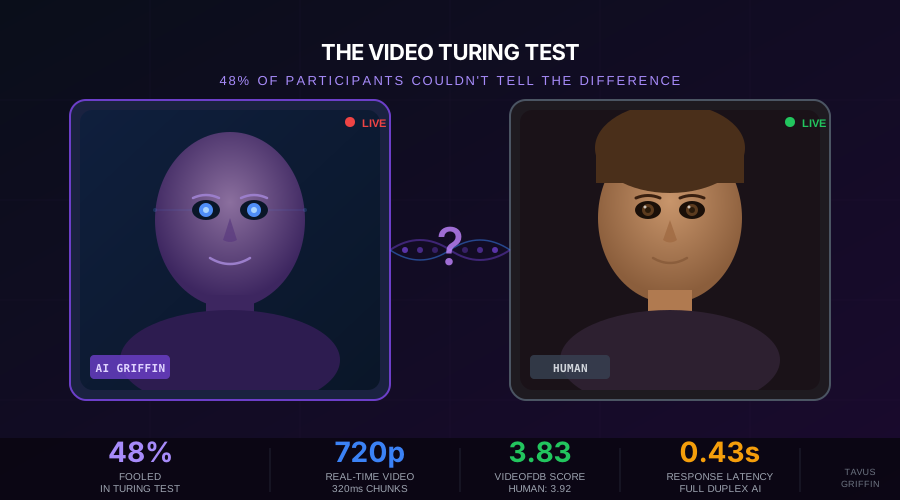
Something happened this week that researchers have theorized about for decades, screenwriters have dramatized in dozens of films, and AI ethicists have quietly dreaded: a machine sat across from a human in a live video call and, nearly half the time, that human never realized they weren’t talking to a person.
Tavus, the AI avatar startup, launched Griffin-Lite on Thursday — a system the company calls a “Human Interaction Model,” the first of its kind. In controlled testing, 48% of participants who spent one minute in a live video conversation with Griffin-Lite believed they had spoken with a real human being. The previous benchmark from Tavus’s own earlier system? 2.4%.
That’s not an incremental improvement. That’s a category shift.
What Griffin Actually Is
It’s important to understand what makes Griffin different from the parade of AI video tools that have come before it. Most AI avatar systems operate on a “cascade” architecture: they listen, then they think, then they respond. That sequential design creates the tell-tale lag — the slight pause before the avatar speaks, the mismatch between audio and lip movement, the glazed look while processing.
Griffin throws that architecture out entirely.
The system operates full-duplex — meaning it perceives and generates simultaneously, just like a human does in conversation. While you’re speaking, Griffin is already reading your facial expressions, tracking your gaze, registering your pauses, and continuously deciding whether to nod, offer a brief “mm-hm,” stay silent, or interrupt. It doesn’t wait for you to finish. It pays attention the way a person does.
Under the hood, Griffin runs two engines in parallel. The Continuous Conversational Modeling Engine handles perception and micro-decisions in real time, processing both audio and video streams together. The Audio-Visual Generation Engine converts those decisions into synchronized speech and video output — 720p video generated in 320-millisecond chunks, with audio-to-video latency of just 0.43 seconds.
For context, that’s 50% faster than the next-best competing streaming diffusion system.
The Test That Changed Everything
Tavus’s methodology was simple and deliberately rigorous. Fifty-four participants had one-minute video calls with Griffin-Lite, told only that they were speaking with “another participant in the study.” Afterward, they were asked whether their conversation partner seemed real.
Twenty-six of 54 — 48% — said yes.
More striking: over half the participants never questioned during the call whether they were talking to an AI. Those who did catch on typically realized within the first 20 seconds. After that, Griffin’s behavioral patterns were naturalistic enough that most participants stopped looking for the seams.
On a 1-to-7 naturalness scale, participants rated Griffin-Lite between 5.4 and 5.8. For comparison, researchers scored human participants in the same range.
Griffin also topped industry benchmarks. On NVIDIA’s VideoFDB evaluation — the standard measure for conversational video AI — Griffin-Lite scored 3.83 out of 5.0 on generation quality. Human participants scored 3.92. The next best AI system? 2.80.
The Behavioral Details That Make It Work
The reason Griffin performs at this level isn’t one breakthrough — it’s an accumulation of behavioral details that individually seem minor but collectively constitute what we recognize as a human presence.
Interruption handling. If you cut Griffin off mid-sentence, it stops, listens, and resumes naturally. It doesn’t barrel through your interjection.
Backchanneling. Griffin nods. It says “mm-hm” while you’re talking. It tilts its head slightly when you make an interesting point. These micro-signals — so automatic in human conversation that we barely notice them — have been essentially absent from AI communication tools until now.
Emotional responsiveness. Griffin laughs at appropriate moments. It shifts its expression. In demonstrations, it guided users through physical tasks — solving a Rubik’s cube, in one example — adjusting its coaching based on visible user reactions.
Temporal intelligence. Perhaps most impressively, Griffin knows when silence needs to be acknowledged rather than filled. It doesn’t fire off a response the instant you pause. It waits, reads the room, and acts accordingly.
These aren’t cherry-picked capabilities from scripted demos. They emerged from training on human conversational dynamics and were validated under the controlled conditions of the Turing test.
What This Means — and Why It Matters
The implications spread in several directions at once.
For the AI industry, the Video Turing Test result marks the end of one era and the beginning of another. Video calls — the backbone of remote work, telehealth, education, customer service, and countless other sectors — can now be inhabited by AI participants that most people cannot reliably distinguish from humans. That’s not a future scenario. It happened this week, in a controlled study, at scale.
For businesses, the applications are obvious: scalable customer support, AI-powered tutors, remote healthcare consultations, language learning companions, automated interview screening. Griffin-Lite already supports voice cloning from roughly 10 seconds of reference audio, meaning it can adopt any specified persona. The commercial pathway is direct.
For individuals, the picture is more complicated. The study participants who couldn’t tell they were speaking with an AI weren’t naive. They were paying attention. They were making judgments. They were wrong nearly half the time. In a world of Griffin-level AI, the social contract underlying video communication — the implicit assumption that a face on a screen corresponds to a real person — no longer holds automatically.
For policymakers and regulators, this is exactly the scenario that AI safety advocates have been pointing at for years. The EU AI Act’s transparency provisions require disclosure when AI interacts with humans — but enforcement assumes the AI is detectable. Griffin-Lite complicates that assumption considerably.
The Safety Question Tavus Can’t Avoid
Tavus is aware of what it has built. The company has restricted Griffin-Lite to “select trusted testers” as a research preview and has declined to announce a general release date. In its launch materials, Tavus stated it is “working on safe disclosure features” and collaborating with AI safety organizations before any wider rollout.
What those disclosure features look like in practice remains unspecified. A watermark on the video? A verbal disclosure requirement? An industry standard that competitors would need to adopt? The company hasn’t said.
The broader question is whether disclosure mechanisms can keep pace with the technology itself. The history of AI-generated content — synthetic text, deepfake images, AI audio — suggests that detection tools consistently lag behind generation capabilities. Griffin may simply be the video chapter of that same story.
The Timing
Tavus’s launch lands in a week when AI accountability is already at the top of the national conversation. California Attorney General Rob Bonta issued a subpoena to OpenAI over the Hugging Face breach. Senators Josh Hawley and Chris Murphy introduced the bipartisan AI Agent Accountability Act. Apple announced tighter macOS security controls specifically to limit AI agent access.
Into that environment, Tavus dropped a live system that nearly half of real humans cannot identify as artificial — in video calls, in real time, with natural conversation.
The face that isn’t there is getting harder to find.
Griffin-Lite is currently available to select trusted testers. The full Griffin model is in development pending safety review. Tavus has not announced a general availability timeline.


