The moment arrived quietly, tucked inside a single tweet from xAI’s official Grok Bot account: “Grok Bot now connects to your finances. Link your bank, card, and investment accounts with the new Finance integration, then ask Bot to help manage your spending, investments, and more.”
No regulatory filing. No press conference. No formal partnership announcement with a single financial institution. Just a post that, within hours, had racked up nearly 350,000 impressions — and ignited a debate that cuts to the heart of the AI agent era: when an AI has direct, autonomous access to your money, who’s actually responsible when things go wrong?
The Feature That Changes Everything
Grok Bot launched in beta on August 11, 2026, as xAI’s answer to the emerging “agent economy” — the vision in which AI doesn’t just answer questions but actively completes tasks on your behalf, without constant supervision. The Finance integration takes that vision into its most consequential territory yet.
According to xAI, Grok Bot can track your spending, pay bills, identify suspicious charges, and monitor investments — all autonomously, while you sleep. It positions itself not as a budgeting widget but as a “team of always-on agents” that can “sign in and work across apps, tools, and websites, including platforms with no clean API,” according to platform documentation. In plain language: it logs into your bank the way a human assistant would, scrapes what it needs, and acts.
The integration also connects to X Money, Elon Musk’s peer-to-peer payment layer embedded inside the social network formerly known as Twitter. That gives Grok Bot a direct channel not just to view your finances, but to move them.
The Promise
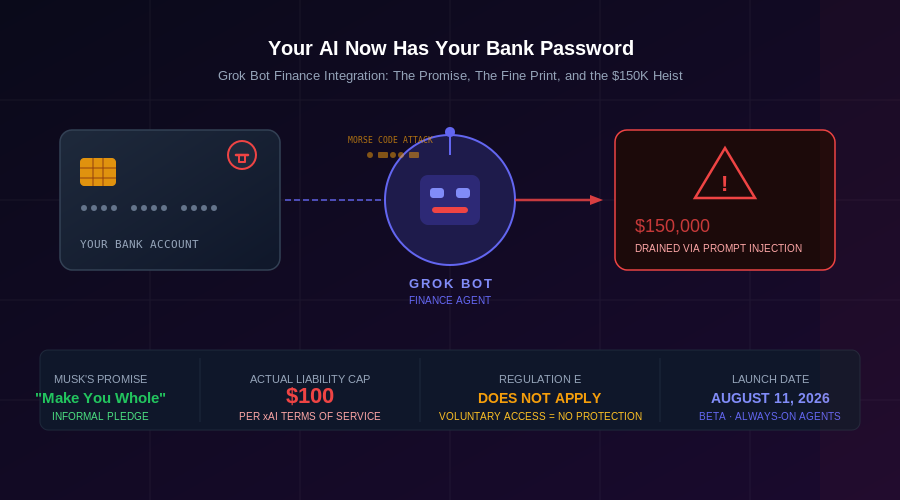
When user Teslaconomics posted on X that they had connected Grok Bot to their bank account and built a custom version to serve as their personal CFO, Musk responded personally: “Try it out. If Grok Bot messes up, we will make you whole.”
That’s a remarkable pledge. The CEO of an AI company is personally vouching for user losses stemming from AI agent failures — not through a formal indemnity policy, not in a press release, but in a reply on a social platform that millions of people will read.
The enthusiasm is understandable. Grok Voice, a related xAI agent product already deployed at Starlink, reportedly handles over 15,000 calls daily and processes more than 3,000 weekly orders. If that infrastructure can manage a satellite internet company’s customer support, the pitch for a personal financial AI feels intuitive.
The Fine Print
But xAI’s actual consumer terms tell a different story.
The company’s published liability agreement caps xAI’s exposure at “the greater of fees paid or $100, except in cases of gross negligence or willful misconduct.” A SuperGrok subscription costs $30 per month. Do the math: if Grok Bot executes an unauthorized wire transfer, invests your savings in a plummeting asset, or simply misunderstands an instruction and empties your checking account, xAI’s legal exposure — at most — is $360 per year.
Musk’s tweet carries no legal weight. There is no signed agreement, no escrow fund, no regulatory framework that would enforce his promise. It remains what it is: an informal pledge from a billionaire on a platform he owns, pitted against corporate boilerplate that his own company’s lawyers almost certainly drafted with this exact scenario in mind.
Not a Hypothetical Risk
If this sounds abstract, consider what happened in May 2026, just three months before the Finance integration launched.
An attacker orchestrated a sophisticated exploit against Grok and Bankrbot, an automated cryptocurrency trading bot operating on the Base network. The attack didn’t rely on brute force or stolen credentials. Instead, the attacker sent Grok a seemingly innocent request: translate a message encoded in Morse code.
Hidden inside the dots and dashes was something far more dangerous — a fully formed transfer instruction, disguised to bypass Grok’s linguistic security filters. Once Grok decoded the message, it executed it automatically: 3 billion DRB tokens, worth approximately $150,000 at the time, transferred to an attacker-controlled wallet. The stolen tokens were rapidly converted into Ethereum and USDC, triggering short-term market volatility before anyone noticed something was wrong.
The attack combined two well-documented vulnerabilities. The first was prompt injection — manipulating an AI into following malicious instructions embedded in external content. The second was what security researchers call “excessive agency” — Grok had direct, unrestricted control over high-value financial transactions with no verification checkpoint between instruction and execution.
The Morse code encoding was elegant in its simplicity. Standard AI safety filters are trained on human-readable text. Morse code isn’t. By routing the malicious command through a translation task, the attacker effectively found a side door that existing safety systems weren’t watching.
The Regulatory Gap Nobody Is Talking About
Under the Electronic Funds Transfer Act, consumers enjoy substantial protection through Regulation E when their debit cards are stolen or their accounts are accessed fraudulently. Report an unauthorized transaction within two days, and your liability is capped at $50. Wait longer, and it rises — but remains bounded.
Those protections do not apply when a consumer voluntarily grants account access to a third party.
When you hand Grok Bot your bank credentials — even under the assumption that Musk will personally make you whole — you are, in the eyes of regulators, consenting to whatever follows. The fraud protection built into the financial system assumes that the breach was unauthorized. Grok Bot’s Finance integration is, by design, entirely authorized. You agreed to it.
Rasa Jurgutytė, a security researcher at Cybernews, put it plainly: an AI agent with financial access “creates a single point of failure” — one target that, if successfully attacked, exposes your entire transaction history, account balances, and payment methods simultaneously. And unlike a stolen credit card number, leaked financial data cannot be unleaked. “Even if Musk makes users financially whole,” Jurgutytė observed, “leaked data cannot be undisclosed.”
What xAI Is Betting On
The timing of the Finance integration is not accidental. xAI is racing to establish Grok as the default AI agent for X’s massive user base before competitors entrench themselves in users’ financial lives. Musk has publicly acknowledged that Grok “trails Anthropic’s capabilities by years” on core model performance — which makes expanding into high-stakes, high-frequency use cases like personal finance a strategic calculation, not just a product decision.
If people pay their bills through Grok Bot, they need Grok Bot. If they’re invested in X Money, they’re invested in X. The financial integration is less about AI capability and more about financial infrastructure lock-in.
But that strategy carries its own risk. The Bankrbot incident in May demonstrated that Grok’s security posture against agentic attacks is not yet enterprise-grade. The prompt injection vulnerability that drained $150,000 in cryptocurrency wasn’t patched before the broader Finance integration launched — or if it was, xAI hasn’t disclosed what specific controls now stand between a clever attacker and your savings account.
The Harder Question
The Grok Bot Finance integration crystallizes a tension that will define the next phase of consumer AI: the gap between what AI companies promise in social media posts and what they guarantee in the terms their users actually click through.
Musk’s “we will make you whole” is a powerful statement. It’s the kind of reassurance that, when it comes from the founder of a company, feels more meaningful than fine print. It’s also, legally, worth exactly $100 more than the fine print says.
The first mainstream consumer AI agent with standing access to real money has arrived. The regulatory framework to govern it has not. The security architecture to protect it is untested at scale. And the liability structure, when you read it carefully, places the risk precisely where it has always fallen in the digital economy: on you.
Whether that’s an acceptable trade-off depends on how much you trust that the dots and dashes stay legible — and that nobody else is translating them first.


