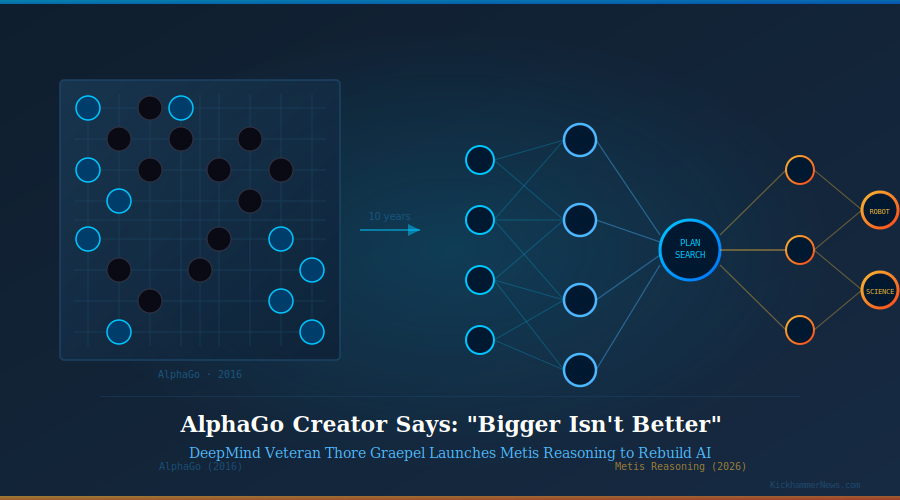
Thore Graepel spent a decade helping push artificial intelligence to its limits. Now he’s betting that the entire industry is climbing the wrong mountain.
In the spring of 2016, inside a packed Seoul theater, Thore Graepel watched history unfold in real time. The Go-playing program he had helped build at DeepMind was facing Lee Sedol, one of the greatest Go players in human history, in a five-game match that most of the AI research community had thought impossible. AlphaGo won four games to one, and in doing so, it didn’t just beat a world champion — it redefined what people believed computers could achieve.
What struck Graepel that week wasn’t pride, though there was plenty of that. It was a nagging question: *If we can do this, what does that tell us about what we’re still doing wrong?*
Nearly a decade later, Graepel has his answer. On Thursday, Bloomberg reported that the longtime DeepMind researcher has quietly departed the organization he called home for most of his career to launch Metis Reasoning, a new startup built around a single contrarian thesis: the next great leap in artificial intelligence will not come from making language models bigger.
The Man Behind the Milestone
Graepel joined DeepMind in 2015, just over a year before the AlphaGo-Lee Sedol match, becoming one of the core architects of what remains one of the most celebrated achievements in the history of AI. Before that, he had already built a distinguished academic career at Cambridge and University College London, working on probabilistic inference, reinforcement learning, and Bayesian game theory — a foundation that would prove directly relevant to what AlphaGo needed to do: reason under uncertainty, search intelligently through vast possibility spaces, and learn from self-play.
Between stints at DeepMind, Graepel spent four years at Altos Labs working on computational biology — using AI not to play games or generate text, but to model the extraordinary complexity of living systems. That experience appears to have deepened his skepticism of language-model approaches to intelligence. Biological problems don’t yield to pattern-matching alone; they demand genuine mechanistic understanding, the ability to reason about systems you’ve never seen before.
He returned to DeepMind and stayed until summer 2026, when he quietly handed in his notice and began the work of building something new.
What Metis Reasoning Actually Does
The company name is a clue. In Greek mythology, Metis was the goddess of wisdom, craft, and cunning intelligence — a figure known not for brute strength but for strategic depth and the ability to devise solutions to unprecedented problems. That’s the kind of intelligence Graepel is trying to build.
Metis Reasoning is focused on what researchers call structured search combined with probabilistic planning — approaches that have roots in classic AI research but have been eclipsed in recent years by the spectacular commercial success of large language models. The core insight is that many of the problems humanity actually needs AI to solve — scientific discovery, engineering design, autonomous robotics — are not retrieval problems or statistical interpolation exercises. They are genuine search problems, requiring systems that can navigate enormous solution spaces, form hypotheses, test them efficiently, and revise their understanding as new evidence arrives.
In Graepel’s framing, today’s dominant LLMs are extraordinarily capable memorizers and pattern-matchers. They can tell you what brilliant people have already thought. What they struggle with, he argues, is inventing genuinely new solutions — particularly in domains where training data is sparse, where the right answer has never been written down anywhere, or where the problem requires reasoning through causal chains that aren’t in any dataset.
“The next leap in AI won’t come from making language models bigger,” he is reported to have told potential investors. His approach is not anti-neural-network — Metis Reasoning will certainly use deep learning — but the architecture will be designed around explicit search and planning processes rather than the transformer-based, next-token-prediction paradigm that has dominated the field for nearly a decade.
The Funding Picture
Graepel is currently raising an initial round in the “tens of millions” of dollars from a small group of backers, according to people familiar with the matter cited by Bloomberg. If successful, the company could later seek “hundreds of millions” in a follow-on round at a higher valuation. Discussions remain in early stages, and no lead investor has been publicly identified.
The numbers are modest by the standards of today’s AI fundraising market — OpenAI raised $40 billion in a single round earlier this year — but they reflect the exploratory nature of the work. Metis Reasoning is not yet building products for enterprise customers. It is, by its founder’s own description, conducting fundamental research into a different kind of AI architecture. The money it needs now is the money to figure out whether the approach works.
A Pattern of DeepMind Departures
Graepel’s exit is the latest in a growing exodus of senior researchers from one of the world’s most storied AI laboratories. In January 2026, David Silver — another AlphaGo luminary, often credited as its lead designer — left to found Ineffable Intelligence, a company working on agent architectures for scientific research. OpenAI’s Ilya Sutskever, who also has deep roots in the early DeepMind era, founded Safe Superintelligence Inc. in 2024 after his dramatic departure from OpenAI.
The pattern isn’t hard to decode: researchers who cut their teeth on reinforcement learning, game-playing agents, and planning algorithms — the “classical” wing of modern AI — are increasingly convinced that the language model paradigm, despite its commercial dominance, is hitting fundamental limits. They are betting their careers and reputations on the idea that the next architectural breakthrough is coming, and that the people most likely to find it are those who remember what was left behind.
“AlphaGo didn’t learn to play Go by reading Go books,” one AI researcher, speaking anonymously, told Sifted. “It learned to play Go by playing Go — billions of times, searching the game tree, updating its estimates. That’s a completely different thing from what a language model does.”
The Skeptics Have a Point, Too
Not everyone in the field is convinced that a return to search-based approaches represents the path forward. The counterargument, made frequently and forcefully by defenders of the scaling paradigm, is that the rapid improvement of large models over the past three years has consistently surprised even their creators. GPT-6, Gemini 3, and Claude Opus 5 — models released in 2025 and early 2026 — have demonstrated reasoning capabilities that most experts would have predicted were years away.
Moreover, the integration of reinforcement learning with language models — exemplified by systems like OpenAI’s o1 and its successors — has already begun to close some of the gap between pure pattern-matching and genuine search. These “thinking” models explicitly reason through problems step by step before committing to an answer, borrowing ideas from the search-and-plan tradition without abandoning the language model architecture entirely.
Critics of ventures like Metis Reasoning argue that the hybrid approach will continue to dominate: language models for their unparalleled breadth of knowledge and natural-language interface, reasoning modules for structured problem decomposition. Why build an entirely new paradigm when you can retrofit the existing one?
Why the Bet Might Pay Off
Graepel’s counter to this is the domains where today’s models still struggle most visibly: robotics, where AI agents must plan actions in continuous physical environments under uncertainty; scientific discovery in low-data regimes; and complex multi-step engineering challenges where a single wrong assumption early in the reasoning chain cascades into catastrophic failure.
These are also, not coincidentally, the domains where the economic stakes are highest. Drug discovery, materials science, autonomous manufacturing — the companies that crack reliable AI reasoning for these applications will not be selling chat subscriptions. They will be capturing value that dwarfs the consumer AI market.
Graepel’s target sectors for Metis Reasoning are reported to include robotics, science, and engineering — precisely the domains where the limitations of current models are most acute.
The Significance of the Moment
There’s something quietly significant about the timing of Graepel’s announcement. It comes in the same week that UN Secretary-General António Guterres convened the first-ever Security Council meeting devoted to AI — a meeting that featured Sam Altman and Dario Amodei warning world leaders about the risks of unchecked AI development. It comes as AMD crossed a trillion-dollar market cap on the strength of AI chip demand, and as the AI arms race between America and China continues to accelerate on every available metric.
In that context, a single researcher leaving a prestigious lab to pursue a contrarian approach with modest initial funding can look like a footnote. But in the history of artificial intelligence, moments like this tend to matter more than they appear to at the time. The people who built the systems that changed everything often had the clearest view of what those systems couldn’t do.
Thore Graepel spent years helping build AlphaGo. He watched it solve a problem that was supposed to be a decade away, and then he spent the years since thinking about what came next. Now he’s left a comfortable perch at one of the world’s great research institutions to chase the answer.
The industry will be watching.
Sources: Bloomberg, Sifted, Investing.com, CryptoBriefing


