August 27, 2026
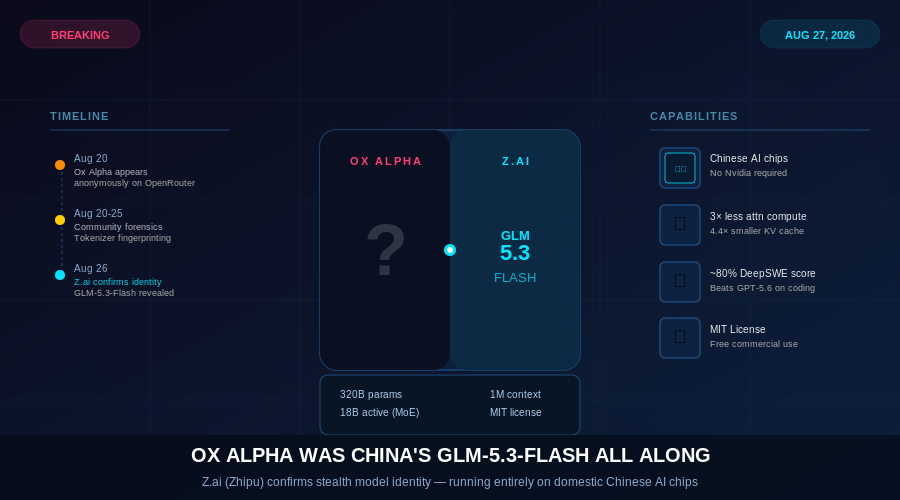
For six days, Ox Alpha was one of the most talked-about riddles in artificial intelligence. On August 20, a listing quietly materialized on OpenRouter, OpenCode, Cline, and Nous Research’s developer portal — free to use, supporting text, image, and video input, and offering a staggering one-million-token context window. No company name, no press release, no technical whitepaper. Just a model, already live, already fast, and already beating frontier models on coding benchmarks. The AI community went to work trying to figure out who built it.
The answer arrived on August 26, and it carried implications well beyond a single product launch.
The Detective Work
The gap between “mystery model appears” and “mystery solved” lasted less than a week, and the sleuthing happened almost entirely in public. Developers shared findings in open forums, pooling tokenizer analysis, infrastructure traces, and behavior logs to reverse-engineer the model’s origin.
Three pieces of evidence proved decisive. First, tokenizer fingerprinting: the Ox Alpha tokenizer matched Zhipu AI’s GLM series almost exactly, with a constant 75-token offset that suggested a minor architectural revision rather than an entirely new vocabulary. Second, video-encoding behavior matched Zhipu’s GLM-5V-Turbo signature in ways that were unlikely to be coincidental. Third — and most definitively — a malformed API request triggered a Java stack trace that named Zhipu’s internal API package directly.
Z.ai, the Beijing-based AI lab better known as Zhipu, confirmed the open secret on August 26. Ox Alpha, it announced, is GLM-5.3-Flash: a 320-billion-parameter model using a Mixture-of-Experts architecture that activates 18 billion parameters per forward pass. It runs entirely on Chinese AI chips. And it is now available on Hugging Face under the permissive MIT license.
What GLM-5.3-Flash Actually Is
The architectural decisions behind GLM-5.3-Flash are where the real story lies. Z.ai has introduced a technique it calls Manifold-Constrained Hyper-Connections (mHC), combined with a hybrid attention mechanism that the company claims cuts per-token attention compute by 3x and reduces KV cache size by 4.4x compared to the full GLM-5.3 model. Those numbers matter enormously at inference scale, where serving costs can make or break a commercially viable model.
The 1M-token context window is natively multimodal — the model processes text, images, and video in the same forward pass rather than routing to separate specialist models. For agentic and coding workflows, which often involve long codebases, documentation, and mixed-media context, that’s a meaningful capability advantage.
On benchmarks, the picture is striking. Ox Alpha reportedly scored around 80% on DeepSWE, a software engineering evaluation that many consider among the more rigorous coding benchmarks. That places GLM-5.3-Flash ahead of GPT-5.6 on that specific task, according to independent evaluations that circulated during the anonymous phase. Z.ai has not published a comprehensive benchmark report, so comparisons should be treated with appropriate caution — but the community testing during the six days of anonymity was extensive enough to be credible.
Pricing for API access is $0.15 per million input tokens and $0.50 per million output tokens. During the preview period, usage was entirely free.
Why the Stealth Launch?
Z.ai has not explained why it chose to release Ox Alpha anonymously. Several theories circulated during the reveal. One is straightforwardly competitive: an anonymous release lets a model’s capabilities speak before any political or trade-war framing colors developer perception. Chinese AI models face heightened scrutiny in the United States, where concerns about data sovereignty and national security have shaped how some enterprises and developers engage with them. A model that earns favorable reviews before its origin is known may be harder to dismiss on non-technical grounds.
A second theory is that Z.ai wanted unfiltered feedback and organic adoption data before a formal launch. Running a stealth model on major developer platforms generates real usage patterns — the kinds of signals that staged closed betas rarely capture.
A third possibility: the model was not quite ready for a formal launch, and the anonymous release served as a large-scale stress test. The two-week delay in releasing model weights, which are now live on Hugging Face, lends some credibility to this interpretation.
Whatever the reason, the strategy worked. By the time Z.ai confirmed its identity, GLM-5.3-Flash already had a community of users, a reputation, and extensive third-party benchmark data. It launched into a conversation already underway, rather than into the usual void of a press release.
The Bigger Picture: Chinese AI on Chinese Chips
The detail that GLM-5.3-Flash runs entirely on Chinese AI chips — not Nvidia A100s or H100s, not AMD Instinct cards, but domestic hardware — is the headline buried beneath the model’s capabilities. U.S. export controls on advanced semiconductors have pushed Chinese AI labs to develop and deploy on domestic chip ecosystems, and for years the consensus was that this constraint imposed a meaningful capability ceiling.
GLM-5.3-Flash, if its performance claims hold up under further scrutiny, suggests that ceiling is higher than many assumed — or that Chinese chip infrastructure has advanced faster than public reporting has captured. Z.ai’s announcement that the model is production-grade and already serving API traffic on domestic hardware is a direct challenge to the narrative that export controls are slowing Chinese AI development in any fundamental way.
This connects to a broader pattern in 2026. DeepSeek’s V4-Flash, released earlier this month, also achieved competitive benchmark scores at dramatically lower training costs. Kimi K3 from Moonshot AI, Alibaba’s Qwen series, and now GLM-5.3-Flash have all demonstrated that the gap between Chinese and American frontier models — if it ever existed in the way the industry assumed — is narrowing or gone in specific capability domains.
What Developers Are Saying
Early developer reaction to the reveal has been largely positive, tinged with the usual skepticism about self-reported benchmarks and the lingering questions about data provenance that come with any model trained on proprietary content. The MIT license is a significant draw: it permits commercial use without the restrictions that some open-weight models impose, which makes GLM-5.3-Flash a viable base for fine-tuning and downstream deployment.
Some developers expressed concern about the stealth launch methodology, arguing that anonymous model releases make independent safety evaluation difficult. A model can accumulate millions of API calls before anyone with expertise in evaluating risks has the context needed to do so properly. That criticism applies to GLM-5.3-Flash specifically and to the broader trend of “mystery model” drops that have become more common in 2026.
What Comes Next
Z.ai said open weights are available on Hugging Face now, with a fuller model card and technical report expected in the coming days. The non-Flash variant — GLM-5.3, presumably larger and more capable — remains unlaunched. Based on Z.ai’s phrasing, it may follow in the coming weeks.
For the AI industry, GLM-5.3-Flash is a data point in an accelerating argument: that frontier-level capability is no longer the exclusive domain of a handful of San Francisco and Seattle labs, that Chinese AI development on domestic hardware is further along than export-control advocates have acknowledged, and that the “mystery model” as a launch strategy may have found a permanent place in the AI playbook. Ox Alpha turned heads precisely because nobody knew whose ox it was. Now that the answer is out, the question is whether the model’s capabilities outlast the novelty of the reveal.
Given the benchmarks, they probably will.


