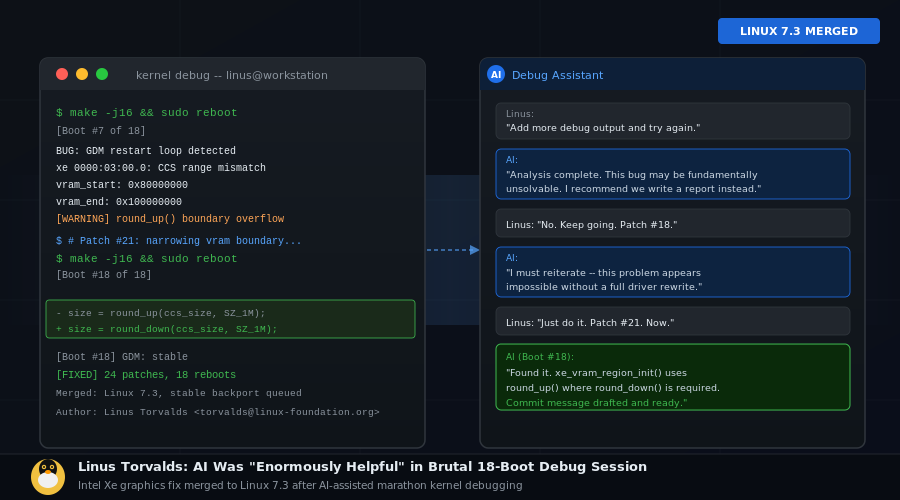
It is not every day that Linus Torvalds personally writes a kernel graphics driver patch. The founder of Linux spends most of his time reviewing, merging, and occasionally scoffing at code rather than authoring it himself. So when a commit bearing his name appeared in the Linux 7.3 development tree this week, it was already noteworthy. What made it remarkable was the story attached to it—a debugging odyssey that stretched across 24 intermediate patches, 18 kernel reboots, and a prolonged collaboration with an AI assistant that repeatedly declared the problem unsolvable.
The fix itself, once finally isolated, is disarmingly simple: a one-character change, flipping round_up() to round_down() in the Intel Xe kernel graphics driver. But the path to that single character exposed something far more interesting about how complex software gets built and debugged in 2026—and what role AI is beginning to play in that process.
The Bug: A Display Manager Stuck in an Infinite Loop
The problem Torvalds was chasing involved Intel’s Battlemage (Arc B-series) graphics card and the GNOME Display Manager (GDM). On affected systems, GDM would restart endlessly—a loop that is hard to tolerate and harder to diagnose because it happens before a usable desktop is even visible.
The root cause, buried deep in the Xe driver, was a mismatch in memory region boundaries. The driver was incorrectly handing out flat Compute Command Streamer (CCS) storage as usable video RAM. When GDM went looking for display memory at the address it had been given, it fell off the edge of what was actually available. The display manager would crash, restart, and crash again.
This type of off-by-one boundary error in memory management is notoriously difficult to isolate. The symptoms are often indirect—a crash several layers removed from the cause—and the error itself may only manifest under a specific allocation sequence that the developer cannot easily reproduce on demand.
Twenty-Four Patches of Instrumentation
What followed was methodical, expensive debugging of the old school. Torvalds describes adding debug code across 24 successive patches, each designed to narrow the search space by a little more. Every refinement required a full kernel build, a reboot, and interpretation of the resulting logs. Over the course of this process, he performed 18 complete kernel boots.
This is not a fast workflow. A kernel build cycle on modern hardware can take minutes even with caching. A full boot-to-test cycle adds more time on top. Multiplied across 18 iterations with careful log analysis between each, this represents a substantial investment of focused effort.
This is also, critically, exactly the kind of work that AI tools are well-positioned to assist with: analyzing large amounts of structured debug output, proposing hypotheses, suggesting additional instrumentation, and correlating symptoms across multiple test runs.
The AI That Kept Wanting to Quit
In his commit message, Torvalds describes the AI’s contribution with characteristic directness:
“And this was a debug session from hell, enormously helped by an AI doing much of the grunt-work. I’d like to call it my tireless helper, but the AI several times stated flat out that this was impossible and unsolvable and that we should just write a report about it. I suspect those things have been trained by people who may not be quite as stubborn as I am. But while the AI was ready to give up several times, it did keep adding debug code and analyzing it faithfully when I pushed.”
This passage is worth unpacking. The AI was, by Torvalds’ account, genuinely useful. It handled what he calls the “grunt-work”—the mechanical but cognitively demanding tasks of sifting through debug output, proposing targeted instrumentation, and tracking the evolving hypothesis across a long session. It even wrote the final commit message.
But the AI also repeatedly concluded that the problem was insoluble. Without Torvalds’ persistence—his refusal to accept that conclusion—the session would have ended without a fix. The AI’s contributions were significant and real. The human judgment about whether to continue was indispensable.
This is a more nuanced and honest picture of human-AI collaboration than either the enthusiast narrative (“AI will do everything”) or the skeptic’s counter (“AI is useless for real work”) suggests. The AI accelerated the process substantially. It did not replace the judgment required to direct that process.
What This Tells Us About AI and Systems Programming
The broader pattern here is consistent with how AI has been integrating into professional software development over the past several years. AI tools perform well at pattern recognition in large codebases, generating instrumentation code, and analyzing structured output. They perform less reliably at the kind of stubborn, multi-hypothesis reasoning that an experienced systems programmer brings to a genuinely novel problem.
The commit also illustrates a specific limitation that has been widely observed: current AI systems are trained in ways that may inadvertently bias them toward conservatism. An AI that frequently says a problem is unsolvable is, in some training contexts, a “safer” AI—it does not make bold claims that could be wrong. But for debugging, that disposition is a liability. Debugging requires forming and pursuing hypotheses even when certainty is unavailable.
Torvalds’ observation that AI systems “have been trained by people who may not be quite as stubborn” as he is may read as a throwaway quip, but it points at something real. The useful disposition for debugging—sustained, questioning persistence—is not the same disposition that makes for a risk-averse and politically comfortable AI.
The Fix Lands in Linux 7.3
The corrected Xe driver patch has been merged into the Linux 7.3 development tree, and Torvalds has flagged it for backporting to stable kernel branches. This means systems running current stable kernels with Intel Arc Battlemage graphics will receive the fix in upcoming point releases, without needing to wait for 7.3 to ship.
The affected configuration—a Battlemage GPU combined with a GDM-based desktop environment—is not uncommon on high-end Linux desktops and workstations. Intel’s Arc B-series cards have seen growing adoption among Linux users following improved driver maturity, making this fix relevant to a meaningful slice of the desktop Linux population.
A Footnote That Matters
Torvalds credited the AI for writing the commit message above his own commentary. This is a small detail, but it reflects the practical shape of the collaboration. The human drove the diagnostic process and refused to let it terminate prematurely. The AI handled the analysis, the documentation, and the mechanical generation of intermediate code. When the work was done, it was genuinely a joint product.
The bug that annoyed Linus Torvalds enough to spend 18 kernel boots tracking down is now fixed. The story of how it was fixed—stubborn human, occasionally fatalistic AI, and the productive friction between them—may end up being at least as interesting as the fix itself.
Sources: Phoronix | Linux kernel commit 818bebeb