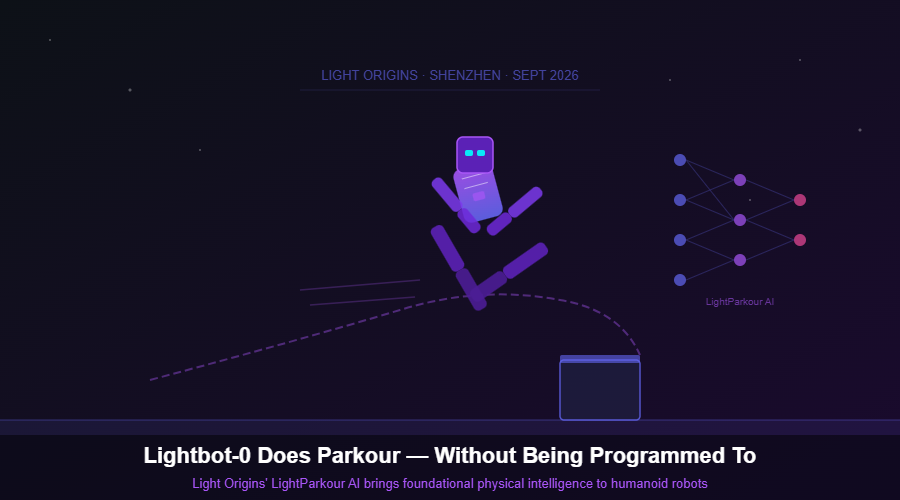
A compact humanoid robot from a Shenzhen-based startup is doing something that used to require months of painstaking manual programming from Boston Dynamics engineers: parkour. Speed vaults. Reverse vaults. Climbing obstacles. Hopping on one leg when the other is restrained. And it learned to do all of it autonomously, from short video clips of human movement, using a unified AI policy that generalizes across terrain rather than running a rigid list of pre-programmed instructions.
The robot is called Lightbot-0. The company is Light Origins. And the AI system behind it, LightParkour, may represent one of the most significant demonstrations yet of what the field calls “foundational physical AI” — the idea that robots, like large language models, can learn general-purpose skills from data rather than hand-coded rules.
What Is Lightbot-0?
Lightbot-0 is a custom-built humanoid: 90 centimeters tall, 18.9 kilograms, with 21 actuated joints. It’s small by humanoid standards — roughly the size of a child — but that compactness is by design. Light Origins founder Roger Jiang, a former OpenAI researcher who was a key contributor to GPT-4, built the platform to be a research vehicle for physical AI, prioritizing agility and sensor density over scale.
Jiang launched Light Origins in August 2024, after leaving OpenAI with a specific thesis: that the methodology behind large language models — learning general capabilities from vast amounts of data — could be applied to physical robotics. Where LLMs learn from text, Lightbot-0 learns from motion.
“We’re using the same philosophy as LLMs,” Jiang has said. “You give the model enough diverse experience, and generalization emerges.”
How LightParkour Works
LightParkour is a locomotion system built on what the team calls a “Real2Sim2Real” pipeline. The process begins with short clips of human motion — not full demonstrations, but seed motions: a vault, a step-up, a balance recovery. These clips are grounded in a physics simulator, where the system generates thousands of variations across different terrain configurations, obstacle heights, and surface conditions. The resulting policies are then distilled into a single deployable depth policy — a neural network that reads the robot’s environment through depth sensors and outputs motor commands in real time.
The key innovation is the distillation step. Previous approaches to agile robot locomotion typically trained separate controllers for separate tasks: one for walking, one for climbing, one for balance recovery. LightParkour combines locomotion and whole-body manipulation skills into a single policy, allowing the robot to fluidly switch between behaviors without a top-level state machine telling it which mode to use.
The results, shown in footage released by the company, are striking. Lightbot-0 walks over uneven terrain, steps up onto platforms, performs speed vaults over barriers, and recovers from pushes — all in response to the same unified policy. When researchers restrained one of its legs during testing, the robot adapted on the fly, hopping or crawling without any human intervention. When both legs were restrained, it switched to a crawling gait entirely, again without explicit programming for that contingency.
Why This Matters
The significance of LightParkour goes beyond the impressive video footage. For the past several years, humanoid robotics has been locked in a familiar cycle: demos that look impressive but break down immediately in unstructured real-world environments. The core challenge has been generalization — building robots that can handle the infinite variety of the physical world rather than succeeding only in carefully staged conditions.
LightParkour’s Real2Sim2Real approach attacks this problem directly. By generating terrain variation in simulation, the system exposes the policy to far more diversity than any real-world training run could provide in a reasonable timeframe. The depth-based perception, meanwhile, makes the policy agnostic to surface texture and lighting — two variables that have historically caused computer-vision-based robot controllers to fail in unpredictable ways.
This is not just a robotics achievement. It’s a demonstration of the broader thesis that scale and data diversity, rather than hand-engineering, are the right path to physical AI. If that thesis holds, it implies that the same dynamics that produced GPT-4 — more data, more compute, better architectures — can produce humanoid robots that are genuinely useful across a wide range of physical tasks.
Light Origins in Context
Light Origins is one of several Chinese humanoid startups that have emerged in the past two years with the explicit goal of challenging established Western players like Figure AI, Agility Robotics, and Boston Dynamics. Unitree, XPENG Robotics, and BYD Robotics have all released competitive hardware in 2025–2026. But Light Origins is differentiated by its explicit focus on the AI side of the stack rather than on hardware specs alone.
Jiang’s background at OpenAI gives the company a credibility that most pure-hardware startups lack. And the LightParkour paper, now posted to arXiv, provides enough technical detail for the research community to evaluate the claims independently — a level of transparency that is, notably, not yet common in the commercial humanoid robotics space.
The company has not yet announced commercial partnerships or a production timeline for Lightbot-0. The current focus is on expanding the policy’s capabilities — the research roadmap includes more complex manipulation tasks, interaction with dynamic obstacles, and deployment on larger humanoid form factors.
The Bigger Picture
What Light Origins has built fits into a broader inflection point in embodied AI. After years in which robotics and language AI advanced largely in parallel, the two fields are beginning to converge. Language models that can reason about spatial tasks, physical simulators that can generate photorealistic training data, and policies that can generalize from minimal human demonstrations are all maturing simultaneously.
The consequence is that the timeline to genuinely useful general-purpose humanoid robots — robots that can work in warehouses, labs, care settings, and eventually homes — is compressing faster than most analysts expected as recently as two years ago. LightParkour is one data point in that compression. It won’t be the last.
For now, a 90-centimeter robot in Shenzhen is doing parkour, and doing it because it learned to. That’s a different world than the one we were in even twelve months ago.


