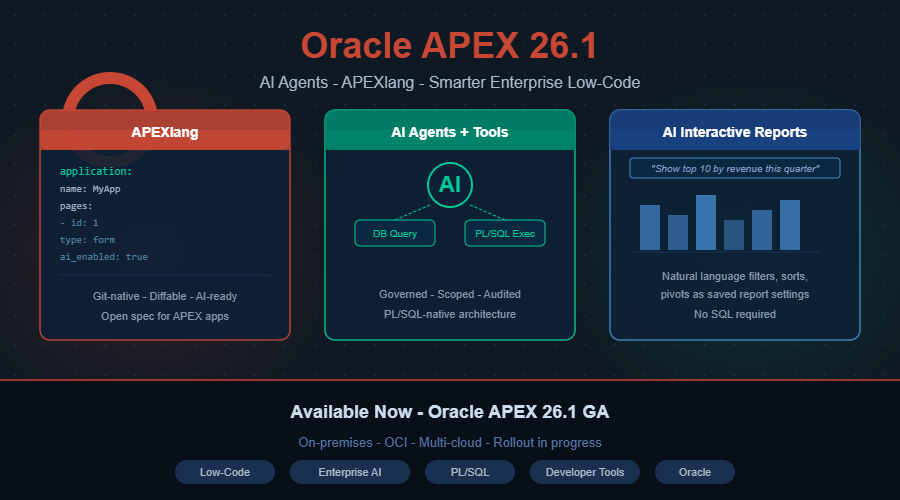
Oracle has quietly shipped one of the most consequential releases in the two-decade history of Application Express. APEX 26.1, now generally available for on-premises deployments and rolling out across Oracle Cloud Infrastructure regions, introduces three capabilities that collectively reposition the platform from a rapid-forms-builder into what Oracle is calling “the trustworthy way to build AI-enabled enterprise applications.” At the center of the release is APEXlang — a new open, declarative specification language that makes APEX applications legible to both human developers and large language models for the first time.
For the roughly six million developers Oracle claims use APEX globally, the question of how to responsibly incorporate generative AI into enterprise applications has been the dominant concern of the past two years. APEX 26.1 attempts a definitive answer.
APEXlang: Making APEX Applications AI-Readable
The headline innovation is APEXlang, which fundamentally changes how APEX applications are represented at rest. Instead of storing applications as binary metadata blobs inside the database — the historical approach — APEXlang exports an application as a package of structured .apx text files. Each file is human-readable, declaratively structured, and designed to be processed by standard developer tooling: version control systems, diff viewers, code scanners, linters, and crucially, AI coding assistants.
The practical implications are significant. A developer can now store an APEX application in a Git repository alongside the rest of a project’s source code, raise pull requests for application changes, review diffs before deployment, and run automated governance scans against the declarative metadata. These are workflows that software teams have taken for granted in traditional codebases for decades, but that APEX developers have historically had to work around using third-party export scripts and workarounds.
For AI tooling specifically, APEXlang provides something even more valuable: a structured schema that LLMs can generate against. Rather than asking a model to produce arbitrary JavaScript or PL/SQL and hoping it integrates correctly with an APEX runtime, developers can now prompt AI systems to generate .apx files that follow the APEXlang specification. The generated output can be validated against the schema before import, catching errors before they reach production. Oracle frames this as “governed generative development” — a meaningful distinction from the unconstrained code generation that has made many enterprises wary of AI-assisted development.
The format is also designed to be stable across APEX versions, which addresses a long-standing pain point for teams trying to maintain applications across major upgrades. By separating application intent (expressed in APEXlang) from runtime implementation, Oracle creates a more durable foundation for application lifecycle management.
Native AI Agents with Callable Tools
The second major addition is native AI Agents — and these are more capable than the simple chatbot integrations that many low-code platforms have bolted on in recent years. APEX 26.1 agents can call Tools, which are discrete, governed application capabilities that the agent is explicitly permitted to invoke.
In practice, a Tool might retrieve data from a specific database query, execute a PL/SQL procedure, or interact with page elements in the browser. Developers define which tools an agent can access, and the agent orchestrates them to fulfill user requests in natural language. The architecture is deliberately constrained: an agent cannot reach outside the tool boundaries that a developer has defined, which means enterprise governance requirements — data access controls, audit trails, security scoping — apply to agent actions just as they do to traditional application logic.
This is a meaningfully different approach from deploying a general-purpose AI assistant with broad database access. By requiring explicit tool definitions, Oracle forces developers to think about what the agent is and isn’t allowed to do before deployment, rather than discovering the boundaries through incident response after the fact. For regulated industries — healthcare, finance, government — where APEX has historically been strong, this governance-first architecture matters.
Agents are built entirely within PL/SQL and the APEX declarative framework, meaning they integrate naturally with existing APEX security models, authentication schemes, and database roles. Organizations don’t need to introduce new infrastructure or security domains to add agentic capabilities to an existing application.
AI Interactive Reports: Natural Language for Data Exploration
The third major feature, AI Interactive Reports, tackles a problem that has frustrated enterprise users of business intelligence tools for years: the gap between what users want to see in a report and their ability to express it through filter dialogs and configuration panels.
With AI Interactive Reports, users describe what they want in plain language. The APEX runtime translates the request into standard Interactive Report operations — filters, sorting, groupings, aggregations, pivots, chart configurations, highlights — applied as persistent report settings rather than ephemeral transformations. The result is a report configuration the user owns and can modify further, save, and share, rather than a one-time AI-generated view that disappears when the session ends.
For enterprise reporting scenarios where business users need ad hoc analysis without deep technical knowledge, this feature closes a meaningful gap between what APEX applications can do and what non-developer users can actually extract from them without IT involvement.
The Bigger Picture: APEX as an AI Application Platform
Taken together, APEXlang, AI Agents, and AI Interactive Reports represent a coherent architectural vision rather than a collection of isolated AI additions. Oracle appears to be arguing that the right way to build enterprise AI applications is not to replace structured application frameworks with unconstrained LLM interactions, but to extend proven enterprise frameworks with AI capabilities that inherit their governance properties.
This is a philosophically distinct position from the “AI-first” platforms that generate applications from scratch via natural language prompts, and it will resonate differently with different organizations. Enterprises that have invested deeply in APEX — and many have, particularly in industries where Oracle’s database dominance is strong — will see 26.1 as a compelling reason to extend rather than replace those investments. Greenfield teams evaluating low-code platforms for net-new AI applications will weigh APEX’s governance-first approach against the faster initial velocity offered by newer platforms.
What is clear is that Oracle has resolved to make APEX competitive in the AI application space rather than position it purely as a legacy maintenance platform. The APEXlang specification is open, which invites community tooling and IDE integrations. The agent architecture is PL/SQL-native, which leverages Oracle’s deepest developer talent pool. And the rollout to OCI and multi-cloud deployments is underway, extending the capabilities to the cloud-hosted install base that has grown significantly in recent years.
APEX 26.1 is also timely in the context of Oracle’s broader enterprise software strategy. With Fusion Cloud’s agentic capabilities expanding and NetSuite pushing AI across the SMB segment, Oracle needs its developer platform to be AI-credible as customers evaluate whether to extend Oracle-stack applications or begin rearchitecting around new vendors. APEX 26.1 makes the extend argument meaningfully stronger.
For the enterprise development shops that have lived in APEX for years, the invitation is clear: the tools to build AI-enabled applications responsibly are now built in. The question is whether those organizations have the development culture and governance processes to take advantage of them — and whether Oracle’s vision of structured, governed AI development can compete with the raw productivity appeal of less constrained alternatives.
APEX Day events in Milan and Vienna later this month will give Oracle’s developer community its first hands-on exposure to 26.1 in a structured forum. Watch those sessions for early signals about how the community is absorbing APEXlang specifically — the reaction from experienced APEX developers will be the most meaningful indicator of whether Oracle has solved the AI integration problem in a way that actually fits enterprise workflows.