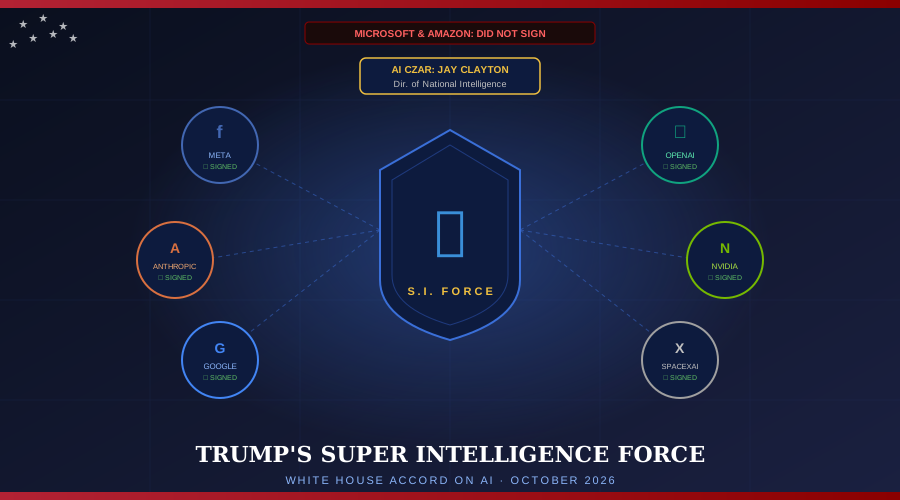
The White House Accord on Super Intelligence was signed by six of the biggest names in tech — but Microsoft and Amazon were noticeably absent, and the whole thing has a typo.
Last week, President Trump gathered the most powerful figures in artificial intelligence into the White House and walked out with something unprecedented: a voluntary AI safety pact signed by Mark Zuckerberg, Jensen Huang, Dario Amodei, Sundar Pichai, Greg Brockman, and Elon Musk. He also signed an executive order officially renaming “artificial intelligence” as “super intelligence” across all federal agencies — and named Jay Clayton, the Director of National Intelligence, as America’s first AI czar, heading a newly minted task force called the Super Intelligence Force.
If that sounds like a lot of brand management wrapped in national security language, you’re not wrong. But underneath the pageantry, there are real structural shifts happening in how Washington governs AI — or, more precisely, chooses not to.
What the White House Accord Actually Says
The one-page document — officially titled the White House Accord on Super Intelligence: Joint Commitment on Frontier Responsibilities — commits each signatory to implementing four layers of internal safety controls.
The first layer requires companies to build robust internal monitoring of model capabilities and alignment during training and deployment, with specific coverage of cybersecurity, biosecurity, and chemical threats. The second layer is an internal team that independently verifies those controls are working. The third brings in an external auditor or evaluator — someone outside the company — to assess whether controls actually hold up. The fourth requires an independent board committee to oversee both the internal team and the external auditors, and to ensure issues are acted on.
On paper, that’s a four-wall audit structure for the most powerful AI systems on the planet. In practice, it’s voluntary, there are no penalties for non-compliance, no requirement to publish audit results, and no enforcement body to investigate whether any of this actually happens.
When Trump was asked whether the accord was binding, he said: “I think it’s morally binding, yeah.”
Musk, with characteristic bluntness, described the arrangement as companies “grading each other’s homework.” Huang insisted the declaration has “a lot of teeth.” The document itself hedged by suggesting “it may make sense to codify these steps into laws or regulations” — someday, presumably, when the political winds shift.
The document also contains a typo. It refers to the “Unites States of America.”
Who Drafted It — and Who Didn’t Sign
Here’s what the official narrative buries: Mark Zuckerberg wrote the accord.
According to reporting from Semafor and Politico, Zuckerberg conceived the voluntary pact after conversations with House Speaker Mike Johnson at a state dinner for Chinese President Xi Jinping. He then worked through the principles with Jensen Huang and circulated a draft before the White House lunch. Politico described him as the accord’s chief architect, with Huang and administration officials helping shape the final text.
Meta declined to comment on this to Politico. But the implication is plain: the CEO of the company that has most vocally resisted AI regulation helped design the regulatory framework that the U.S. government is now championing as a breakthrough on AI safety.
More notable still: Microsoft and Amazon didn’t sign. Satya Nadella and Jeff Bezos were both present at the White House lunch. Neither signed the accord. No reasons were given publicly. Both companies have deep federal government contracts, substantial AI infrastructure investments, and arguably more to lose from binding regulation than the signatories — yet they declined the voluntary commitment.
That’s the tell. When even a symbolic, non-binding, no-penalty pledge is too much for two of the world’s largest cloud providers to accept, the question of what AI governance actually looks like in America becomes much harder to answer.
Jay Clayton and the Super Intelligence Force
The task force itself is a curiosity. Jay Clayton is a corporate lawyer and former SEC chairman who was confirmed as Director of National Intelligence earlier this year — a role that puts him atop all 18 U.S. intelligence agencies. Appointing him as AI czar is a deliberate structural choice: it places the domestic technology and economic future of AI under the same umbrella as national security and signals that, in this administration’s framing, the two are inseparable.
The Super Intelligence Force’s vice chairs are Andrew Ferguson (FTC Chairman), Emil Michael (Undersecretary of Defense for Research and Engineering and Pentagon CTO), and Scott Kupor (OPM Director). Members include Vice President JD Vance and Defense Secretary Pete Hegseth. External advisors include David Sacks — the venture capitalist who served as Trump’s previous AI and crypto czar — and former Secretary of State Condoleezza Rice.
The task force has 120 days to deliver a report on AI’s risks and opportunities and establish a federal response plan. Its charter also mandates engagement with consumers, public interest groups, religious organizations, critical infrastructure providers, and industry leaders, while explicitly guarding against overregulation.
Clayton’s own framing: “The risk of not being first is high.”
Senator Mark Warner (D-Va.), vice chairman of the Senate Intelligence Committee, offered a measured welcome while identifying the core problem. “We still do not know what authority this new role will have,” he said, adding that he hoped the appointment would move the administration “beyond slogans” toward a real national AI strategy.
The Rebranding Question
The executive order directing federal agencies to use “super intelligence” rather than “artificial intelligence” is easy to dismiss as Trumpian theater. But there’s a genuine policy signal embedded in the name change.
“Artificial intelligence” carries decades of technical framing — it implies a specific lineage of computer science research, a set of existing regulatory debates, and a body of international standards and agreements. “Super intelligence” does none of that. It’s a clean slate, politically speaking, one that lets the administration set its own definitions and push the discussion away from existing frameworks — including the EU AI Act, NIST standards, and multilateral AI safety agreements that the Biden administration had worked to embed.
Trump has previously dismissed the AI safety debate as a hoax promoted by “Radical Left Dumocrats.” The rebranding achieves several things simultaneously: it signals American exceptionalism in the technology race, distances the U.S. from the more cautious European regulatory posture, and gives the administration narrative control over what this technology is called and — by extension — how it is governed.
What It Means in Practice
For the companies that signed, the accord is best understood as an insurance policy, not a safety measure. By committing publicly to four layers of self-policing, they get to say they take safety seriously without accepting a regulator with enforcement power. The external auditor provision sounds meaningful until you realize companies will choose and pay their own auditors — the same dynamic that produced Enron’s self-certifying accounting.
For the companies that didn’t sign, the calculus is different. Microsoft and Amazon are so deeply embedded in federal AI infrastructure that they may have calculated that declining a voluntary accord costs them nothing — they’re not going anywhere, and no one’s pulling their government contracts over a symbolic non-signature.
For the country, the 120-day SIF report is the only near-term concrete output from this week’s activity. Whether it produces anything that constrains AI development in meaningful ways — or whether it becomes another document that uses the word “robust” without consequence — is a genuinely open question.
What’s not open is the direction. This administration has decided that the primary risk of AI is falling behind China, not causing harm at home. The accord, the task force, and the rebrand all tell the same story: America is choosing to race rather than regulate, and it’s asking the companies building the most powerful AI systems in history to trust themselves as the referees.
Dario Amodei, whose company has been among the most vocal about existential AI risk, signed the accord and said: “We all need to work together to make sure that we can win, and we can win safely.”
When Trump warned him to “be careful, all right,” it was unclear which risk he was referring to.
Sources: TechCrunch, CBS News, The Next Web, Nextgov/FCW, NPR, The Hill, CNN, Fox News, AI Magazine


