When you think of the infrastructure behind artificial intelligence’s explosive growth, you probably picture sleek server racks, fibre-optic cables, and gleaming cloud campuses. You probably don’t picture convoys of compressed natural gas trucks rolling through the Utah desert. But that’s the reality Oracle has been quietly living for more than a year — and the strategy is spreading.
Bloomberg reported this week that Oracle (ORCL) is delivering compressed natural gas by truck to multiple AI data center sites after pipeline infrastructure failed to keep pace with the company’s aggressive buildout schedule. The disclosure adds a striking new dimension to the debate over AI’s energy demands, revealing that the world’s most ambitious data center programmes are not just straining the electrical grid — they’re stress-testing the entire energy supply chain.
A Supply Chain Problem Nobody Predicted
Oracle’s challenge begins with a simple mismatch: the company’s AI data center programme is expanding faster than the gas pipelines required to fuel it. When pipeline connections are delayed by permitting battles, construction backlogs, or utility coordination failures, Oracle has been bridging the gap by trucking in compressed natural gas directly to its sites.
The approach has been operational at a facility on the outskirts of Salt Lake City, Utah, for over a year. There, Certarus — a unit of Superior Plus — has been supplying the gas via truck-mounted compressed cylinders. A second site in Shackelford County, Texas, is building out a campus for OpenAI, where VoltaGrid has provided the deliveries.
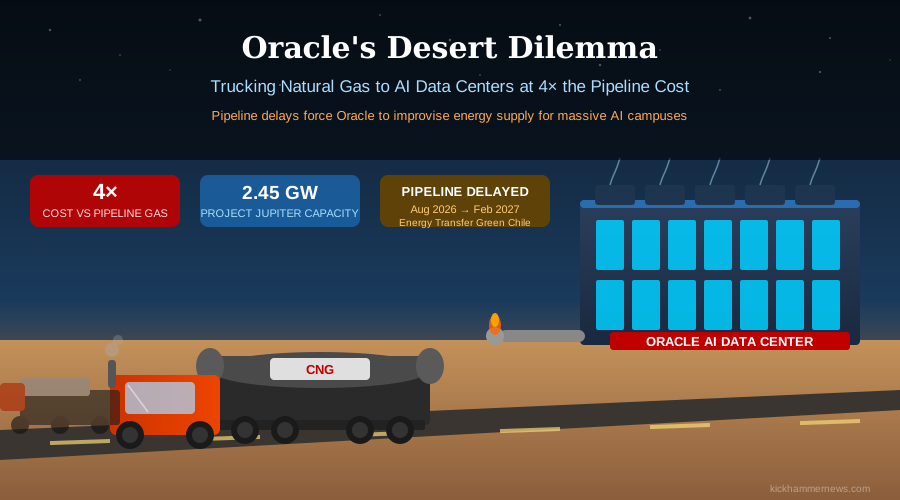
The numbers involved are staggering in their own peculiar way. According to East Daley Analytics analyst Jack Weixel, delivered compressed natural gas can cost roughly four times the price of gas at a major pipeline hub, once labour, equipment, and truck fuel are factored in. To understand the operational scale, SemiAnalysis analyst Ellie Holbrook offered this illustration: at 100 megawatts of demand, a single large trailer provides approximately 40 minutes of generation capacity. AI data centers routinely operate at hundreds of megawatts.
Project Jupiter: The New Mexico Flashpoint
The most high-profile site in question is Project Jupiter, Oracle’s massive AI campus in Doña Ana County, New Mexico. Designed around up to 2.45 gigawatts of Bloom Energy fuel-cell capacity — itself a recent pivot away from an original plan using gas turbines and diesel generators — the campus is one of the largest AI infrastructure projects in the world.
The pipeline originally expected to serve the site, Energy Transfer’s Green Chile pipeline, has already slipped its in-service date from August 15, 2026 to February 1, 2027. That delay prompted Oracle to issue a force majeure notice to the project’s developer in September, with Reuters reporting that Oracle sought the ability to defer certain payments if the project’s 2028 operational target slipped.
Oracle has maintained publicly that Project Jupiter remains on schedule. Blue Owl Capital, which has financial commitments tied to the campus, stated its position is unchanged. But the force majeure filing and the pipeline delays tell a more complicated story — one in which Oracle is now reportedly weighing whether to deploy trucked natural gas for New Mexico as well, repeating the Utah playbook on a far larger scale.
The Bigger Picture: AI’s Energy Infrastructure Crisis
Oracle’s predicament is not unique. Microsoft, Google, and Amazon have all disclosed energy challenges tied to their AI data center expansions, including renewed interest in nuclear power and long-term power purchase agreements with utilities that have backlogs of their own. What makes Oracle’s trucking strategy notable is its directness: rather than waiting for infrastructure to catch up, the company is physically moving energy to where it needs to be.
Certarus captured the zeitgeist in a rare public comment. The company said that longer timelines for securing pipeline and grid connections had created “a growing need for scalable energy solutions that can be deployed quickly.” It declined to comment on specific deals.
The financial implications are real. Bloomberg noted that Oracle’s free cash flow is currently negative and expected to remain under pressure until more AI data centers are completed and generating revenue. Spending four times the market rate for natural gas at multiple sites is not the kind of cost that disappears into a rounding error at Oracle’s scale.
Oracle’s Environmental Justification
Perhaps sensing that “trucking gas to a data center” sounds counterintuitive in an era of net-zero pledges, Oracle has highlighted the environmental rationale for its fuel-cell approach at Project Jupiter. The company projects that the updated Bloom Energy design will deliver approximately a 92% reduction in nitrogen oxide emissions compared to the earlier gas turbine and diesel generator plan. That’s a meaningful improvement — though environmentalists may note that fuel cells still rely on natural gas combustion, and that trucking that gas across the desert has its own carbon footprint.
The tension between AI’s energy hunger and sustainability commitments is increasingly difficult to paper over. Oracle’s New Mexico campus, if completed at full capacity, would consume enough power to supply several hundred thousand homes. The fact that it may be partially fuelled by gas arriving in trucks underscores how far the reality of AI infrastructure remains from its marketing image.
What This Means for Enterprise IT Leaders
For CIOs, CTOs, and enterprise architects planning AI workloads, Oracle’s situation is a cautionary tale about the compounding infrastructure risks in the AI era. The assumption that public cloud providers have seamlessly solved the energy problem is proving naive. Providers are managing complex, imperfect supply chains — and those supply chain pressures can and do affect pricing, availability, and long-term capacity commitments.
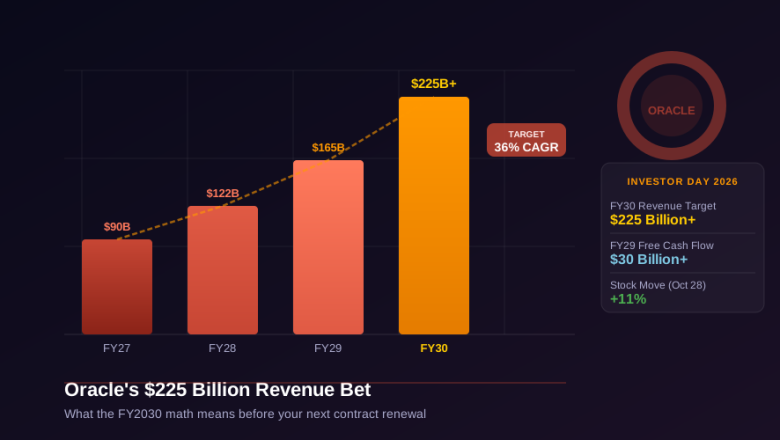
Oracle’s stock has had a volatile 2026. After a dramatic crash in July that briefly wiped out hundreds of billions in market cap over AI capex concerns, the company has partially recovered as its cloud bookings figures have remained strong. The $664 billion backlog Oracle reported earlier this year represents a genuine pipeline of demand — but fulfilling it depends on solving very un-digital problems: permits, pipelines, and the physics of moving gas by road.
For now, Oracle is doing what enterprises everywhere are learning to do in the AI era: improvise creatively, absorb the cost, and keep building.
Sources: Bloomberg (October 8, 2026), QZ, Lapaas Voice, Guru Focus, Supply Chain Brain, Seeking Alpha