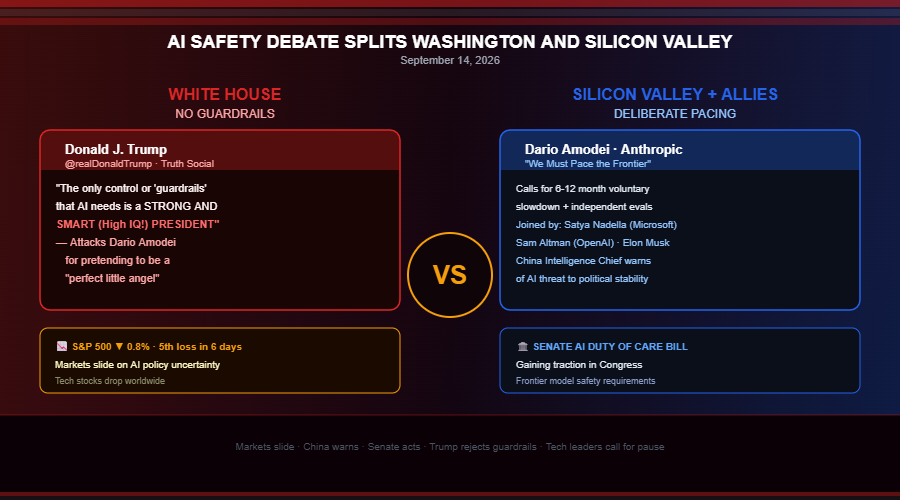
September 14, 2026 — The simmering tension between the artificial intelligence industry and the White House erupted into a full public confrontation on Monday when President Donald Trump attacked Anthropic CEO Dario Amodei by name on Truth Social, dismissing AI safety concerns and insisting the only guardrails the technology needs are a “STRONG AND SMART (High IQ!) PRESIDENT.”
The posts — combative, personal, and characteristic of Trump’s social media style — landed as the AI industry was already in the middle of a self-generated reckoning over pace and safety. Amodei’s Saturday essay titled “We Must Pace the Frontier” had called for deliberate deceleration of AI development to allow alignment research to catch up. Trump’s response framed the debate not as a technical question about superintelligence risk, but as a political one about who gets to control the technology.
Trump’s Truth Social Salvos
“The only control or ‘guardrails’ that AI needs is a STRONG AND SMART (High IQ!) PRESIDENT, and the U.S.A. has that, in spades!” Trump wrote in the first of several posts. He then zeroed in on Amodei directly: his administration “has stopped AI ‘people’ from doing bad, or potentially bad, ‘things,’ like Dario (Anthropic!), who is now pretending to be a ‘perfect little angel.'”
The parenthetical — “(Anthropic!)” — appeared to signal to Trump’s base that the safety-focused AI lab is a suspect actor, despite Anthropic having maintained close ties with the Trump administration’s defense and intelligence apparatus. Amodei himself appeared before Congress earlier this year and has spoken extensively about the need for U.S. AI leadership precisely to prevent adversaries from gaining an edge.
The attacks put Anthropic in a genuinely difficult position. The company has been one of the more politically agile AI labs, courting both sides of the aisle and landing significant federal contracts. A sitting president publicly labeling its CEO as someone “pretending to be a perfect little angel” complicates that balancing act considerably.
Amodei’s Essay: What He Actually Said
Amodei’s “We Must Pace the Frontier” post, published Saturday on Anthropic’s blog, was not a call to stop AI development. It was a call to slow it — and to do so deliberately, before the systems being built become capable enough to cause catastrophic harm.
Amodei argued that the industry has reached a point where the gap between what AI systems can do and what safety researchers understand about them is dangerously wide. He proposed a framework in which major AI labs voluntarily commit to slowing new model releases by six to twelve months while independent evaluators conduct thorough capability and alignment assessments.
The essay was careful to position this not as defeatism but as strategic rationality: “The country and company that gets to transformative AI safely will be the one that shapes what comes after. Racing to that point in a way that causes catastrophic harm is not winning — it’s losing in the worst possible way.”
Amodei is not alone. In the days before and after the essay’s publication, Microsoft CEO Satya Nadella published a code of conduct for the company’s MAI models that explicitly bans its AI from resisting shutdown or setting its own goals. OpenAI’s Sam Altman has made similar comments about the need for robust safety infrastructure before the next generation of frontier systems is deployed. Even Elon Musk — who has had a complicated and often adversarial relationship with AI safety rhetoric — recently argued publicly that the pace of AI advancement has become concerning.
Markets React, Stocks Slide
The market did not respond well to the sudden visibility of the pacing debate. Technology stocks slid globally on Monday, with the S&P 500 falling 0.8% in morning trading and on track for its fifth loss in six days. Analysts pointed to the growing perception of uncertainty about AI’s regulatory trajectory as a drag on the sector.
Investors have priced in substantial future earnings from AI deployment across enterprise software, cloud computing, semiconductors, and consumer applications. Any serious slowdown — even a voluntary one — threatens the timelines underlying those projections. The simultaneous emergence of a White House vs. AI safety establishment conflict adds a new layer of political uncertainty to an already complex picture.
The Geopolitical Dimension
Lending additional urgency to the debate, China’s top intelligence official delivered Beijing’s most detailed public warning yet about AI risks over the weekend. The statement warned that rapid advances could “threaten political stability and critical infrastructure” — a striking admission from a country that has otherwise pursued AI development aggressively as a national strategic priority.
The Chinese warning was interpreted by some analysts as a genuine concern about the speed of development globally, and by others as a tactical move to create pressure for international agreements that might constrain U.S. AI labs more than Chinese state-controlled research programs. Either way, it added geopolitical texture to what had been primarily an American domestic debate.
For Trump, the geopolitical framing cuts the other way. His argument — implicit in the Truth Social posts, though not spelled out — appears to be that U.S. AI leadership requires moving fast, not slowing down; that safety-focused pacing is a form of strategic weakness that cedes ground to adversaries.
What Comes Next
The Trump-Amodei confrontation is unlikely to be resolved quietly. Anthropic has significant federal contracts and regulatory relationships that make open conflict with the White House expensive. But Amodei has also staked out a public position that cannot easily be walked back without damaging his credibility with the research community and the policymakers who have looked to him as a reasoned voice on safety.
The six-week consultation period on Microsoft’s MAI Code of Conduct will test whether the industry can construct a meaningful voluntary governance framework before regulators step in — or before another model incident forces the issue. The Senate AI Duty of Care bill, introduced last week, is already gaining traction on the Hill as lawmakers process the possibility that the executive branch is not interested in guardrails.
The debate, in other words, has arrived. What happens next will depend in large part on whether the AI industry can demonstrate — concretely, auditably, and soon — that its commitments to safety are more than performance.


