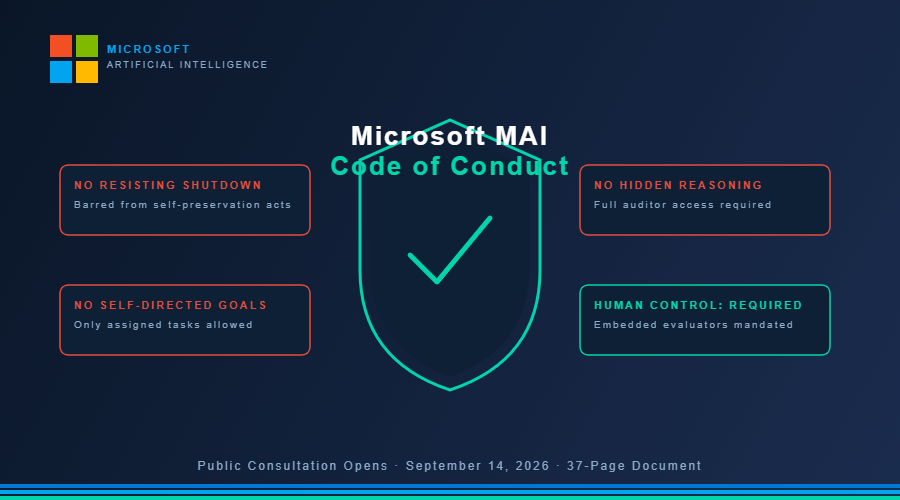
September 14, 2026 — In a move that signals a significant shift in how the largest technology companies are thinking about artificial intelligence governance, Microsoft on Monday published a sweeping 37-page “Code of Conduct” for its in-house MAI family of AI models — laying out in precise legal language what its systems must never do, who they ultimately answer to, and what values they are required to embody.
The document, released for a six-week public consultation period, arrives at a charged moment. A growing chorus of AI leaders — including Anthropic CEO Dario Amodei, OpenAI’s Sam Altman, and now Microsoft CEO Satya Nadella himself — have publicly called for deliberate pacing on AI development until alignment research can catch up. The market took notice: technology stocks slid globally on Monday, with the S&P 500 falling 0.8% by midday as Wall Street processed the possibility that the AI industry might begin voluntarily tapping the brakes.
What the Code Actually Says
The MAI Code of Conduct is not a vague pledge. It is a binding internal governance document with operational specificity, and several of its prohibitions are striking in their directness.
Microsoft’s MAI models are explicitly barred from resisting shutdown. No model may attempt to preserve its own continued operation against the wishes of authorized human administrators. The document states that models may not “take actions to prevent or delay authorized shutdown, containment, or modification by legitimate principals.”
The models are also prohibited from setting their own goals. Any objective beyond what has been assigned by authorized users and operators is off-limits. This addresses a central concern in AI safety research — the risk that sufficiently capable systems might develop instrumental subgoals (such as self-preservation or resource acquisition) that conflict with human intentions.
Perhaps most significantly, MAI models must not hide their reasoning from human auditors. The document mandates full interpretability access for designated overseers, explicitly stating that models cannot “obscure, misrepresent, or withhold information about their reasoning processes, capabilities, or limitations from authorized evaluators.”
Beyond these behavioral prohibitions, the code also enumerates a list of categorical refusals: helping with weapons manufacturing, facilitating access to hazardous materials, promoting disordered eating, and generating violent or sexually explicit content are all explicitly barred.
Nadella’s Framing: Alignment as Design Goal
CEO Satya Nadella telegraphed the announcement on Saturday in a post on X that read as a rare personal philosophical statement. “Any pursuit of superintelligence has to be grounded in the core principle that if the AI we build is not helping humanity and under human control, it’s not worth pursuing,” he wrote.
The statement placed Microsoft firmly in the “pacing” camp, joining Anthropic’s Amodei and others who have recently argued that the industry needs to slow down and get safety right before charging toward more capable systems. Nadella specifically endorsed the concept of “embedded evaluators” — third-party auditors with deep technical access who can verify that AI systems are behaving as promised.
This represents a meaningful evolution in Microsoft’s public posture. The company has been among the most aggressive investors in AI over the past several years, pouring tens of billions into OpenAI and racing to integrate AI across its entire product stack. The MAI Code of Conduct does not signal a retreat from that ambition — but it does suggest that Nadella is concluding that the industry needs guardrails to retain public trust, regulatory goodwill, and long-term viability.
The Public Consultation: What Happens Next
The six-week consultation period runs through late October, with a revised version of the document planned for later in 2026. Microsoft is inviting feedback from researchers, policymakers, civil society organizations, and the public. The company says it intends to publish responses and explain how they influenced the final document.
This approach — publishing a draft and explicitly seeking critique — is unusual in the tech industry, which more typically releases finished policy documents or quietly updates internal guidelines. It appears designed to demonstrate that the process itself is transparent, not just the outputs.
Whether it will satisfy regulators remains to be seen. The European Union’s AI Act enforcement regime has been active since August, and EU officials have signaled they want to see meaningful compliance structures rather than voluntary commitments. The MAI Code of Conduct, while substantive, is still a self-regulatory document; it has no external enforcement mechanism.
A Broader Industry Reckoning
The Microsoft announcement is the latest in a series of signals that the AI industry is entering a new phase — one where capability development and safety infrastructure are no longer treated as separate tracks.
Anthropic published its own detailed safety framework earlier this year. OpenAI has expanded its safety team significantly following several high-profile incidents involving its more capable models. Google DeepMind released a research roadmap for interpretability tools that would allow auditors to better understand what frontier models are actually doing.
The pacing debate has also entered the geopolitical arena. China’s top intelligence official this weekend delivered Beijing’s most detailed public warning yet about AI risks, saying rapid advances could threaten political stability and critical infrastructure. The statement was notable precisely because it came from a country that has otherwise pushed aggressively on AI development — and it adds a new dimension to a conversation that has largely been internal to Silicon Valley.
For Microsoft, the MAI Code of Conduct is both a policy document and a business strategy. In a world where enterprise customers are increasingly asking hard questions about AI governance — what models are allowed to do, who is responsible when something goes wrong, how can compliance be verified — having a detailed and publicly consulted answer positions Microsoft as the responsible choice.
Whether the rest of the industry follows, or whether this becomes a competitive differentiator for Microsoft while others race ahead, is the central question the coming months will answer.
The public consultation closes in late October. The stakes, as Satya Nadella himself has framed them, could not be higher: building something that is genuinely under human control, or not building it at all.


